Most hydroponic farms sell cool-season leaf and fruit crops, then watch demand for something fresh keep arriving from buyers who cook hot-climate cuisine. Okra answers that demand and few farms grow it, which is exactly the gap. Growing okra in Dutch buckets works because the crop’s two demands — warm roots and a big, long-fed root zone — match what a drain-to-waste bucket system delivers better than any recirculating channel does.
Other bucket crops have their own articles; cucumbers, peppers and eggplant are covered separately, and the bucket hardware itself has a dedicated buyers’ guide. This one is about okra: what it needs, what it yields, and when it is the wrong crop.
Why Okra in Dutch Buckets Fits Heat and Long Cycles
Okra is a heat crop through and through. Air temperatures of 24–32 °C push growth, and yields drop sharply below 18 °C — a planning range that assumes ordinary film greenhouse conditions rather than sealed climate control. Where lettuce farms fight the summer, an okra block cruises through it, which makes the crop a natural summer slot in regions with genuinely hot seasons.
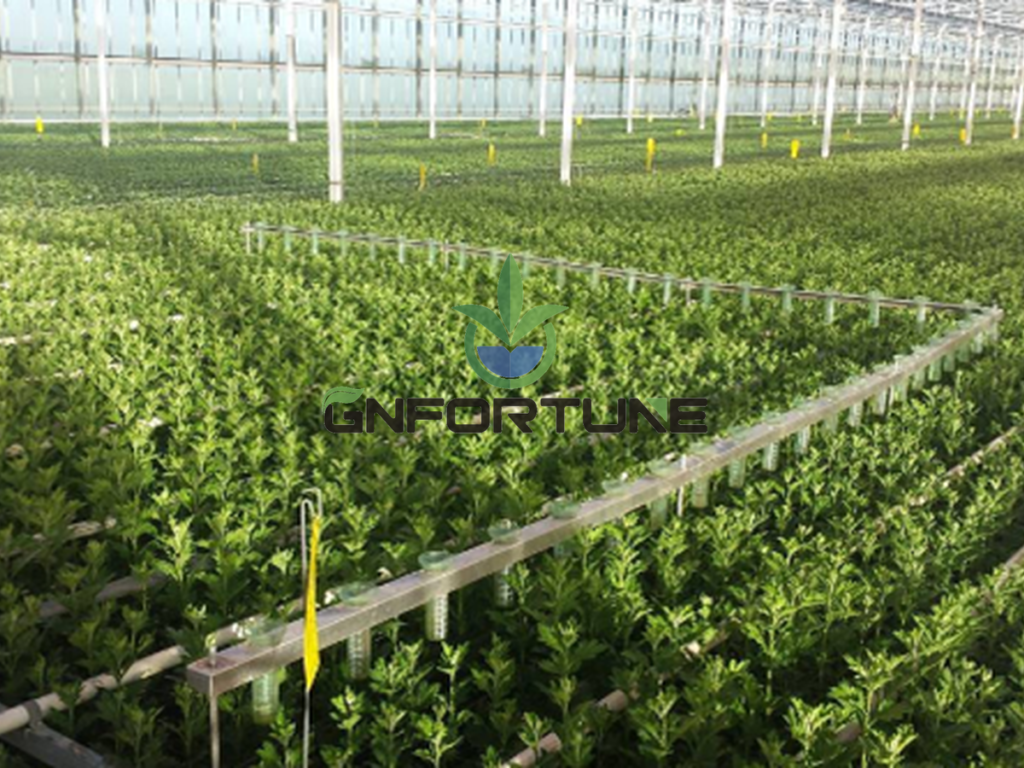
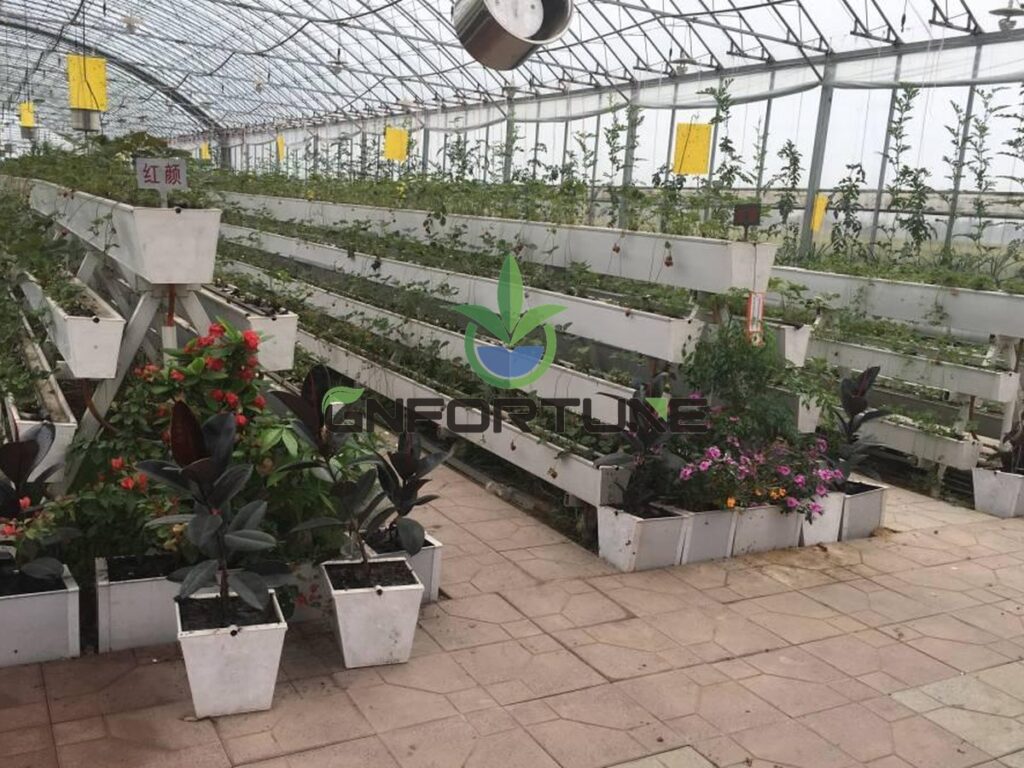
The system match is just as specific. Okra develops a deep, thirsty root system and holds a canopy for 4–6 months, far longer than a lettuce cycle. Dutch buckets give each plant its own large media volume, drain to waste so salts never accumulate in heat, and let irrigation be tuned per row rather than per house. Recirculating channels, built for shallow-rooted fast crops, are the wrong vessel.
The trade-off is space and structure. Okra plants reach 1.5–2.5 m under greenhouse conditions, and a productive block looks more like a tomato house than a lettuce bay. Budget for head height, trellis and weekly training labour before budgeting for seedlings.
Spacing, Buckets and Trellis Load
Okra pays for generous spacing. Crowded plants shade each other, hold foliage instead of pods, and become a disease pocket in humid weather. Working figures from bucket-grown blocks:
- One plant per bucket is the safe default; two per bucket only with a large bucket, aggressive pruning and strong light.
- Row spacing of 1.2–1.5 m with plants 40–50 cm in-row, giving a planning density of roughly 1.5–2.2 plants per square metre. Tighter layouts raise canopy risk in humid climates more than they raise yield.
- Media choice matters less than drainage: perlite or cocopeat blends both work, provided the bucket outlet drains freely. Okra roots rot in stagnant media faster than most greenhouse crops.
- Trellis for a tall, top-heavy plant: a horizontal wire at 2 m plus individual strings, lowered-and-leaning tomato style, handles the load. A mature plant carrying a full canopy and a heavy pod set pulls noticeably on its string; anchor wires and fixings should be rated as for vine crops, not for lettuce benches.
Training is weekly work. Side-shoot removal below the first fruiting node, leaf removal as the canopy ages, and lowering plants along the wire keep the pod zone reachable. The trellising and plant support guide covers the hardware and the labour pattern; okra follows the same discipline.
Irrigation, EC and Steering Through the Heat
Drain-to-waste buckets forgive salinity but not drought. Okra transpires hard at high temperature, and a dry midday in a bucket shows up within hours as small, fibrous pods — the exact grade defect buyers reject. Pulse irrigation through the hot hours beats a single large morning dose in warm climates.
| Parameter | Planning range | Assumptions and notes |
|---|---|---|
| Day temperature | 24–32 °C | Growth slows below 18 °C; sustained >35 °C needs shade and airflow support |
| Nutrient solution EC | 2.0–2.8 mS/cm | Assumes drain-to-waste buckets, moderate raw-water salinity, full canopy |
| pH | 5.8–6.5 | Standard bucket fertigation band; verify against raw water alkalinity |
| Drain fraction | 20–30% | Drain-to-waste; lean to the upper end during heat spikes |
| Irrigation pattern | Pulses every 30–60 min in peak heat | Short pulses sized to media; large single doses leach media and starve roots |
| Cycle length | 4–6 months continuous | Single planting, trained as a leaning crop; replant when pod quality declines |
These are planning ranges, not recipes. Raw water analysis, media type and local humidity all move them, and steering between vegetative and generative growth follows the same logic as any large fruiting crop — the transfers almost unchanged. The physical delivery side, from emitters to per-row valves, follows the design rules in the dutch bucket drip system design guide.
Pick Cycles, Grading and What Buyers Pay For
Okra is a picking crop, and the picking decides the money. Pods move from tender to woody in days at warm temperature, so a productive block is picked every 1–2 days in peak season. The premium grades are 8–12 cm pods that snap rather than bend; anything longer sells at a discount or not at all in export-facing markets, though some local markets accept larger pods.
Three operational realities to plan around:
- Handle the plant, not just the pod: okra carries fine spines on leaves and pods. Bare-handed picking across a long season is genuinely painful; crews need gloves and long sleeves, and pick speed drops accordingly.
- Grade in the house, not the pack shed: pod size classes are set at picking. A picker who strips everything costs more downstream than the seconds saved.
- Cool fast, sell fast: okra pods lose condition quickly at ambient temperature. Same-day delivery or rapid cooling preserves the snap that defines the premium grade, so the post-harvest cooling and cold chain rules for fresh produce apply without modification.
When Okra Is the Wrong Crop
An honest assessment keeps more money than enthusiasm does. Okra in Dutch buckets fails in three settings:
- Cool climates without real heat: if the house cannot hold 24 °C and rising through the season, the crop limps along at a fraction of its potential and never repays the trellis and labour investment. Unheated high-altitude or coastal-cool sites should look at other crops.
- Low houses: below about 3 m of ridge height, a leaning-and-lowering system becomes cramped, and yields per square metre fall as fast as the plants hit the roof.
- Thin markets: okra sells to specific cuisines and communities. Before planting, confirm a buyer who takes the 8–12 cm grade continuously, not one enthusiastic restaurant. A block producing for months without a contracted channel becomes a giveaway crop.
Where the climate is hot, the house is tall and a buyer is real, the arithmetic works: a long productive cycle, modest input costs and a premium price on a vegetable few local farms grow. That combination — heat used as an asset instead of a fight — is what makes okra worth the space it takes.

Okra in Dutch buckets rewards farms that can supply heat, height and a standing buyer, and it punishes everyone else. Check all three before the seedlings — the crop is easy to grow and hard to stop once it starts.
FAQs About Okra in Dutch Buckets
What EC should nutrient solution run for okra in buckets?
A planning range of 2.0–2.8 mS/cm is a workable starting band for drain-to-waste buckets at full canopy, assuming moderate raw-water salinity. Confirm against drain EC readings and adjust gradually; abrupt EC changes at high temperature show up in pod quality within days.
How many okra plants fit per square metre?
Plan on 1.5–2.2 plants per square metre with rows 1.2–1.5 m apart and 40–50 cm in-row, one plant per bucket. Denser layouts raise humidity and disease risk faster than they raise yield, especially in humid climates.
How often do okra pods need picking?
Every 1–2 days in peak season. Pods pass from tender to fibrous within days at warm temperatures, and the 8–12 cm premium grade exists only if picking keeps pace with the crop. Missed picking rounds also suppress further pod set.
Can okra share a drip line with other bucket crops?
Only if they share the same EC, irrigation frequency and cycle length. Okra’s heat-season pulse irrigation differs from what peppers or cucumbers want at the same time, so give okra its own valve zone. Mixed zoning rules are covered in the crop zoning guide.
Does okra need pollination support in a greenhouse?
No. Okra is self-pollinating and sets pods without bees or vibration work, which is one reason it behaves more like a leaf-and-pod crop than a greenhouse fruit crop. Poor set is almost always a temperature or drought problem, not a pollination one.
Related Reading
- Dutch Bucket System Components and Layout Basics — The hardware beneath the crop described here
- Growing Cucumbers in Dutch Buckets: A Grower’s Guide — The other tall, fast bucket crop and how it differs
- Hydroponic Peppers in Dutch Buckets: A Grower’s Guide — A slower bucket crop with a different steering pattern
- Eggplant in Dutch Buckets: Commercial Setup — Spacing and training for a third heavy bucket crop
- Most Profitable Hydroponic Crops: Yield, Price and Demand — Where a niche crop like okra fits the margin picture
Next Step: What to Send for a Quotation
A bucket block for okra is quoted from geometry and climate, not from crop optimism. If trellis load, head height and heat-season irrigation are not in the specification, they will surface as change orders after the frame is up.
Evaluating an okra block or a mixed bucket house? For an RFQ or project consultation, send: greenhouse dimensions and ridge height; target crop mix and planting densities; ambient temperature range and ventilation or cooling capacity; raw water analysis; drain disposal or recycling plan; irrigation zoning preference; delivery schedule; and the budget band. G AND N FORTUNE LIMITED supplies Dutch bucket systems, drip layouts and greenhouse structures quoted against those parameters.