

The Trellis Carries Everything You Grow
A vine crop’s weight ends up hanging from whatever you chose to hang it from. Tomato crops can carry several kilograms per plant at peak, cucumber and pepper loads are similar in their own way, and that load sits on overhead wires that are themselves pulling on the greenhouse structure. Choose the support too light and you get broken wires mid-season; too heavy and you paid for steel you did not need.
A hydroponic trellising system is also a labour machine. Every minute spent lowering, clipping, suckering or tying is repeated across thousands of plants weekly. The hardware you pick decides most of those minutes, which is why the cheapest spool of twine can be the most expensive item in the crop budget.
What Each Vine Crop Needs
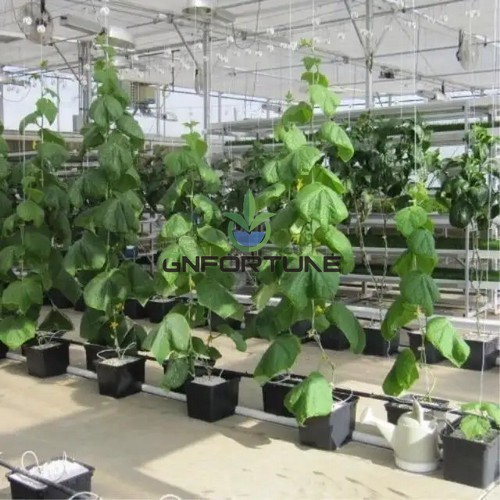
| Crop | Support style | Typical arrangement | Key point |
|---|---|---|---|
| Tomato (indeterminate) | Single or double stem on twine, leaned and lowered | Overhead high-wire with Dutch hook or equivalent mechanism | Plants are lowered continuously; the pay-out mechanism must work under load |
| Cucumber | Vertical cordon, often with umbrella or high-wire training | Twine to overhead wire, laterals managed | Fruit is heavy and easily damaged; keep stems supported near the pick point |
| Pepper | Two to four stems on vertical strings | Individual strings per stem, sometimes a supporting net | Stems snap at the joint if weight is taken too late |
| Eggplant | Staked main stem, sometimes with support netting | Per-plant stake or string | Heavy fruit pulls branches down; support branches, not just the leader |
| Bean and pea (where grown) | Netting or vertical strings | Net panels or strings per row | Access for picking drives the layout more than plant training |
Anatomy of a High-Wire System
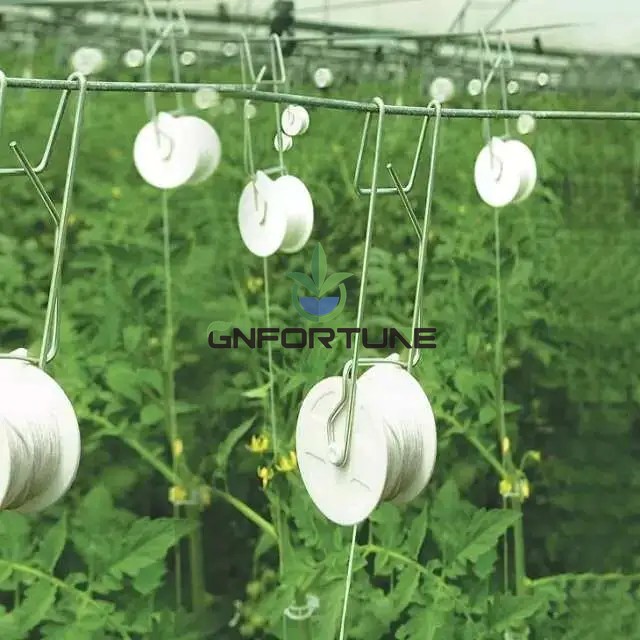
- Overhead support: purlins, cross-wires or dedicated trellis steel carrying the vertical load
- Activity wire versus static wire: one moves as the crop is lowered, one carries the permanent load
- Dutch hook (or hook-and-cord system): the standard mechanism for paying twine out under load
- Plant twine: specified by breaking strain and UV resistance, not by price per spool
- Crop clips and supports: tomatoes need stem clips and truss supports; peppers need stem clips; cucumbers often need fruit supports
- Row-end anchors: where the whole system’s tension actually resolves
The most expensive failures come from the two ends of that list. Overhead steel that was not assessed for crop load, and row-end anchors that were an afterthought.
Load: Do the Arithmetic Before You Buy
| Input | What to establish | Why it matters |
|---|---|---|
| Plants per row | From your spacing decision | Total row load is the product of plants and peak plant weight |
| Peak plant weight | Typical peak crop load per plant, including fruit and foliage | Underestimating this is how wires sag mid-season |
| Safety factor | Applied to breaking strain | Loaded twine also has to survive gusts, handling and ageing |
| Wire span and support spacing | Distance between structural pick-up points | Long spans deflect more, even with adequate breaking strain |
| Structural capacity | What the house itself can carry | Crop load is a permanent addition to wind and snow cases |
Confirm structural suitability with whoever designed the house, especially for retrofit. Adding a full crop load to a structure designed for lighter crops is a real risk, and it is far cheaper to add bracing before planting than to fix a sagging trellis in week ten.
Labour: Where the Money Actually Goes
| Task | Frequency | What reduces the time |
|---|---|---|
| Stringing new plants | Once at planting, again after any re-tie | Pre-cut lengths, hooks that hang one-handed |
| Winding / clipping stems | Weekly or more during peak growth | Good-quality clips over hand-tying; consistent stem handling |
| Lowering and leaning | Weekly once plants pass wire height | Twine mechanisms that pay out smoothly under load |
| Suckering | Weekly for indeterminate tomato | Standardised method and trained crew |
| De-leafing | Routine through the season | Clear access aisles and a set leaf-height target |
| End-of-crop strip-down | Once per cycle | Twine that can be cut down quickly and disposed of affordably |
Small differences per plant become large numbers per hectare. A clip that saves a few seconds per plant per week is worth real money over a season — but only if it holds. Falling trusses cost more than the clip saved.
Choosing Hardware
- Twine breaking strain: must exceed peak load with a real safety margin, and must be rated for UV exposure in a house with high light
- Clips: sized to the stem at the time of use; check whether they grip without cutting as stems thicken
- Truss supports: heavier trusses and certain varieties need them — if you are losing fruit to stem snapping, this is usually why
- Hooks and pay-out mechanisms: buy one type, keep spares, and train everyone on the same motion
- Compatibility: standardise across crops so consumables and spares are interchangeable
Common Failure Patterns
- Wires sagging by mid-season — underestimated peak load or unsupported span
- Twine snapping under ripe fruit weight — specification below real load, or degraded by UV or chemical exposure
- Stems snapping at the clip — oversized support, or clip applied after the stem had already bent
- Crop leaning out of the row — lowering performed too late, so plants fold rather than slide
- Tangled strings at strip-down — mixed hardware types and inconsistent lengths
- Structure damage after wind events — crop load not included in the original structural case
FAQ
What height should the trellis wire be?
High enough to carry the crop through its productive head without repeated stripping out. Very tall systems are common in modern tomato production but demand taller houses and more labour per lowering — check your structure and staffing before specifying.
Can I reuse twine and clips?
Clips often yes, if removed cleanly and sanitised. Twine is usually treated as single-use; its strength after UV exposure and chemical contact through a full season is not something worth gambling a crop on.
Do cucumbers need different support to tomatoes?
Yes in practice. Both use overhead twine, but cucumber needs lateral management and fruit support near the picking point, while tomato needs continuous lowering and truss support.
How much weight does a trellis really carry?
More than most people assume. Multiply your plants per row by realistic peak plant weight, including fruit and foliage, then add a safety factor and check it against your structure rather than only against the twine.
Should I use nets for peppers?
A supporting net can work well, particularly where stems are trained in pairs. Individual strings per stem give finer control; nets reduce per-stem handling where labour is tight.
Is single or double stem better?
Double stem suits some pepper programmes; stem number for tomato is usually a density and fruit-size decision tied to season and price. Trial it against your own grade-out pattern instead of copying a neighbouring farm.
Design Support Before You Plant
Trellis hardware is cheap to specify correctly now and disruptive to change once the crop is up. Send us your crop, house dimensions and structural information and we will return a support layout with load figures and a consumables list. Start with the quote form.
Related reading: support loads sit on the structure — check greenhouse structural design and loads and plant spacing and density; for crops see tomatoes in Dutch buckets, cucumbers in Dutch buckets and peppers in Dutch buckets.