

Dutch Bucket System: What “Complete” Actually Means
A Dutch bucket hydroponic system looks simple on a drawing: a row of buckets, one drip line feeding each, one drain line carrying the surplus away. Projects go wrong because the drawing stops there. What decides whether a 2,000-bucket tomato block irrigates evenly in week two and in week forty is the part nobody draws — reservoir volume, manifold pressure, emitter uniformity and drain fall. This article walks the components in order from bucket to pump, then gives the layout numbers checked on site before a system is signed off.
Two naming conventions confuse most enquiries: buyers use “Dutch bucket” and “Bato bucket” interchangeably, but the drainage detail differs and changes how the return is plumbed. The Bato bucket vs Dutch bucket comparison covers that. Everything below assumes the Dutch bucket pattern: a container whose drain fitting sits above the base so a shallow pool of solution remains at the bottom.
Dutch Bucket Hydro Components, Bucket to Reservoir
In a Dutch bucket hydro layout the water path is a loop, and every component sits on it. Remove one and the symptom is not an alarm — it is uneven growth that appears three weeks later at the far end of the row.
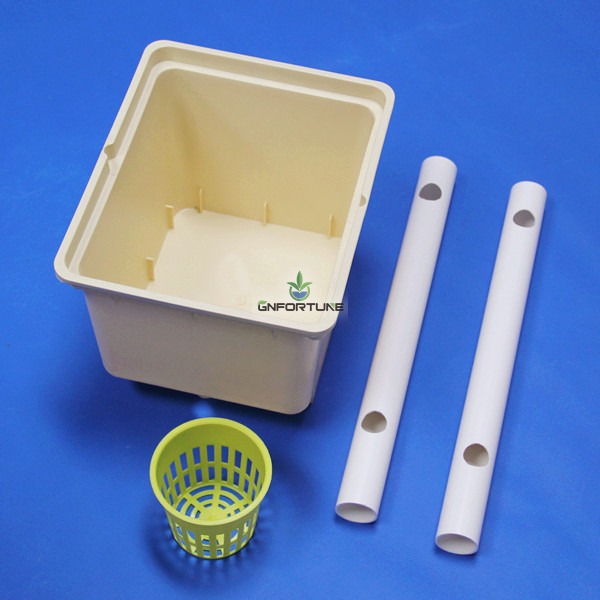
- Bucket, 10 to 14 L for tomato and cucumber, 6 to 10 L for pepper. Opaque, UV-stabilised, food-grade PP or HDPE, drain elbow 30 to 50 mm above the base.
- Media, 8 to 12 L per bucket. Perlite, coco coir or a blend. The media is the buffer that keeps roots alive when a pump trips.
- Drain fitting and collection line. 32 to 50 mm pipe under the row at a continuous 1 to 2 percent fall, to the tank or to waste.
- Feed manifold and laterals. 20 to 25 mm laterals off a 32 to 50 mm manifold, with 4 mm micro-tube or in-line drippers.
- Emitters. Pressure-compensating 2 to 4 L/h per bucket for tomato. Non-compensating emitters cost less and suit level rows under 20 m.
- Filtration. 120 to 150 mesh screen or disc filter ahead of the manifold; not optional on a return loop.
- Reservoir and pump. Tank sized to peak-season demand, pump sized to emitter count and manifold pressure.
- Fertigation and control. Dosing unit, EC and pH probes, plus a return-line EC meter if you recirculate.
Suppliers quote buckets and media and leave the rest to the installer, which is how two quotes for the same bucket count end up 40 percent apart. The Dutch bucket system product page shows how a complete kit is assembled; ask every bidder to quote those eight lines.
Row Layout, Spacing and Aisle Widths
The short answer: single rows at 1.2 to 1.5 m centres, buckets 0.35 to 0.5 m apart within the row, service aisles 0.9 to 1.2 m wide, and a drain run no longer than 30 to 40 m before it steps down or changes diameter. Those four numbers set both your plant count and your labour cost per harvest, so they are worth fixing before anyone quotes pipe.
| Layout parameter | Typical range | Why it matters | Where it fails |
|---|---|---|---|
| Row spacing | 1.2 to 1.5 m for tomato and cucumber; 1.0 to 1.2 m for pepper | Canopy light and spray access | Below 1.0 m the canopy closes and disease spreads |
| Bucket spacing in row | 0.35 to 0.5 m vine crops; 0.25 to 0.35 m strawberry and herbs | Sets plants per metre of row | Tighter spacing raises humidity, not yield |
| Service aisle | 0.9 to 1.2 m | Two workers with a harvest cart | Under 0.8 m the picking rate drops |
| Drain run length | 25 to 40 m per section | Keeps fall achievable | Long runs force fall below 1 percent |
| Drain fall | 1 to 2 percent | Moves media fines out of the pipe | Flat runs hold sludge |
Once aisles and headlands are counted, a Dutch bucket house lands at roughly 0.9 to 1.3 buckets per square metre of floor. A 12 L bucket of wet coir weighs 12 to 15 kg, so the fill and empty path needs a cart route. Cucumbers run two plants per bucket with tighter in-row spacing; the cucumber Dutch bucket guide covers those numbers.
Drainage Options: Return Line vs Drain-to-Waste
Answer first: recirculate when raw water is expensive, scarce or high in sodium, and drain to waste when disease pressure or water chemistry makes return blending a liability. Dry-region vine-crop houses typically recirculate with 20 to 30 percent of the runoff bled off; humid sites with a history of root disease run drain-to-waste and accept the fertiliser bill as insurance.
| Option | Capital | Operating profile | Main risk | Fits |
|---|---|---|---|---|
| Return line, 20 to 30 percent bleed | Higher: collection pipe, return pump, filtration | Lower water and fertiliser cost; return EC climbs | Sodium build-up; pathogens share the loop | Arid sites, tight water allocation |
| Drain-to-waste | Lower: no return pump, screen filter only | Higher water and fertiliser cost; stable root-zone chemistry | Runoff disposal rules | Humid sites, root-disease history |
| Hybrid (plumb both) | Highest upfront | Switch when return EC exceeds roughly 1.5x feed EC | Needs a written decision rule | Sites where water rules may tighten |
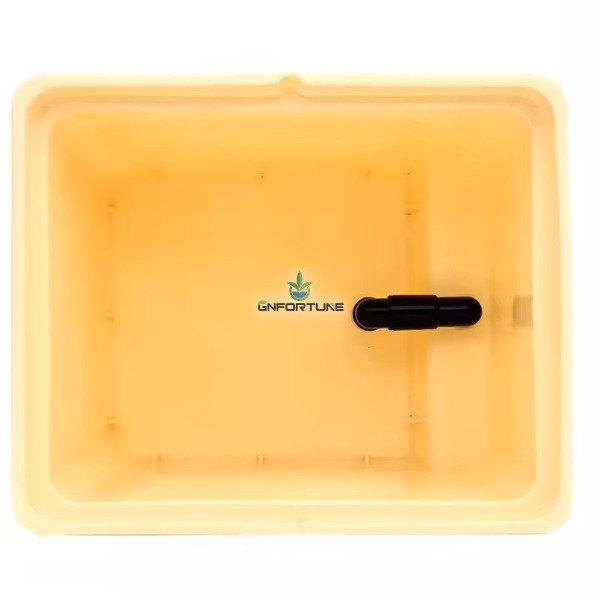
Whichever option you choose, the drain line has to be accessible. A buried collection pipe with no cleanouts is a common reason a five-year-old bucket house gets rebuilt rather than repaired.
Sizing Pumps, Emitters and the Reservoir
Sizing is arithmetic: total emitter flow sets the pump, peak daily demand sets the tank, and manifold pressure decides whether the last bucket gets the same volume as the first.
Take a 1,000-bucket tomato block with two pressure-compensating 2 L/h emitters per bucket. Emitter flow is 4,000 L/h, so the feed pump must deliver about 4 m³/h at 1.5 to 2.5 bar at the manifold, checked on the pump curve at that duty point. Peak demand of 1.5 to 2.5 L per plant per day with two plants per bucket gives 3,000 to 5,000 L/day, so a recirculating tank lands near one day of demand, while a drain-to-waste site runs about half that. Irrigation is cycled, not continuous: six to ten events of 10 to 20 minutes per day, the first about an hour after sunrise and the last two hours before dusk.
| Sizing check | Target | Failure symptom |
|---|---|---|
| Far-end manifold pressure | 1.5 to 2.5 bar, within 10 percent of the near end | End-of-row plants wilt first |
| Emitter uniformity | 90 percent or better across the block | Uneven fruit size at grading |
| Filtration rating | 120 to 150 mesh before the manifold | Blocked emitters within a season |
| Runoff fraction | 20 to 30 percent of applied volume | Under 10 percent: salt build-up |
| Feed and return EC | Feed 2.0 to 3.0 mS/cm; return under 1.5x feed | Higher return EC means bleed or switch to waste |
Two references sit alongside this section: the reservoir and pump sizing guide for tank and duty-point detail, and the drip irrigation for Dutch buckets walkthrough for emitter and cycle design. Manifold material and pressure class are covered in the commercial drip irrigation guide.
Field Problems We Keep Meeting
The failure mode on site is almost never the bucket — it is the drain. Media fines settle in a collection pipe laid at the wrong fall, the last third of the row backs up, and buckets at that end sit saturated while the manifold end dries out. The grower diagnoses a nutrition problem and changes the recipe; the fix was a cleanout and five millimetres more fall per metre. Walk the drain line with a level before handover and confirm 1 to 2 percent fall plus a cleanout at each end.
The second recurring issue is emitter matching. Rows repiped with a mix of 2 L/h and 4 L/h emitters produce two plant populations in one block, and no fertigation change will merge them. Keep one emitter rating per block and keep spares on the shelf.
FAQ
How many Dutch buckets fit in 1,000 square metres of greenhouse?
A: Roughly 900 to 1,300 buckets once aisles and headlands are deducted, starting from 1.2 to 1.5 m row spacing and 0.4 to 0.5 m in-row spacing.
What size pump do I need for 1,000 buckets?
A: Multiply emitters per bucket by emitter flow: two 2 L/h emitters per bucket gives 4,000 L/h, so specify about 4 m³/h at 1.5 to 2.5 bar at the manifold.
Should a commercial Dutch bucket system recirculate or drain to waste?
A: Recirculate where water is scarce and bleed 20 to 30 percent; drain to waste where humidity and root disease make a shared return line unsafe.
What media volume does each bucket need?
A: 8 to 12 L of perlite, coco coir or a blend in a 10 to 14 L bucket for tomato and cucumber; 6 to 10 L buckets suit pepper.
How often should emitters and filters be checked?
A: Clean the screen or disc filter weekly and check emitter output at the first and last bucket monthly. A 10 percent flow drop at the far end points at the filter or the mainline.
Get a Dutch Bucket Layout for Your Greenhouse
A Dutch bucket hydro block performs only when components, spacing and drainage are specified together rather than bought as separate line items. Send your greenhouse dimensions, crop, plant count and water analysis through the Dutch bucket system quote request and the engineering team will return a component list, a row layout with spacing and aisle widths, and pump and reservoir sizing.