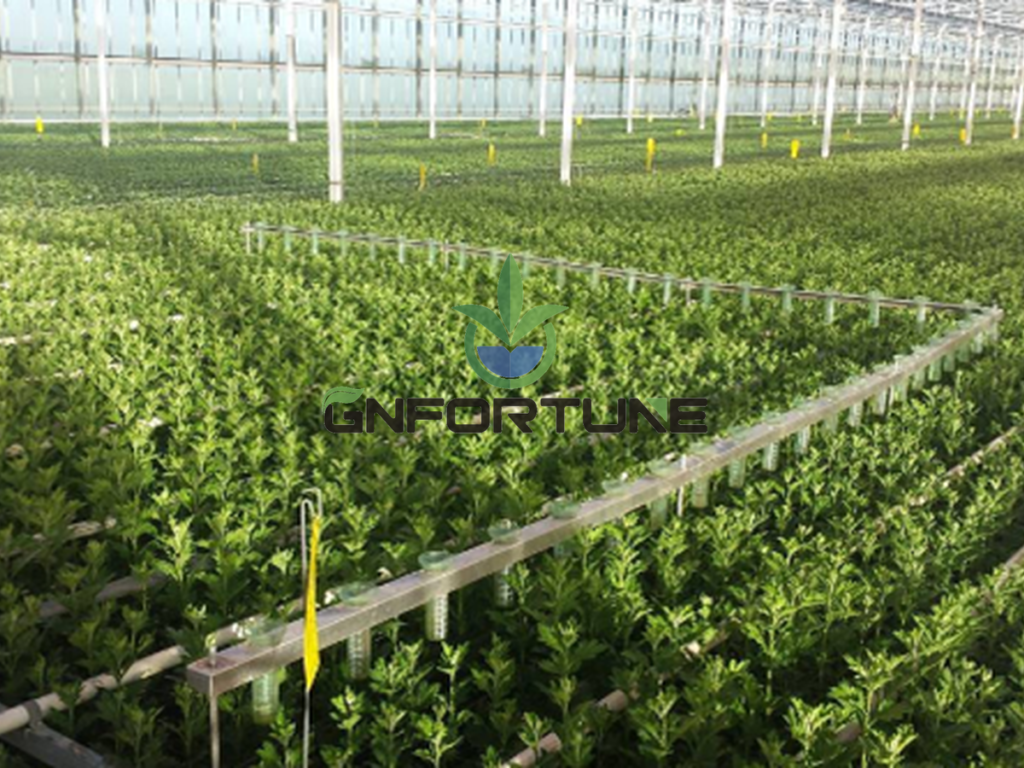
The first week of a tomato crop usually decides whether hanging gutters were worth the money. Ground-level substrate rows force the crew to bend for every leaf pull, every clip and every lower truss; a suspended gutter row can be lifted, walked and harvested at waist height all season. On commercial vine crops, hanging gutters are less about yield per plant and more about labour per plant — with drainage and structural detail deciding whether the system behaves or fights the crew for eleven months.
This article covers the system itself. Container and media choice is a separate decision compared in the guide to grow bags versus slabs versus buckets for vine crops, and strawberry gutters have their own layout logic; vine crops are the focus here.
What Hanging Gutters Change in a Vine Crop House
A hanging gutter is a profiled substrate channel suspended from the structure by hooks or wire, carrying bags or slabs of media with drip irrigation and a drain path. Four things change immediately when the row leaves the floor:
- The work surface moves. Height becomes an adjustment, not a constant. Rows can be raised for harvest and lowered or angled for young plants, keeping the canopy in the crew’s working band.
- The floor stays open. Drainage, cleaning and cart movement all happen under the row instead of around it. Standing water and media spills stop being permanent fixtures of the aisle.
- Drainage becomes visible. Every gutter end discharges where you can see it, so a blocked outlet or a failing drip shows within a day rather than at the next root inspection.
- The structure takes the load. Saturated media plus plants plus water is real weight, and the roof or a suspended frame carries it for the whole crop.
Working Height and Ergonomics: Setting the Numbers
The height decision drives daily labour more than any other gutter parameter. As a planning range used on substrate gutters for tomato and cucumber, a working top edge of roughly 550–750 mm above the floor suits most harvest and leaf-pull tasks for crews of mixed height, with taller rows reserved for houses using hydraulic lift platforms or pipe-rail trolleys. The assumption behind the range is a standing crew performing leaf pulls and harvests several hours a day; if most work happens from trolleys, the constraint relaxes.
Three ergonomics checks belong in the design review:
- Reach test at the young-plant stage: can the crew plant and clip into the row without stooping? If not, plan the low position on the hooks.
- Truss access at full crop: the lowest fruiting truss should sit between waist and chest height at harvest, which may mean lowering the gutter as the crop grows.
- Aisle clearance under the gutter: carts, knees and drain lines all share that space. A planning clearance of 400–600 mm under the gutter edge keeps both passable.
Moveable gutter systems add a row-spacing benefit: sliding rows open one wide aisle for trolleys and close the rest, trading a little hardware for a large cut in walking distance across a season. The work standards that set these rates — plants per hour per task — are worth reading alongside the crew standards article.
Structural Load and Hanging Hardware
Saturated substrate is heavier than most first-time buyers assume. A planning figure for loaded gutters is in the order of 25–45 kg per running metre for typical vine-crop slabs and profiles, assuming full saturation plus mature crop weight — and the suspension must carry that continuously, not briefly. Hooks and wire therefore get specified for the wet, loaded condition with margin, and anchored into structure members, not into cover fixings or glazing bars that were never designed for it.
Two failure patterns show up repeatedly in retrofits:
- Hooks spaced too far apart: the profile bridges between supports and slowly sags between hooks, pooling water at the low points. Closer spacing or a stiffer profile fixes it.
- Uneven tension: rows strung by eye drift out of level over a long run, and the drain gradient vanishes mid-house. Stringing to a set gradient — not level — is the fix.
| Aspect | Fixed (non-moveable) gutters | Moveable hanging gutters |
|---|---|---|
| Hardware cost per metre | Lower; simple hooks and wire | Higher; sliding rails or hangers |
| Aisle use | One access path per row | Rows bunch to open one working aisle |
| Best fit | Single-crop houses, tight budgets | High-labour crops, pipe-rail trolley programmes |
| Watch for | Long walking distances all season | Drive and rail maintenance; per-row locking must hold |
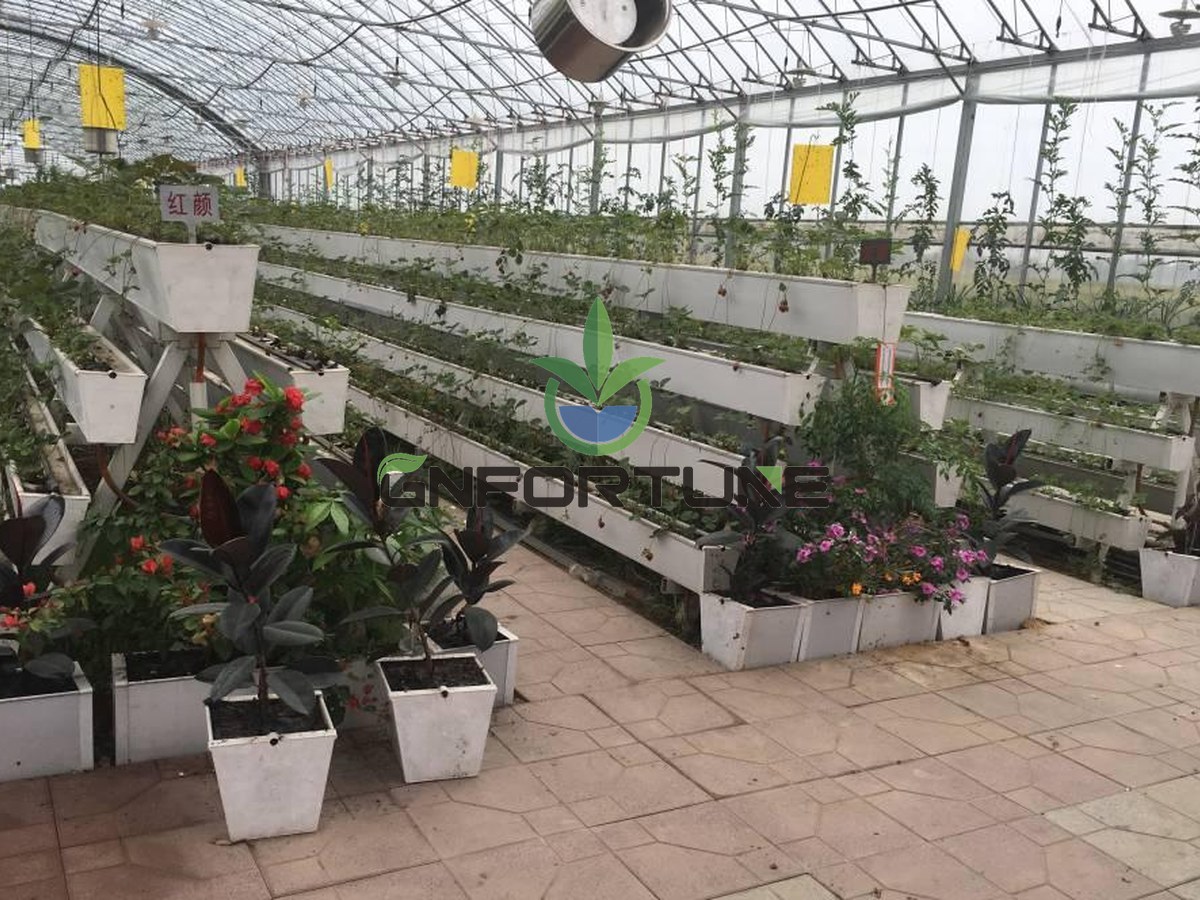
Drainage: Slope, Outlets and What the Drip End Tells You
Drainage is where gutter projects most often disappoint, and almost always for the same reason: the run loses its fall. A planning gradient of roughly 0.3–0.5% along the gutter — one to five centimetres of fall per ten metres, depending on profile — keeps drain water moving to the outlet without starving the high end. On a suspended system this gradient is set at stringing time and checked with a line level, because nothing about a horizontal wire produces a slope by accident.
Detail that pays back all season:
- One outlet per gutter end, not per bay. Individual ends are easy to check by eye during the daily walk.
- A visible discharge point — into a collection channel or gully, not into a buried pipe with no sight glass. You want to see drain volume and colour, not infer them.
- Drip placement at the high end of each slab or bag position so the wetting front runs the full media column.
- Drip control: where drips fall onto walk surfaces or structure below, a collection profile or re-routed drain line is the fix — water on the floor is both a hygiene and a safety problem.
Drain collection and the percentage-of-drain measurement that drives irrigation steering is covered separately in the article on substrate drain percentage and water content; here the point is the hardware: a gutter system without observable, free-flowing drain ends is flying blind.

Specifying Hanging Gutters: What to Confirm Before Ordering
The questions that decide whether the system behaves are mostly ones buyers can answer themselves, but they need writing down before the quote:
- Crop and cycle: tomato, cucumber or pepper change truss load, height setting and hook spacing.
- Profile and media: which bag or slab format, and the gutter section designed to carry it wet.
- Row length and gradient target, plus how level the structure actually is along that length.
- Fixed or moveable rows, and whether trolleys or platforms will work the crop.
- Structure attachment points: what the hooks anchor into, and that member’s load capacity.
- Drain destination: collection channel, recycling loop or discharge, and where ends are visible.
Row and plant spacing numbers that sit on top of this hardware are set out in the plant density guide, and the trellising layer — wire, twine and clips that hang above the gutter — is a related purchase planned together in the guide to trellising and plant support for vine crops. Deleafing and pruning schedules also interact with gutter height, since a row set too low pushes every leaf pull into a stooped position.
Specified with height, load and drainage written down as numbers, hanging gutters earn their cost through eleven months of easier, faster, cleaner crop work — the kind of payback a labour line item understands.
FAQs About Hanging Gutters for Vine Crops
What height should vine crop gutters hang at?
A planning range of 550–750 mm to the top edge suits standing crews doing leaf pulls and harvests, adjusted by crop stage. Trolleys or platforms relax the constraint and allow taller, denser layouts.
How much weight does the structure carry per gutter?
Plan on roughly 25–45 kg per running metre loaded — saturated media, crop and water — with suspension hardware rated for the wet condition plus margin, anchored into structural members. Confirm your structure’s rating before committing.
Do hanging gutters improve drainage over floor systems?
They make drainage observable and controllable: one visible outlet per end and a gradient you set at stringing. Floor systems can drain fine, but faults stay hidden until roots or floors report them.
Are moveable gutters worth the extra cost?
Where labour dominates the budget and trolleys are already in use, yes — the bunched-aisle layout cuts walking distance substantially. On single-crop houses with tight budgets, fixed rows usually win the payback test.
Can hanging gutters be retrofitted into an existing house?
Often, but the roof or frame must be verified for the sustained load, and long runs must still hold a drain gradient. Get the attachment points engineered before ordering hooks, not after the first sag.
Related Reading
- Grow Bags vs Slabs vs Buckets for Vine Crops — The media decision the gutter profile has to carry
- Tomato Clips and Trellis Hardware: Buying Specs — The consumables the hanging system depends on
- Vine Crop Deleafing and Pruning Schedule — The daily work whose ergonomics gutter height sets
- Crop Work Standards for Hydroponic Farms — The task rates height and layout are built around
- Multi-Tier Irrigation: Pressure and Drainage — Feeding gutter rows at different levels
Next Step: What to Send for a Quotation
Gutter systems are quoted from layout facts, not from greenhouse photos alone. For an RFQ or project consultation, send: crop and crop cycle; gutter profile preference and media format; row length and number of rows; fixed or moveable rows and whether trolleys are planned; structure type and attachment details; drain destination and whether recycling is planned; target working heights for the crew; delivery schedule; and the budget band. G AND N FORTUNE LIMITED supplies substrate gutter systems, hanging hardware and matched irrigation quoted to those parameters, with profiles extruded in-house.