Every winter, farms that sold confidently through October start missing orders in January, and the crops rarely get the blame they deserve. The real constraint is the winter light ceiling: the total daily light an unlit greenhouse receives in the darkest weeks, which caps growth no matter how well nutrients, temperature and labour are managed. Planning around that ceiling — choosing crops and slots the light can actually finish — separates farms that keep customers from farms that apologise every February.
What the Winter Light Ceiling Actually Is
The ceiling is the daily light integral the house receives at the worst time of year, and it is a physical limit rather than a management problem. As a planning range, an unlit film greenhouse at roughly 35–45° latitude can expect 3–6 mol/m²/day in December and January under typical overcast conditions, rising to 8–12 mol/m²/day by March. Glass and diffusing covers shift these figures somewhat; local cloud climate shifts them more. The assumption behind every number in this article is a house without supplementary lighting — with lights, the ceiling moves and the arithmetic changes.
Two consequences follow directly. Growth slows to a fraction of the spring rate, so a crop that finishes in 30 days in April may need 50–65 days in January at the same transplant date discipline. And because light, not temperature, is usually the limiting input in those weeks, pushing heat into the house does not buy speed — it often only raises respiration and produces softer, paler plants under the same light.
Day-length management and the lighting math behind these figures are covered separately in the guide to photoperiod and day length in the greenhouse; this article stays on the crop and slot decisions the ceiling forces.
Crops That Hold Up in the Low-Light Months
Crops differ sharply in how gracefully they tolerate slow light. The general rule: the lower the winter light ceiling, the further the plan should move toward compact, low-light-tolerant, short-cycle greens — and away from anything that needs speed or high light to set quality.
| Crop or slot | Behaviour under a low winter ceiling | Practical slot decision |
|---|---|---|
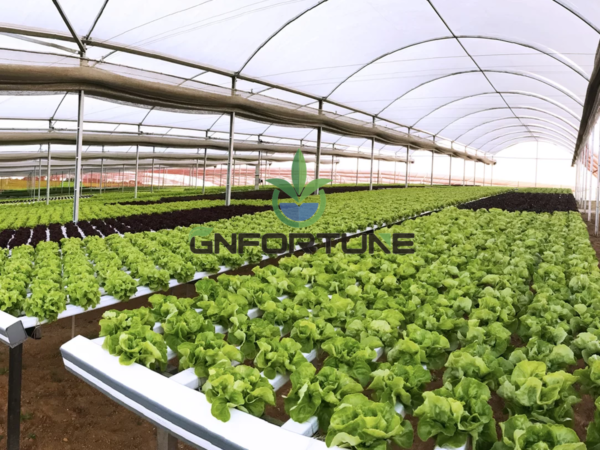
| Butterhead and oakleaf lettuce | Slow but reliable; heads form, just later | Hold the area, stretch the promised harvest window by 3–4 weeks |
| Baby leaf and cut-and-come-again lines | Light-sensitive for regrowth speed; first cut still workable | Hold, but lengthen the cycle between cuts |
| Spinach and cold-tolerant Asian greens | Among the best winter performers in cool houses | Expand; these carry the winter programme |
| Basil and warm-season herbs | Grows slowly, quality drops, botrytis pressure rises | Reduce area or pause unless the house is genuinely warm |
| Tomato, cucumber and other vine crops | Set and fill decline steeply; existing crop limps | Plan the replant after the trough, not inside it |
| Fast specialty greens (arugula, mustard) | Cycle doubles; bolting risk is low but so is yield | Keep a small slot for premium orders, not volume |
Spinach is the quiet winner in most winter programmes, and the cycle detail behind it is set out in the 35-day spinach playbook. Asian greens and other cool-season choices are covered crop by crop in their own guides; here the point is only the ranking logic: in the low-light months, area follows the crops that convert scarce light into sellable weight most reliably.

Slot Decisions: What to Drop, Hold and Push
The ceiling is most useful as a scheduling tool. Three moves repeat across well-run winter programmes:
- Drop the volume slots that need speed. Fast-cut lines planned for a 21-day cycle will still grow in January — at 40+ days. If the order book assumes spring speed, the farm misses; better to contract that volume to a southern or lit site for those weeks.
- Hold the crops that store value on the plant. Compact lettuce, spinach and hardy greens stand in the house without collapsing when the harvest slips a week. That standing buffer absorbs the delivery risk winter creates.
- Push replants past the trough. New vine crops and long-cycle plantings scheduled into the darkest weeks cost more than they return; moving the replant to late January or February costs one idle week and saves six weak ones.
The transplant calendar that carries these decisions is built in the guide to crop scheduling for continuous production; the winter revision is the single most valuable edit that calendar gets all year.
Promising Orders the Light Can Actually Deliver
Sales commitments written in October for January should be priced against the ceiling, not against autumn throughput. A workable method: take the December–January DLI planning range for your site and latitude, apply the crop’s winter growth curve rather than its annual average, and quote lead times and volumes from the winter figure. Where a customer insists on spring volumes in midwinter, the honest options are supplementary lighting, a partner farm, or a written longer lead time — not a promise the house cannot keep.

Does Supplementary Lighting Change the Answer?
It can, and the decision is an arithmetic one. Lighting converts the ceiling into a controllable input, but the economics depend on electricity price, target DLI, hours of boost and the price the winter crop commands. As a planning heuristic, farms at high latitude with strong winter contracts run the numbers first and buy hardware second; farms where winter demand is soft often make more money rearranging slots than running lamps for a thin margin. The equipment comparison and the PPFD and DLI arithmetic belong to a greenhouse lighting guide — the point here is sequencing: fix the slot plan first, then price the light.
Watch-Outs Specific to Winter Crops
Slow growth changes the risk profile as well as the output. Botrytis and leaf-edge quality problems rise in still, humid canopies, so winter airflow deserves attention even when vents barely open. Weak transpiration slows calcium delivery, and tipburn on hearting lettuce shows up more readily in the dark weeks than growers expect — the disorders and their triggers are listed in the article on tipburn, bolting and physiological disorders. Bolting, the classic summer failure, is rarely the winter problem; soft, wet growth is. Heating the house properly for those weeks is an equipment and energy question covered in greenhouse heating and root-zone temperature planning — it matters, but only after the light arithmetic is honest.
Farms that write the winter light ceiling into their plan — as a number, a slot rule and a pricing input — stop being surprised by January. The crops that hold get the area, the crops that limp get pushed, and the orders that go out in the dark weeks are ones the house can finish.
FAQs About the Winter Light Ceiling
How much light does an unlit greenhouse actually get in winter?
As a planning range, 3–6 mol/m²/day in December–January for an unlit film house at 35–45° latitude, rising through February. Confirm with a light sensor on your own site — local cloud climate moves the number more than cover type does.
Which crops should carry a winter programme?
Spinach and cool-season compact greens lead, followed by butterhead lettuce on stretched cycles. Warm-season herbs and vine crops are the first candidates for area reduction or replanting after the trough.
Can heating make up for low winter light?
Not directly. Light is usually the limiting input in dark weeks; extra heat without light tends to produce softer growth and higher disease pressure. Heat still matters, but for preventing cold damage rather than buying speed.
Should we replant vine crops in December?
Most winter plans push the replant to late January or February. A crop planted into the darkest weeks settles slowly, sets poorly and ties up labour and bench space for a weak return.
When does supplementary lighting pay for itself?
When firm winter contracts, high electricity efficiency at your tariff and a crop price premium all line up. Run the DLI arithmetic for your site before buying; slot rearrangement is often the cheaper fix.
Related Reading
- Greenhouse Lighting: LED vs HPS, PPFD and DLI — The lighting arithmetic that moves the winter ceiling
- Photoperiod and Day Length in the Hydroponic Greenhouse — How short days change crop behaviour
- Hydroponic Spinach Production: A 35-Day Playbook — The crop that carries most winter programmes
- Crop Scheduling for Continuous Production — Building the calendar the winter revision edits
- Greenhouse Heating: Sizing and Root-Zone Temperature — Heat as a supporting input, not a light substitute
Next Step: What to Send for a Quotation
A winter plan is only as good as the house it runs in, and small upgrades — airflow, sensors, a lighting-ready structure — are cheap against one missed contract. For an RFQ or project consultation, send: your location and latitude; the crops and slot volumes now planned for December–February; whether supplementary lighting is on the table and at what electricity tariff; current heating capability; greenhouse dimensions and the number of zones; the winter orders you most need to protect; and the budget band. G AND N FORTUNE LIMITED supplies greenhouse structures, NFT and substrate systems, and matched climate equipment quoted against those parameters.