

Greenhouse supplemental lighting is the second-largest electricity line item after HVAC in a northern-latitude hydroponic project, and the decision between LED and HPS sets the operating cost for the next decade. The right answer is rarely “buy the cheapest fixture” or “buy the most efficient,” because the crop matters, the climate matters, and the metric that actually drives yield — Daily Light Integral — is not on most product spec sheets. This guide walks through how DLI is calculated, how LED and HPS compare on PPFD output, energy use, spectrum, and heat load, and how to size a system against real crop targets.
Why DLI Is the Metric That Matters
Light intensity for plants is measured as Photosynthetic Photon Flux Density (PPFD), in micromoles of photosynthetically active photons per square meter per second. Over a whole day, the integrated total is the Daily Light Integral, or DLI:
DLI (mol/m²/day) = PPFD (μmol/m²/s) × photoperiod (hours) × 0.0036
The 0.0036 factor converts seconds to hours and micromoles to moles. This single number — mol of photons per square meter per day — is what the crop “sees,” and it is the only metric that makes a fixture spec comparable to a crop’s actual need.
Different crops want very different DLIs. Leafy greens saturate in the 12–17 mol/m²/d band; fruiting crops need 20–30 mol/m²/d to convert light energy into fruit dry matter rather than just leaves.
| Crop | Target DLI (mol/m²/day) | PPFD × hours to hit it | Notes |
|---|---|---|---|
| Lettuce, leafy herbs | 12–17 | ~200 μmol × 18 h | Dimmer shading tolerated; DLI above 17 wastes energy |
| Strawberry (day-neutral) | 14–20 | ~220 μmol × 18 h | Higher DLI tightens fruiting interval |
| Tomato | 20–28 | ~450 μmol × 16 h | Slips past 30 in summer with no shading |
| Cucumber | 20–25 | ~430 μmol × 16 h | Same band as tomato; leaf burn starts above ~30 |
| Pepper | 22–30 | ~520 μmol × 16 h | The most light-hungry common fruiting crop |
The trap is marketing language: “grow light for 12 hours a day” tells a buyer nothing unless the PPFD at crop height is also stated. Always work in DLI, never in hours.
LED vs HPS: PPFD, Spectrum, Heat, and Lifespan
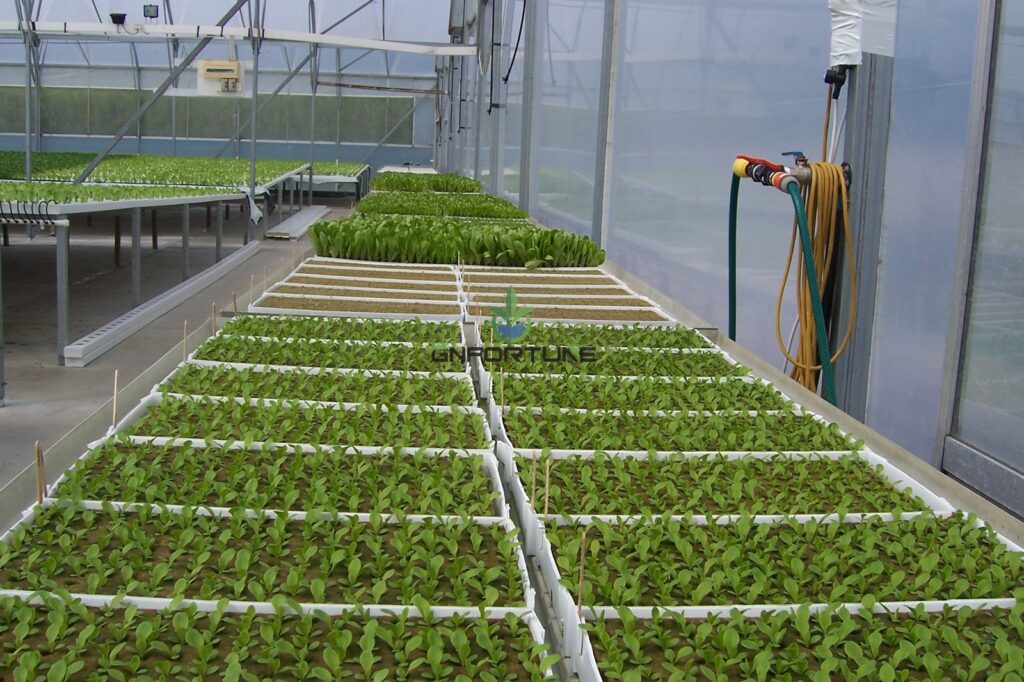
Greenhouse top cover with natural sunlight reaching the canopy of hydroponic cropHigh Pressure Sodium (HPS) has been the greenhouse workhorse for forty years. Light Emitting Diode (LED) fixtures are now the default for new builds in most latitudes. The comparison buyers actually need:
| Parameter | HPS (400–1000 W) | LED (300–800 W equivalent) |
|---|---|---|
| Fixture efficacy | ~1.4–1.7 μmol/J | ~3.0–3.8 μmol/J |
| Typical fixture wattage | 400 / 600 / 1000 W | 200 / 400 / 600 / 800 W models |
| Spectrum | Fixed yellow-orange heavy (~2100 K) | Tunable; full-spectrum white or red+blue blends |
| Fraction of energy as radiant heat at canopy | High (~40%); canopy leaves feel it | Low (~10–15%); heat stays in the fixture |
| Lamp life (L90 or driver life) | 10,000–24,000 h; replace lamps, not fixtures | 50,000+ h; whole-fixture replacement cycle |
| Lamp replacement cost | Recurring; $30–80 per lamp, yearly | Near zero within the 10-year horizon |
| Dimmable | Stepped or magnetic ballast only | 0–100% standard via 0–10 V or DALI |
| Cooling demand on the greenhouse | Increases HVAC load | Reduces HVAC load in summer |
Two practical rules from audits of hybrid greenhouses: LED fixtures deliver 2–2.5× more photons per kWh than HPS at the same rated wattage; and because LED heat stays largely in the diode heat-sink, summer cooling loads drop noticeably — a benefit that is real but rarely counted in a simple ROI.
Sizing Supplemental Light for Your Crop
The reverse calculation is the one that fits a fixture count into a greenhouse:
- Step 1 — Estimate natural DLI for your latitude and month. Mid-latitude winter in northern climates often sits at 3–6 mol/m²/d outdoors; greenhouse glazing cuts this by another 30–40%, so the inside number can drop to 2–4 mol/m²/d.
- Step 2 — Subtract from crop target. For tomato at 22 mol/m²/d target and 5 mol/m²/d natural, the supplemental requirement is 17 mol/m²/d.
- Step 3 — Convert supplemental DLI to wattage. 17 mol/m²/d / 16 h photoperiod / 3.5 μmol/J effective = ~300 W/m² LED, or ~600 W/m² HPS to produce the same photons.
Layout comes next: at 1.5–2.0 m mounting height, a 600 W LED fixture typically covers 6–9 m² at uniform PPFD. Wider footprints need closer spacing and lower mounting; otherwise PPFD uniformity falls below 80% across the bay, which translates directly into uneven fruit sizing at the edges.
Spectrum Choices: Full Spectrum vs Red-Blue Blend
Plants use primarily blue (400–500 nm) and red (600–700 nm) light for photosynthesis, with green (500–600 nm) contributing through the canopy. Two practical patterns:
- Red+blue blends (typical 4:1 or 5:1 red:blue). Highest photon efficacy per watt. Looks purple to the eye. Proven in leafy greens and vertical-farm bench setups. The downside is worker inspection — color distortion makes it harder to spot pests and deficiency symptoms.
- Full-spectrum white (3000–5000 K). Slightly lower μmol/J, but the white light lets staff read plant condition accurately. For commercial fruiting greenhouses where staff walk the rows daily, full spectrum is usually the better trade-off.
Far-red (700–750 nm) is increasingly added in tomato and strawberry research to manipulate flowering and stem stretch, but it is a tuning dial, not a baseline. Most buyers should specify a white-dominant fixture with a red peak and revisit far-red only after the basic DLI target is met.
Energy Cost and Payback in Real Projects
The payback math in a retrofit HPS-to-LED swap is more honest than in new builds, because the baseline is a known electricity bill. A worked example for a 1 ha tomato greenhouse running 16 h/day, 8 months/year:
- HPS at 1.6 μmol/J: ~480 W/m² installed, electricity 700,000 kWh/year at $0.10/kWh = $70,000.
- LED at 3.4 μmol/J to deliver the same DLI: ~225 W/m² installed, electricity 330,000 kWh/year = $33,000.
- Annual saving: ~$37,000; LED retrofit installed cost typically $20–35/m² for hardware; payback 1.5–2.5 years on the lamp-and-fixture delta.
Greenfield builds usually run 2–4 years to payback against HPS because LED CAPEX is higher and electricity is the only line being saved. Always include HVAC savings — LED lower heat load can cut summer ventilation electricity 10–20%, which on its own can shift payback by several months. Buyers planning new projects should cross-check against the assumption set used in our hydroponic farm ROI resource.
On-Site Mistakes We Correct Most Often
Three recurring retrofit failures: (1) fixtures mounted too close, scorching the canopy; (2) PPFD mapped at the center of the fixture footprint only, leaving dark edges that quietly cost yield; (3) spectrum chosen by efficacy alone, leaving workers unable to see pests or deficiency in the purple-pink glare. None of these show up on a fixture data sheet — they show up six weeks after planting.
A short checklist to walk through with a supplier before ordering:
- PPFD map, not a center number. Ask for a 9-point uniformity map at the recommended mounting height; reject anything below 80% uniformity.
- IP rating and driver warranty. Greenhouse humidity is high — IP65 driver housing and a 5-year driver warranty are the minimum sensible specs.
- Certifications for your market. UL/ETL/DLC for North America, CE for Europe, CCC for China, SAA for Australia. Specs without the right certification do not get past customs.
- Dimming interface matched to the controller. 0–10 V is most common; DALI is needed for addressable zoning on larger bays.
- Mounting compatible with the greenhouse structure. Truss spacing, purlin height, and anti-sway bracing change the installation cost more than the fixture cost.
FAQ
What DLI does lettuce need?
A: 12–17 mol/m²/day. Below 10, head formation slips; above 17, the extra light turns into heat rather than yield and the energy is wasted.
Is LED really cheaper than HPS now?
A: Per photon, yes — LED produces 2–2.5× more μmol per kWh. Per fixture, LED still costs more up front. Payback on the electrical delta usually lands in the 1.5–3 year range for retrofits.
Do tomato growers still use HPS?
A: Some, especially in cold climates where the radiated heat from HPS reduces winter heating load. In mild climates or in summer, LED has largely displaced HPS because the heat becomes a cooling penalty rather than an asset.
How high should the fixtures be?
A: Most 400–600 W LED fixtures mount at 1.5–2.5 m above canopy for an even footprint. Higher mounting gives better uniformity but more light lost to walls and aisles. Always check the manufacturer’s photometric file at the planned height, not at the center of the spec sheet.
Does far-red help?
A: It can shift tomato and strawberry flowering in research settings, but it is a fine-tuning option, not a baseline. Get white + red peak coverage first, then add far-red only if the crop response justifies the extra cost.
Get a Light Plan Sized to Your Greenhouse
Send your greenhouse area, latitude, and target crop through the quote form, and our engineering team will return a fixture count, mounting layout, target DLI, and electricity estimate — supplier-agnostic, so it works as a spec whether you buy from us or shop the local market. For lettuce production lines, the NFT lettuce guide pairs with this lighting brief on common DLI ranges; for tomato and cucumber bays, the hydroponic system design resource covers the structural side of a retrofit.