
Eggplant in Dutch Buckets: Commercial Setup
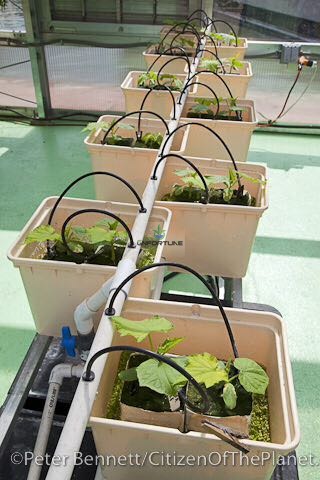
Eggplant hydroponics asks more of a container than most vine crops do, because the plant stays in it for six months or longer. A Dutch bucket gives each plant its own drainage path, its own emitter set and its own media volume, which is what a woody, long-cycle crop needs; a shared trough ties every plant to the same root environment and to the same disease risk. The trade-off is that the bucket has to be specified for the peak, not for the transplant.
Why Dutch Buckets Suit Eggplant
Three crop characteristics point at buckets. Eggplant is long-cycle, so the media and the container have to stay stable through a season of salt loading and root growth. It is a heavy, woody canopy by month four, so each plant needs a defined spacing and an anchor point. And it is sensitive to root-zone problems, so isolating drainage per plant limits how far a problem spreads.
| Requirement | What eggplant needs | How the bucket answers it |
|---|---|---|
| Cycle length | 6 to 9 months of production | Reusable container, media changed per cycle |
| Media volume | 10 to 20 L per plant | Single-plant body with a drain outlet |
| Isolation | Root problems contained | One outlet and one drain line per unit |
| Anchor | Plant stays upright under canopy load | Rigid body ties to the trellis wire above |
| Service access | Emitter and drain checked without moving the plant | Top access and a visible outlet |
Spacing follows the canopy rather than the bucket. Eggplant rows commonly sit at 1.2 to 1.5 m along the row with 1.5 to 2.0 m between rows, giving roughly 2 to 3 plants per square metre. Tighter spacing raises short-term yield per square metre and costs airflow, light penetration and picking speed later in the crop.
Bucket layout, drainage and emitter mapping are set out in the Dutch bucket layout basics. Growers already running peppers can compare directly with the pepper bucket guide, because the two crops share most of the hardware.
Media and Per-Bucket Plant Count
One plant per bucket is the standard, and two is the exception. Eggplant builds a wide, woody canopy and a root system to match; two plants in a 10 to 20 L body compete for the same water and the same emitter, and the pair grades smaller than either plant would alone.
- Volume. 10 to 20 L per plant, with the larger end preferred for a crop that runs past six months.
- Blend. Coir and perlite near 70:30, or straight perlite where drainage control is tight.
- Drainage layer. A coarse layer at the base keeps the outlet clear of fines.
- Reuse. Buckets wash and return to service; media is normally replaced each cycle and the old media handled as waste.
On site we often find salt built up in the bottom third of the bucket while the top looks fine: one emitter at a low rate, short shots and no measurable runoff means the lower media never gets flushed, and EC there can sit far above the feed strength. The plant answers with marginal leaf burn and small, dull fruit at exactly the point the crop should be peaking. Run two emitters, keep 20 to 30 percent runoff, and measure the drain EC rather than guessing from the feed tank.
Emitter Rate and Salt Build-Up
Emitter specification is the most under-specified line on an eggplant bucket order. The crop needs enough flow to cover peak demand and enough volume to push a leaching fraction through the media, and one 2 L/h dripper per bucket rarely does both once the canopy is full.
| Stage | Emitters per bucket | Events per day | Target runoff |
|---|---|---|---|
| Establishment, first three weeks | 1 at 2 L/h | 2 to 4 | 10 to 15 percent |
| Vegetative growth | 2 at 2 L/h | 4 to 6 | 20 to 30 percent |
| Flowering and fruit set | 2 at 2 to 4 L/h | 5 to 8 | 20 to 30 percent |
| Peak production, hot house | 2 at 4 L/h | 6 to 10 | 25 to 35 percent |
Feed strength sits in a moderate band. EC 2.0 to 3.0 mS/cm at pH 5.8 to 6.3 suits most programmes, eased at establishment and pushed toward the upper end in peak production. The control that matters is the drain: measure runoff EC at the bucket outlet weekly, and if it runs more than about 1.0 mS/cm above feed strength, raise the leaching fraction before the crop shows stress.
Pruning and Canopy Management
Eggplant is pruned to a fixed stem count and kept there. Left alone it makes a thicket, the interior fruit goes pale and the picker cannot reach the harvest without damage.
- Stem count. Train to two or three main stems on a string system; remove other breakouts early.
- Sucker removal. Weekly, before the side shoot hardens and the wound gets large.
- Deleafing. Strip lower leaves once they shade the fruit or touch the media surface.
- Fruit position. Keep fruit off the media and off the walkway; a fruit resting on wet media rots at the calyx.
Grafted plants are worth costing out for a long cycle. Grafted eggplant on a vigorous rootstock costs more per transplant and returns the difference in season length and disease tolerance; on a nine-month crop that trade usually favours grafting, on a short one it may not.
Fruit Support and Harvest Frequency
Eggplant fruit is heavy for its size but hangs on a short, woody peduncle, so slings are rarely needed on a well-pruned plant. Support matters where a cluster forms on a lateral and bends it toward the walkway.
- Fruit weight. Commonly 200 to 500 g at market size, depending on type and buyer specification.
- Support. Clips or short ties on loaded laterals, fixed to the stem wire rather than the string.
- Harvest interval. Two to three passes per week in peak production, weekly or less in a cold house.
- Maturity. Cut at glossy, full-colour skin before seed cavities develop; use shears, not a pull.
Yield is a planning range, not a promise: 8 to 15 kg per plant per season is a common band for a well-run protected crop, and figures vary by region and season. Harvest labour is the recurring cost that decides whether the line pays, so measure passes per hour against the buyer’s grade specification before scaling.
Temperature and Root-Zone Targets
Eggplant is the warmest of the common solanaceous greenhouse crops, and it stops producing below the band. Day temperature of 22 to 28 °C with night at 18 to 20 °C keeps growth and fruit set moving; below about 15 °C at night, set fails and fruit develops poorly. Root zone should sit at 20 to 24 °C, and a root zone under 18 °C slows uptake even when the air is warm.
That temperature floor is an energy decision, not an agronomy one. In a cold climate the winter energy cost of holding 18 °C at night is the single largest variable in the crop budget, and it should be sized before the greenhouse is specified. The greenhouse heating and root-zone guide covers the sizing method, and the tomato bucket guide gives a useful comparison of load and layout on the same hardware.
FAQ
How many eggplant plants go in one Dutch bucket?
A: One, at 10 to 20 L of media. Two plants compete for the same emitter and water and grade smaller than a single plant would.
What EC suits eggplant in a bucket system?
A: EC 2.0 to 3.0 mS/cm at pH 5.8 to 6.3, eased at establishment and raised during peak production.
How often should eggplant be irrigated?
A: Four to six events per day in growth, six to ten at peak in a hot house, with 20 to 30 percent runoff measured at the outlet.
Does eggplant need slings for its fruit?
A: Usually not; the peduncle is woody. Clips or short ties are used where a lateral bends a cluster into the walkway.
How long does a bucket crop run?
A: Roughly 60 to 90 days from transplant to first harvest, then six to nine months of picking in a heated house.
Aubergine Dutch bucket production is a long-cycle crop on short-cycle hardware, and the specification that decides it is the emitter count and the drain. Growers who set two emitters, hold real runoff and prune to a fixed stem count get a clean, marketable fruit through the whole season.
Request an Eggplant Bucket System Quote
Send your row lengths, plant count and target season length, and we will return a bucket layout with media volume, emitter count, drain line sizing and trellis wire set for a six to nine month crop. Use the request an eggplant bucket system quote form, and see Dutch bucket system components for the hardware.


