

What “Outdoor” Means in Commercial Hydroponics
An outdoor hydroponic system is a soilless production block with no climate-controlling envelope over it: open-field Dutch bucket rows, NFT or gutter runs under a shade net, or beds inside a polytunnel with permanently open sides. Irrigation and fertigation work exactly as they do in a greenhouse — the same pumps, filters, emitters and dosing units. What is missing is the structure that would otherwise intercept ultraviolet radiation, rain and wind, and every design change on an outdoor site follows from those three loads.
The equipment class is unchanged by the setting. UV-stabilised channels, food-grade tanks, pressure-compensating emitters and correctly rated pipe are specified the same way; they simply work without the shelter a greenhouse provides, so material and anchoring specifications move up rather than down. Sites that treat outdoor growing as a cheaper version of greenhouse growing spend the savings on replacement parts within three seasons.
When an Outdoor Hydroponic System Beats a Greenhouse
Answer first: outdoor wins where the climate is mild and dry enough that an envelope buys little, where land is cheap relative to structure, and where the crop tolerates the ambient range. It loses where rainfall, humidity or wind push the crop outside its band for weeks at a time. The decision is a climate calculation before it is a construction one.
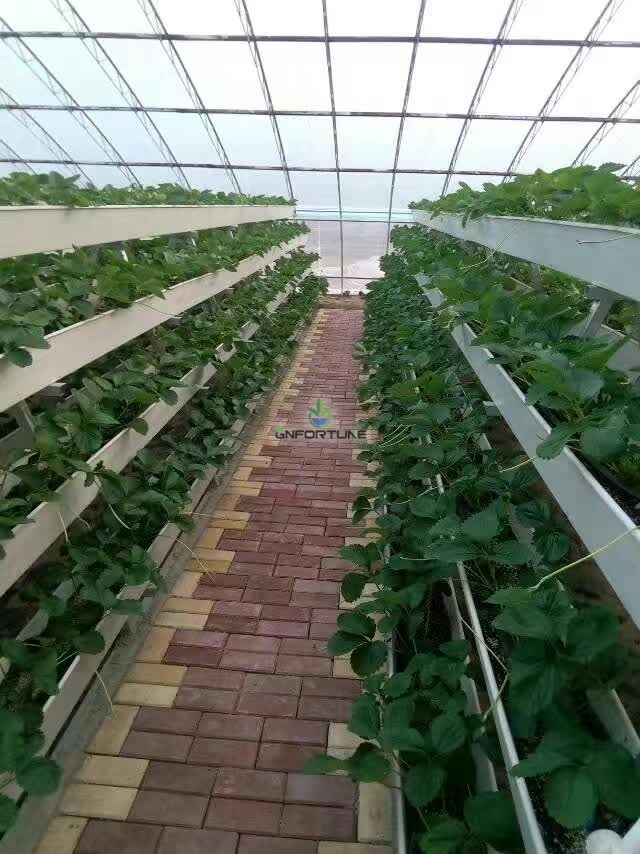
- Dry, moderate coastal or highland climates. Where daytime temperatures sit in the crop band most of the year, the capital saved on structure is real.
- Seasonal or contract production. A block running eight months a year does not need to justify a full envelope.
- Land-rich, capital-constrained projects. Outdoor blocks scale by area rather than by cubic metres of structure.
- Crops with wide tolerance. Leafy greens under shade, herbs, strawberries in gutters, vine crops in dry seasons.
- Pilot or expansion phases. An outdoor block proves demand and labour capacity before permanent structures are financed.
The trade-off is control, and control is what a greenhouse sells. Once rain, wind and radiation are unmanaged, yield consistency drops and labour scheduling gets harder; figures vary by region and season, so model both seasons separately before committing. The greenhouse and high tunnel comparison sits between the two options, and the crop and system matching guide shows which crops tolerate the outdoor range. Humid tropical sites are the hardest case, covered in the Southeast Asia hydroponics notes.
UV Exposure, Material Aging and Warranty Reality
Answer first: specify UV-stabilised polymers with a stated stabiliser package and a stated outdoor service life, and treat any warranty that excludes outdoor use as no warranty at all. Sun damage is the single largest cause of early replacement on outdoor blocks, and it is invisible until a channel cracks under a light push.
| Material | Outdoor behaviour | Typical service life outdoors | Specification to request |
|---|---|---|---|
| UV-stabilised HDPE or PP, 2 to 3 percent carbon black | Slow surface fade, retains impact strength | Roughly 7 to 10 years | Stabiliser type and loading in writing, not “UV resistant” |
| Unstabilised PP or recycled-content channel | Chalks, then cracks at stress points | 1 to 3 years | Avoid outdoors regardless of price |
| uPVC channel and pipe | Yellows and embrittles; welds fail first | 3 to 6 years with stabiliser | Impact modifier content and outdoor rating |
| Galvanised steel frame | Corrosion starts at cut edges and bolt holes | 10 to 20 years by coating mass | Coating weight and post-fabrication treatment |
| Shade net and film | Loses tensile strength before it looks worn | 3 to 5 years | UV warranty in kilo-Langley or months, not “long life” |
Warranty wording deserves a slow read. Many equipment warranties cover manufacturing defect indoors and explicitly exclude UV degradation, chemical attack and weather events, which is most of what happens outdoors. Ask for the exclusion list in writing and compare it line by line; the equipment lifespan guide covers what actually ends service life, and the food-safe materials guide explains which stabilisers and colourants are acceptable in crop contact.
Rain, Dilution and Nutrient Control
Answer first: rain is a nutrient problem before it is a drainage problem. Water falling directly into open channels dilutes the recirculating solution, and a single heavy storm can halve feed EC in an afternoon. Tanks and dosing units keep working; the crop simply stops receiving the concentration the recipe assumes.
Scale the numbers before designing the response. A 25 mm storm over 1 hectare puts about 250 m³ of water on the site. If channels and beds cover roughly 60 percent of that area, about 150 m³ lands directly in the system — on a block circulating 150 m³, that is close to a halving of EC. An open reservoir is less exposed: a 40 m² tank surface takes about 1 m³ from the same storm, so tank covers protect the concentrated side, while channel-level dilution has to be corrected by dosing back to target.
Three controls are standard outdoors: covers over mixing and return tanks, a rain sensor that pauses dosing during a storm and resumes on a measured EC reading, and overflow capacity sized to local peak rainfall intensity rather than daily totals. Site drainage carries the rest — open drains at a 1 to 2 percent fall, no low spots where a bed can sit ponded, and settling before discharge. Fitting types and pressure classes for those runs are covered in the irrigation pipe fittings guide.
Wind, Anchoring and Site Layout
Wind does two kinds of damage: it lifts and racks structures, and it drives transpiration and physical leaf damage that shows up as tipburn and stem abrasion. Both are layout problems as much as anchoring problems.
- Anchor spacing and embedment. Ground anchors at 1.5 to 2 m along a row, 0.6 to 1.0 m embedment in compacted soil, guy wires on every end frame. Sandy soils need larger plates or deeper embedment.
- Row orientation. Run rows across the prevailing wind only where a windbreak exists; otherwise run rows with it, so gusts pass along the canopy rather than into end frames.
- Windbreaks. A 30 to 50 percent permeable net or a tree line at the windward edge cuts gust load without the turbulence a solid wall creates.
- Cover fixation. Shade net and film fail at fixing points first. Use continuous locking channels rather than clip-on fasteners along an edge.
- Design wind speed. Anchor and frame calculations must use the local code value for the site, not a generic figure.
| Outdoor design item | Target | Failure mode if ignored |
|---|---|---|
| Anchor spacing along rows | 1.5 to 2 m, ends guyed | Whole rows lift in a single storm |
| Anchor embedment | 0.6 to 1.0 m compacted soil | Anchors pull out in saturated ground |
| Channel support spacing | 0.8 to 1.2 m | Sagging, low spots, uneven film depth |
| Site cross-fall | 1 to 2 percent away from beds | Ponding under beds after storms |
| Overflow capacity | Sized to local peak intensity | Tanks overtop and lose solution |
| Filtration | Screen or disc filter before emitters, cleaned more often than indoors | Dust and pollen block emitters |
Common Outdoor Failures
The failure mode we keep meeting outdoors is a channel specified for greenhouse duty and installed in full sun. The profile is the right section, the price was attractive, and the stabiliser package was never stated. Eighteen months later the channels chalk, hairline cracks appear at the support points, and the block loses containment mid-cycle. On an outdoor site the material certificate is worth more than the section drawing: ask for stabiliser type, loading and a stated outdoor service life before comparing prices.
The second failure is a drain designed for irrigation volume instead of storm volume. An outdoor block has to shed rainfall from its whole catchment, not just crop runoff, and undersized drains turn a wet week into a flooded bed.
FAQ
Can a commercial hydroponic farm operate outdoors without any structure?
A: Yes, in mild and dry climates with shade net or open field layouts. The crop must tolerate the ambient temperature range, and materials, anchoring and drainage have to be specified for full exposure.
What materials last longest outdoors?
A: UV-stabilised HDPE or PP with 2 to 3 percent carbon black, typically 7 to 10 years outdoors. Unstabilised or high-recycled-content profiles can fail in one to three seasons.
How does rain affect nutrient solution outdoors?
A: Rain falling into open channels dilutes the solution; a 25 mm storm can roughly halve feed EC on a shallow system. Cover tanks, pause dosing during storms, and resume on a measured EC reading.
Do outdoor hydroponic systems need wind anchoring on every row?
A: Yes. Ground anchors at 1.5 to 2 m spacing with 0.6 to 1.0 m embedment, guyed end frames, and shade structures calculated to the local code wind speed.
Is outdoor cheaper than building a greenhouse?
A: Capital cost is lower, but material replacement, higher filtration demand and less consistent yield narrow the gap over time. Model both options against local climate; figures vary by region and season.
Get an Outdoor Layout for Your Site
An outdoor hydroponic system is specified against three loads a greenhouse would otherwise absorb — ultraviolet radiation, rainfall and wind — and the cost of ignoring any one of them arrives within a few seasons. Send your site dimensions, climate data, crop plan and water analysis through the outdoor system design and quote request and the engineering team will return a material specification with UV ratings, a drainage and dilution control plan, and anchoring and layout details.