

Best Crops for Hydroponic Systems: Matching Guide
The best crops for hydroponic systems are the ones whose root mass, cycle length, and harvest method suit what the hardware does well. Short-cycle, shallow-rooted, whole-head crops belong in channels or rafts; long-cycle, heavy-canopy crops belong in substrate containers with room for roots and a trellis above. Most equipment regret on commercial farms comes from the reverse order — the system is bought first and the crop is forced into it. The matching table below is the short answer; the sections after it explain why each pairing works.
The Short Matching Table
| Crop group | System that suits it | Why |
|---|---|---|
| Lettuce, kale, pak choi, arugula | NFT channels or DWC raft beds | Shallow roots, 4 to 6 week cycle, whole-head harvest, high plants per square metre |
| Basil, coriander, parsley, mint | NFT or raft for cut-and-come-again; buckets for woody herbs | Fast regrowth, moderate root mass, frequent cutting |
| Tomato, cucumber, pepper | Dutch bucket or Bato bucket with substrate | Large root volume, long crop, needs trellis load and a substrate buffer |
| Strawberry | Gutter or trough systems with substrate | Shallow crown roots, needs free drainage and airflow around fruit |
| Microgreens | Trays on racks, ebb-and-flow or capillary mats | Days-long cycle, harvested at the stem, no channel required |
| Blueberry and other long-cycle fruit | Containers with acidic media and drip | Perennial root system, narrow pH window, low density |
Leafy Greens: Why NFT Dominates
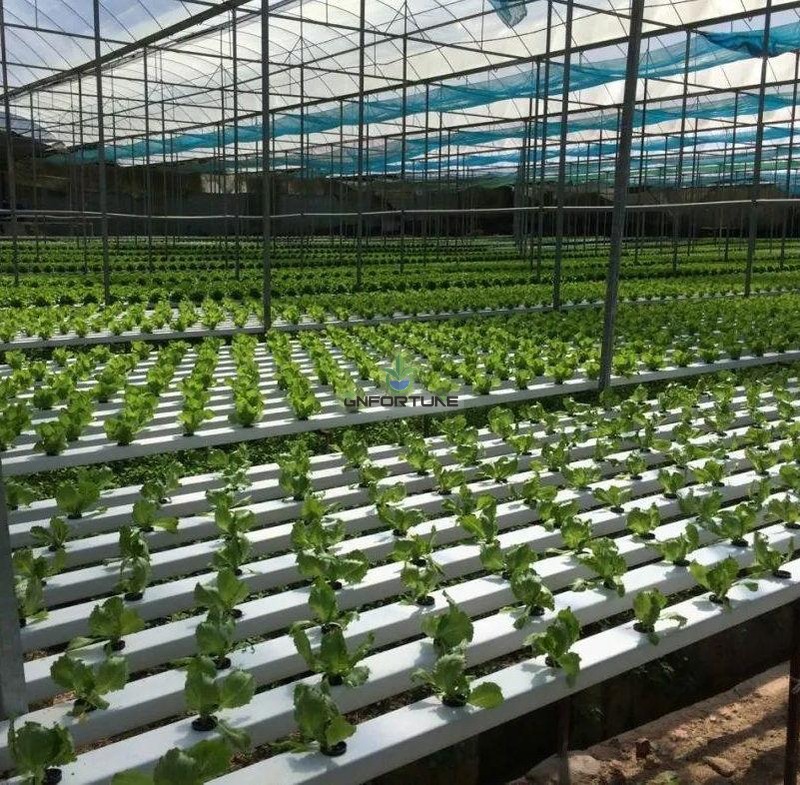
Leafy greens suit nutrient film because the crop’s economics and the system’s strengths point the same way. Roots stay thin and shallow, the crop finishes in roughly four to six weeks from transplant, and the harvest is a whole head lifted in one motion. Channel layouts put 20 to 30 plants per square metre of growing area, which is what makes the per-head cost work for salad processors.
| Crop | Cycle from transplant | Plants per m² | Feed EC range | System |
|---|---|---|---|---|
| Butterhead and crisphead lettuce | 28 to 35 days | 20 to 30 | 1.2 to 1.8 mS/cm | NFT or raft |
| Baby leaf and salad mixes | 21 to 28 days | 40 to 80 | 1.4 to 2.0 mS/cm | Raft or tray |
| Kale and pak choi | 35 to 50 days | 16 to 24 | 1.6 to 2.2 mS/cm | NFT |
| Spinach | 28 to 40 days | 20 to 30 | 1.4 to 1.8 mS/cm | NFT or raft |
| Basil | 30 to 45 days to first cut | 16 to 25 | 1.6 to 2.2 mS/cm | NFT or bucket |
Two practical points sit behind those ranges. Rapid turnover rewards a system that can be emptied, cleaned, and replanted in a day, and channels do that faster than containers. Uniformity matters more than maximum density, because a processor buying a fixed weekly count wants heads that finish together. Details of channel grade and flow for these crops are in the lettuce NFT production guide.
Vine Crops: Why Buckets Win
Tomato, cucumber, and pepper run long cycles — commonly eight to eleven months in a heated house — and build root systems that would block a shallow channel. A substrate container of 10 to 20 litres gives the root mass somewhere to go, holds a buffer of solution and air, and tolerates a missed irrigation cycle far better than a film of flowing nutrient.
Vine crops also impose structural and labour requirements that channels do not:
- Trellis and canopy load. Overhead wires carry several kilograms per plant; the system has to leave clearance for stringing, pruning, and lowering.
- Low density. Roughly 2.5 to 4 tomato plants per square metre, 2 to 3 cucumber, 3 to 4 pepper, so the economics come from yield per plant over months rather than plants per square metre.
- Higher feed strength and drain fraction. EC commonly runs 2.0 to 3.5 mS/cm with a drain fraction that keeps salts from concentrating.
- Service access. Workers spend months in the same aisle, so aisle width and working height matter more than in a six-week lettuce crop.
Drainage type is the main buying decision inside this group. The Bato bucket and Dutch bucket comparison covers how the siphon elbow and the baffle change what each container does with excess solution.
Strawberries and Specialty Gutters
Strawberry sits between the two cases. The root system is shallow enough for a trough, but the crop is long-cycle and the fruit zone needs dry air, so gutters are built with generous drainage and with the crown held above the solution line. Plants are commonly set at 8 to 12 per square metre in single or double rows, or roughly 5 to 8 per metre of gutter.
Three design points decide whether a strawberry gutter performs:
- Drainage and crown height. The crown must sit above the wet zone; standing solution at the crown is the usual cause of collapse.
- Airflow at the fruit zone. Botrytis follows still, humid air around developing fruit, so gutter spacing and fan placement matter as much as the feed recipe.
- Cultivar and cycle. Day-neutral types give a long, steady pick; short-day types give a concentrated flush. The picking pattern drives labour planning.
The strawberry gutter guide sets out profiles and layout options for commercial tiers.
Herbs and Niche Crops
Herbs split by growth habit. Soft, fast-cutting herbs — basil, coriander, parsley, mint — behave like leafy greens and run well in channels or rafts at 16 to 25 plants per square metre, with repeated cutting over several months. Woody herbs — rosemary, thyme, sage — build a persistent root system and do better in containers with substrate and drip, where they can be cut without disturbing the root ball.
Microgreens are a different business model rather than a different system. Trays on racks, with capillary mats or ebb-and-flow, turn a crop in seven to fourteen days, and the constraint is packing labour and cold storage rather than growing area.
Mistakes When Growers Force the Wrong Match
The advisory line on crop and system matching: the mismatch always costs more than the equipment it was meant to save. Tomatoes in NFT channels plug the channel with root and topple under their own weight; lettuce in Dutch buckets pays container cost and floor area for a crop that needs neither. Decide the crop and the sales channel first, then buy the system that suits it.
Three patterns account for most mismatches seen on operating farms:
- Root volume ignored. A crop is chosen because the channel is already installed; roots fill the channel, flow drops, and the far end starves.
- Cycle length ignored. A long crop in a system designed for fast turns blocks the cleaning schedule, and disease carries from one cycle to the next.
- Harvest method ignored. Systems built for whole-head harvest struggle with cut-and-come-again crops, and the labour estimate in the business plan stops matching reality.
Revenue per square metre is the number that should settle any dispute between two candidate crops, and it moves with local price and season; figures vary by region and season, so model both crops against the same market before committing floor area. Ranking the best crops for hydroponic systems without that calculation is how farms end up with a system that grows well and sells poorly. The comparison of profitable hydroponic crops lays out the method.
FAQ
Which crops suit NFT channels best?
A: Leafy greens and soft herbs — lettuce, kale, pak choi, spinach, basil. Short cycles, shallow roots, and whole-head or cut-and-come-again harvest match what channels do well.
Can tomatoes grow in NFT channels?
A: Not commercially. Root mass blocks the channel and the plant needs trellis support and substrate volume. Vine crops belong in buckets or slabs.
What is the best system for strawberries?
A: Gutter or trough systems with substrate, with the crown held above the solution line and airflow directed at the fruit zone to limit botrytis.
How many plants per square metre should I plan for?
A: Roughly 20 to 30 for lettuce in channels, 8 to 12 for strawberries in gutters, and 2.5 to 4 for tomato in buckets. These are planning ranges, not guarantees.
Is it better to pick the crop or the system first?
A: The crop and its market. Equipment follows the crop’s root volume, cycle length, and harvest method, and reversing that order is what produces stranded hardware.
Get a Crop and System Match for Your Farm
Send your target crops, market, and available floor area through the crop and system matching quote form and the team will return a system recommendation with layout density, feed range, and the equipment list that suits those crops. Best crops for hydroponic systems is a question about your market as much as about the hardware.