

Strawberry Gutter System Equipment: Buyer’s Guide
Strawberry gutter system equipment is quoted as one line and bought as four. The channel is the cheapest part of a commercial set; the money sits in the frame that carries it, the substrate that fills it, and the drainage hardware that holds a shallow root zone inside a narrow EC band. Buyers who compare only price per metre find the gap after installation, when end caps leak and the frame coating rusts. This guide splits the package into comparable line groups for operators and importers.
What a Commercial Strawberry Gutter System Includes
A commercial strawberry gutter system is a substrate-filled channel supported on a tier frame or hung from the greenhouse structure, fed by pressure-compensated drip lines, and drained either to waste or into a return main. The channel acts as container and drainage path at once, which is why profile geometry matters more than resin price.
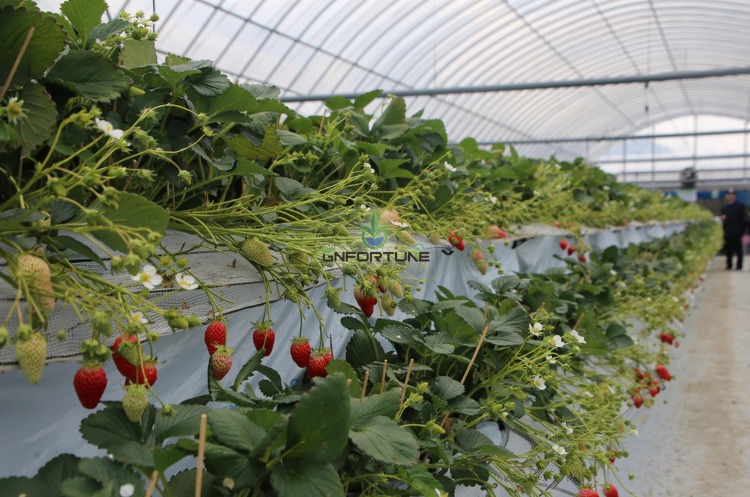
A complete set has six line groups. Ask a supplier to separate them, because bundled pricing hides what matters:
- Channels. PVC-U or PP profile in 3 m, 4 m or 6 m lengths, with end caps and an outlet per run.
- Support. A-frame steel, hanging brackets or wire hangers, plus purlin fixings.
- Substrate. Coir and perlite blends, straight perlite, or slabs in a wide trough.
- Irrigation. Drippers at 1 to 2 L/h, a manifold per tier, filtration at 120 mesh or finer.
- Drainage. Sloped runs, drain holes, a collection channel per tier, a return main.
- Dosing. Reservoir, pump, dosing unit and disinfection if the system recirculates.
Substrate and fertigation are the groups most often excluded. If a supplier quotes “gutter system” and the number looks low, check whether media, drippers and dosing are inside the scope. The strawberry gutter crop guide covers the growing side.
Gutter Profiles: Sizes, Openings and Drainage Holes
Choose a profile by media depth and replacement cycle, not by appearance. Strawberry roots want 12 to 18 cm of media above a free-draining layer; a shallow channel dries out in a summer afternoon and the plant pays for it in fruit size.
| Profile family | Typical section | Best fit | Trade-off |
|---|---|---|---|
| Wide open trough | 200 to 250 mm wide, 150 to 200 mm deep | Single or double row | Most media, heaviest wet load |
| Standard substrate channel | 150 to 180 mm wide, 120 to 150 mm deep | Single row, 20 to 25 cm spacing | Cheapest to ship; dries fast |
| Lidded or split channel | 150 to 200 mm wide, clip-on lid | Media replaced every 12 to 18 months | Lid cost; less algae |
| Deep trough for slabs | 200 by 200 mm | Slab or bag-in-gutter | Fewer media changes; heaviest |
Wall thickness for this duty is commonly 1.8 to 2.5 mm, with a UV stabiliser declared for houses under high radiation or single-layer film. Ask for ±5 mm on cut lengths, because a short run leaves the end cap seated on a gap. The same question applies to wholesale NFT channel profiles.
Drainage is where most field complaints start. Standard practice is a slope of 0.5 to 1.5 percent, drain holes of 25 to 40 mm at 0.5 to 1.0 m centres, and an outlet at the low end of every run. A 4 m run at 1 percent drops 40 mm, so frame levelling must hold tighter than that or sections pond while others run dry.
Tier Frames and Layouts: A-Frame vs Single-Row Hanging
A-frames buy plants per square metre of floor; hanging rows buy light uniformity and picking access. On a 1,000 m² block the plant count difference between a three-tier A-frame and a single hanging row is roughly two to one, and the aisle width you surrender is the price of that density.
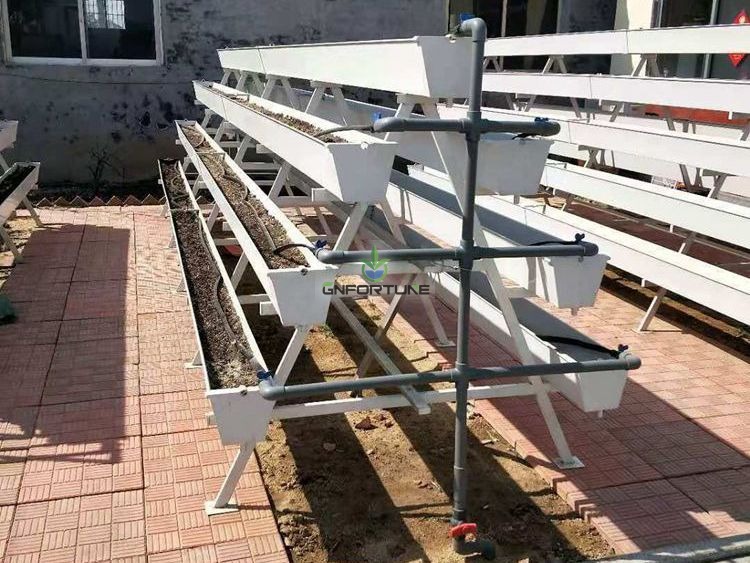
| Layout | Tiers | Plants per m² of floor | Aisle | Notes |
|---|---|---|---|---|
| Single-row hanging | 1 at 1.8 to 2.2 m | 6 to 8 | 1.0 to 1.2 m | Best light, fastest picking |
| Double-row hanging | 1 | 8 to 10 | 1.1 to 1.3 m | Compromise for low ceilings |
| A-frame, three tiers | 3 | 10 to 14 | 0.8 to 1.0 m | Lowest steel cost per plant |
| A-frame, four to five tiers | 4 to 5 | 14 to 18 | 0.9 to 1.2 m | Needs 4.5 m gutter height |
Three frame details decide whether the structure survives its second season. Wet media weighs roughly 15 to 25 kg per linear metre, so the frame and the purlins carrying it must be rated for the loaded case. Coating should be specified in writing: hot-dip galvanised steel outlasts light pre-galvanised sections in a humid house by years. The top tier should also sit within reach of a picking trolley, or daily harvest loses the labour saving.
Substrate and Pots That Match Gutters
Match the media to the channel depth rather than the other way round. Coir and perlite blends at 60:40 to 70:30 are the common choice, with a 2 to 3 cm drainage layer of coarse coir chip at the base; straight perlite drains faster and needs more frequent irrigation events.
- Media depth. 12 to 18 cm of working media above the drainage layer.
- Feed target. EC 0.8 to 1.2 mS/cm, pH 5.5 to 6.0 for most varieties.
- Runoff. 20 to 30 percent per event, checked at the low end of the run.
- Spacing. 20 to 30 cm gives 4 to 5 plants per metre, or 8 to 10 staggered.
- Planting format. Plugs or bare-root trays set into the media; net pots suit buckets, not gutters.
Yield expectations drive the investment case, so keep them honest: protected strawberry production is commonly quoted at 15 to 30 kg per square metre per cycle, and figures vary by region and season. Model the low end of that range. The crop and system matching guide covers this in more depth.
Six Checks Before You Compare Quotations
Convert every quotation into a cost per planted metre before comparing. Two suppliers quoting different units, frame coatings and fitting counts are not describing the same product, and the per-metre channel price is the least comparable number in the package.
- Unit of sale. Linear metres, planted metres or plant positions. Convert to planted metre cost, including frame length.
- Material and wall. PVC-U or PP, virgin resin, wall thickness with a tolerance, UV stabiliser in writing.
- Drain hardware. End caps, outlets, connectors and the count of each per metre. “Accessories” usually means not included.
- Frame specification. Steel grade, coating type and microns, tier count, rated load per metre.
- Scope boundaries. Who supplies media, drippers, filtration and dosing. Get exclusions in writing.
- Packing, spares, terms. Bundled or boxed, 2 to 3 percent spare caps, lead time, Incoterm, claim window.
If two quotes differ by more than about 20 percent, the cause is usually one of these six lines. Asking which line differs beats asking for a discount.
Common Buying Mistakes
The expensive mistakes in a gutter project are specification mistakes, not price mistakes.
The line item that separates two gutter quotations is rarely the channel: it is the frame coating and the drain fittings. A supplier quoting light pre-galvanised steel and loose end caps can sit 20 to 30 percent under a hot-dip galvanised frame with moulded outlets, and the gap appears as corrosion at the legs and leaking caps in season two. Ask for coating microns and fitting counts per metre in writing before any price comparison means anything.
Four further mistakes repeat across projects:
- Profile fixed before the variety. Day-neutral and short-day varieties differ in plant size and runner management, which changes spacing and tier count.
- Levelling tolerance ignored. A frame that cannot hold slope within a few millimetres per metre creates wet and dry zones in one run.
- Profiles mixed across blocks. Two profiles on one farm doubles the spares inventory and complicates reorders.
- No trial bay. A 20 to 50 m² trial exposes drainage and labour height before a container is ordered. G&N Fortune runs a 2,400 m² trial greenhouse where profile and spacing combinations can be checked.
FAQ
How many strawberry plants fit in one metre of gutter?
A: Four to five plants at 20 to 25 cm spacing in single row, eight to ten staggered. Confirm against the variety and harvest method.
What slope should a strawberry gutter run at?
A: 0.5 to 1.5 percent, roughly 5 to 15 mm of drop per metre. Steeper slopes dry the media faster; flatter slopes risk ponding.
Can one profile serve strawberry and lettuce?
A: Rarely. Strawberry needs 150 to 250 mm of width and 12 to 18 cm of media depth, while lettuce NFT channels run 50 to 100 mm wide.
Should a strawberry gutter system recirculate or drain to waste?
A: Drain-to-waste is common because it limits the spread of root disease. Recirculation works with filtration and disinfection, at higher capital and management cost.
What lead time and MOQ should a container order expect?
A: Standard profiles typically ship 15 to 30 days after deposit, longer for custom tooling. MOQ is set per profile in linear metres; G&N Fortune sets its NFT gutter MOQ at 1,000 m.
A strawberry gutter system is a long-life structure bought on a one-page quotation. Buyers who get it right specify coating, fitting counts and media scope before they ask for a number.
Get a Strawberry Gutter Package Quoted
Send four numbers with your enquiry: growing area, tier count, variety and target yield per square metre. Use the strawberry gutter equipment RFQ form for a line-by-line quote covering profile, frame coating, drain fittings and media scope.