

Agricultural Irrigation Pipe Fittings: Types and Sizing
Agricultural irrigation pipe fittings are the connectors that join, turn, branch, reduce, control, and terminate pressurized lines, and on a commercial project they are bought as a schedule rather than one at a time. That distinction matters: a fittings schedule is derived from the pipe specification, so a change in pipe standard or pressure class re-opens the whole list. Buyers who order fittings before the pipe is fixed end up with cartons of parts that do not seal. The correct sequence is pipe standard first, then size, then pressure class, then material.
What a Pipe Fitting Schedule Covers
A fitting is defined by four attributes, and a quotation missing any one of them is incomplete: nominal size (matched to pipe outer diameter, not to a trade name), pressure class, material grade, and connection standard at each end. Threaded ends are the usual trap, because BSP and NPT threads look alike, measure close, and do not seal together.
Two standards appear in most export quotations. Metric PE and PVC pipe is rated by PN number, where PN10 means a nominal working pressure of 10 bar. North American PVC is often rated by ANSI schedule instead, and the two are not interchangeable.
Fitting Types by Job
Each fitting type exists to solve one field problem. Matching the list to jobs is faster than memorizing part numbers.
- Coupler and straight connector. Joins two lengths of the same size. Compression couplers allow disassembly; fusion couplers do not.
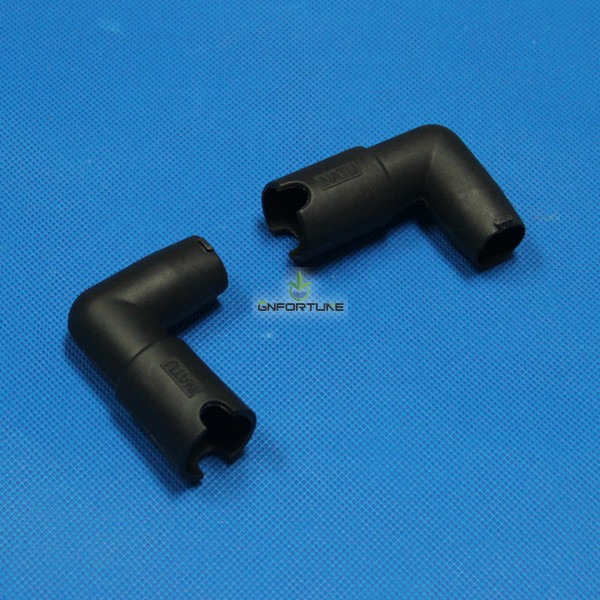
- Elbow, 90 degree and 45 degree. Changes direction. A 45 degree elbow on a mainline reduces pressure loss and surge compared with a hard 90.
- Tee and reducing tee. Creates a branch, or a branch one size smaller. Most zone take-offs are reducing tees.
- Reducer. Steps between sizes on the same run; needed whenever the mainline diameter drops.
- End cap and plug. Terminates a line and allows it to be opened for flushing. Flush caps are worth specifying rather than buying separately.
- Ball valve, butterfly valve, and check valve. Isolation and backflow control. Butterfly valves are normal above roughly 63 mm; ball valves below.
- Saddle or take-off clamp. Connects a drip lateral to a sub-main without cutting the main.
- Barbed insert fittings. The standard connection for LDPE drip laterals; the barb size must match the lateral’s inside diameter.
- Threaded adapter and union. Transition to pumps, filters, and dosing equipment, which normally arrive with threaded ports.
Pump and filter connections are where the schedule is most often short. Those components arrive with threaded ports, and the adapters, unions, and gaskets to land them are left off the list until installation week. The reservoir and pump sizing guide covers the equipment side of that interface.
Sizing by Outer Diameter and Pressure Class
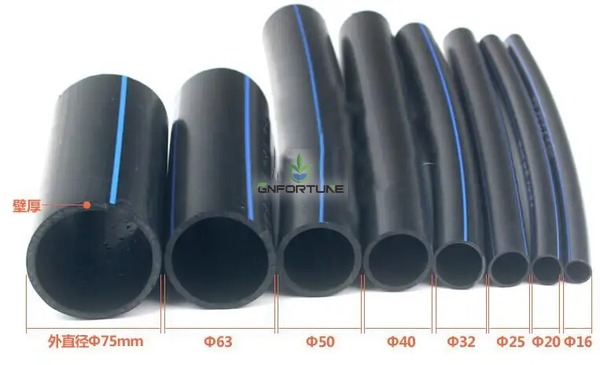
PE and PVC pipe is designated by outside diameter, so fittings are sized to OD. The table below reflects how a typical hydroponic or farm irrigation system steps down from header to lateral.
| Position in system | Typical OD | Typical wall / class | Working pressure |
|---|---|---|---|
| Header or trunk main | 90 to 160 mm | PN10 to PN16 | 4 to 8 bar |
| Zone mainline | 63 to 90 mm | PN10 to PN16 | 4 to 8 bar |
| Sub-main to blocks | 40 to 63 mm | PN6 to PN10 | 3 to 6 bar |
| Manifold to rows | 25 to 40 mm | PN6 to PN10 | 2 to 5 bar |
| Drip lateral | 16 to 20 mm | Thin-wall LDPE | 1 to 3 bar |
| Suction and pump connections | Matched to port | Full-bore fitting, no restriction | Suction side is negative pressure |
Two rules keep the schedule honest. First, never let a fitting be the lowest-rated component in a zone: a PN6 coupler on a PN10 line becomes the failure point at the first surge. Second, the suction side of a pump is a different problem from the discharge side — it runs below atmospheric pressure, so any restriction or air leak there shows up as cavitation and lost flow rather than as a leak.
Pipe and fitting standards are set together, and the farm irrigation pipe guide explains how wall thickness and pressure class interact before the fittings list is written.
Material Choice: HDPE, uPVC, or PP Compression
Material is decided by joining method and by what the water carries. Fertilizer solution, acid dosing, and oxidizing disinfectants all narrow the choices, mainly through gasket compatibility.
| Material | Joining method | Where it is used | Watch for |
|---|---|---|---|
| HDPE (PE80 or PE100) | Butt fusion, electrofusion, or compression | Mainlines and sub-mains outdoors | Fusion needs trained operators and power on site; specify carbon black for UV stability |
| uPVC | Solvent weld, threaded, or flanged | Zone mains, manifolds, indoor runs | Brittle in cold handling and under impact; solvent cure time slows installation |
| PP compression fittings | Hand-tightened compression on PE | Sub-mains, manifolds, repairs | Cheapest to install and to change; more joints means more potential leak points |
| Barbed fittings (PP or acetal) | Push into LDPE lateral | Drip laterals and emitter connections | Barb size must match lateral ID; clamp where pressure exceeds about 2 bar |
| Brass or stainless threaded | Threaded, with sealant | Pumps, filters, dosing units | Confirm alloy compatibility with fertilizer and acid before specifying |
Gaskets are a separate line item and a common source of early leaks. EPDM suits most fertilizer solutions; NBR suits oily or hydrocarbon exposure. A quotation that lists valves without stating gasket material has not been fully specified.
Ordering Checklist for Project Buyers
Before a fittings order is released, confirm the following in writing. Each line prevents a specific failure that appears after the container lands.
- Pipe standard, OD, and material grade — PE80 or PE100, PVC-U, and the exact OD in millimetres.
- Pressure class of every fitting, matched to or above the pipe class on that line.
- Thread standard — BSP or NPT, stated per end. Mixed threads are the single most common installation-week problem.
- Gasket and seal material, checked against fertilizer, acid, and disinfectant exposure.
- UV stabilization for anything exposed, normally carbon black in PE.
- Quantity with allowance — 5 to 10 percent spare for small sizes, because a missing 25 mm tee stops a row.
- Packaging and labelling by size and type, so the installation crew is not sorting mixed cartons on site.
- Approved sample and pre-shipment inspection for bulk orders, with dimensional checks against the pipe actually being used.
- Lead time, minimum order quantity, and container loading confirmed together, since small fittings consolidate well and large fittings do not.
Ordering fittings alongside pipe and valves from one supplier reduces the mismatches described above. The irrigation systems range keeps pipe, fittings, and valves on a single specification.
Common Failure Points in the Field
What a fittings quotation tells you about the supplier: a serious exporter lists size, pressure class, material grade, and thread standard on every line. A quotation that says only “PE fittings, assorted” is not a specification — it is an invitation to discover on installation day that half the carton does not fit the pipe. Insist on line-by-line detail before comparing prices.
Three failure modes account for most warranty claims on irrigation fittings, and all three are specification problems rather than manufacturing defects.
- Thread mismatch. BSP and NPT differ in thread angle and pitch. Forced together they seal briefly, then weep under pressure cycling.
- Rating mismatch. A fitting one class below the pipe fails at the first water hammer event, usually at pump start or at fast valve closing.
- Chemical attack on seals. Acid and chlorine dosing at maintenance concentrations degrades the wrong gasket material within a season, and the leak appears at the joint, not at the seal face.
Pressure testing before backfilling or before closing ceilings is the cheapest control. A zone held at working pressure for 30 minutes with no drop finds every one of these problems while parts are still accessible. That test belongs in the purchase terms for every agricultural irrigation pipe fittings order.
FAQ
Are PE and PVC fittings interchangeable?
A: No. They differ in sizing basis, joining method, and pressure rating. Transitions between the two need a purpose-made adapter, identified on the drawing.
What does PN10 on a fitting mean?
A: A nominal working pressure of 10 bar at the reference temperature for that material standard. Ratings fall as water temperature rises, so hot-water or steam-cleaned lines need a higher class.
How many spare fittings should a project order?
A: Typically 5 to 10 percent extra on small sizes and one spare of each valve. Missing connectors block installation, and small parts are rarely worth a second shipment.
Do compression fittings need tools?
A: Most PP compression fittings tighten by hand, with a strap wrench for larger sizes. Over-tightening deforms the seal.
Which is better for a drip manifold, compression or barbed?
A: Compression suits rigid sub-mains and manifolds where lines may be reconfigured; barbed suits LDPE laterals. Both are standard, and the choice follows the pipe, not the price.
Get a Fittings Schedule and Quotation
Send pipe sizes, pressure class, materials, and thread standard through the irrigation fittings quotation form and the export team will return a line-by-line fittings schedule matched to that pipe specification, with packaging and loading noted.