

What a Deep Water Culture Raft System Actually Is
A deep water culture raft system is a lined, insulated pond holding 150 to 200 mm of nutrient solution, with rigid foam boards floating on the surface and seedlings held in net pots through holes cut in the boards. Roots hang in the solution permanently. There is no media, no drip line per plant and no drain cycle — the entire crop shares one body of water, which is the reason a raft bed is forgiving of pump failures and unforgiving of temperature and disease mistakes. The design work is mostly structural and thermal, not plumbing.
Scale changes the engineering. A hobby tote holds 40 litres and stabilises itself by volume; a commercial bed holds 2 to 20 m³ and behaves like a small reservoir, so depth, insulation, flow path and aeration have to be designed rather than assumed. Crop choice also narrows: lettuce, basil, pak choi and some Asian greens suit rafts, while long-cycle or fruiting crops do not. The crop and system matching guide lays out that split.
Bed Depth, Length and Board Spacing
The numbers, in order of how much they cost to get wrong: solution depth 150 to 200 mm, bed length 10 to 30 m per run, bed width in multiples of the board width (usually 1.2 m), plant spacing 150 to 200 mm on the board, and working height 0.6 to 0.9 m for raised frames. Depth is the one buyers under-specify, because shallow beds look cheaper until the first hot week.
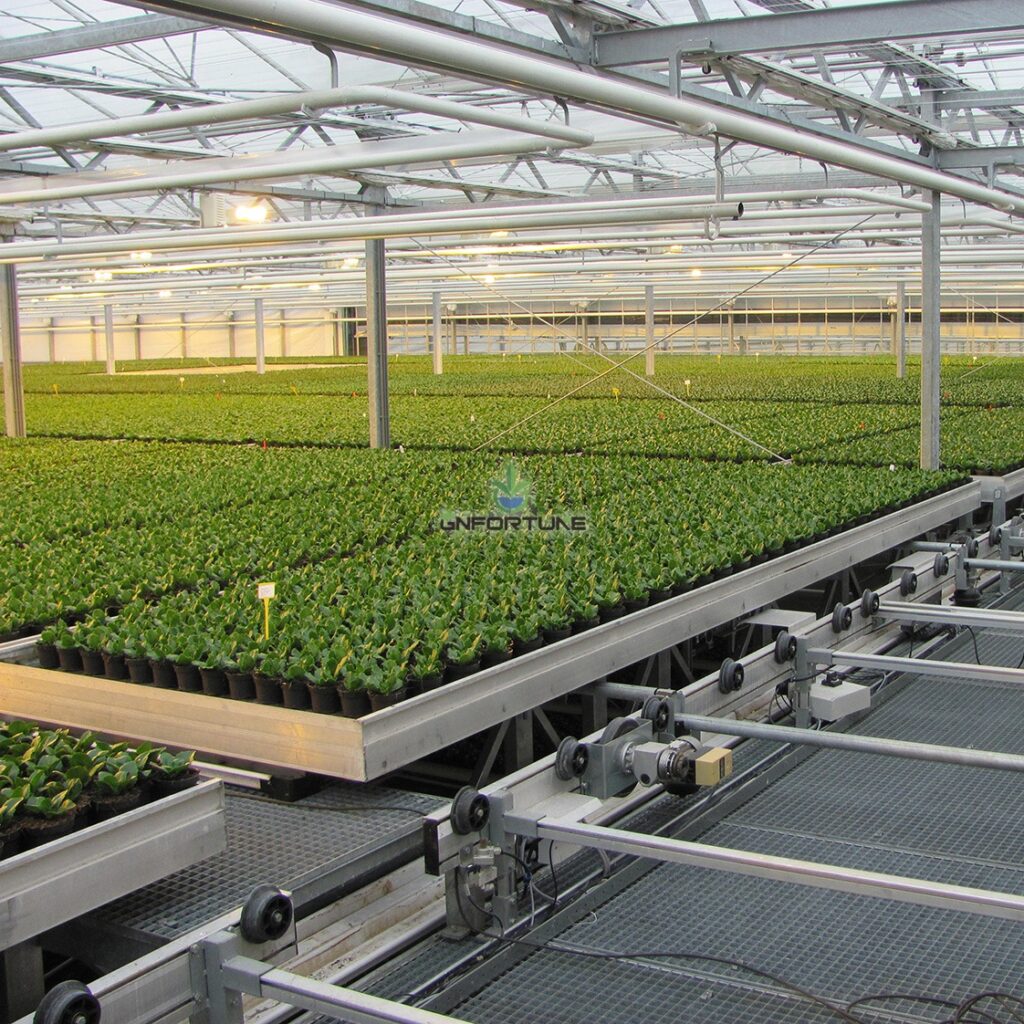
| Parameter | Typical range | Why it matters | Where it fails |
|---|---|---|---|
| Solution depth | 150 to 200 mm | Sets thermal mass and root-zone buffer | Under 120 mm the bed swings 3 to 5 degrees C daily |
| Bed length | 10 to 30 m per run | One flow path per run | Over 30 m the inlet-to-outlet DO gradient widens |
| Bed width | 1.2 to 1.5 m | Boards must be reachable from an aisle | Wider beds force reaching over planted boards |
| Board size | 1.2 x 0.6 m, 30 to 50 mm thick | Rigidity and reuse life | Thin boards sag and drown the plug |
| Plant spacing | 150 to 200 mm square, 20 to 30 plants per m² | Head size versus count | Tighter than 150 mm gives small heads |
| Working height | 0.6 to 0.9 m raised | Transplant and harvest ergonomics | Low beds raise labour time per board |
Boards are the consumable nobody budgets for correctly. A 1.2 x 0.6 m board at 180 mm spacing carries about 20 plants and is moved by hand several times per cycle, from seeding to germination to bed to harvest. Extruded polystyrene with a sealed skin survives repeated washing; expanded bead board is cheaper and breaks at the edges within two seasons.
Insulation, Walls and Liner Choices
Answer first: the wall and liner decision is a temperature decision, not a containment decision. Any liner holds water; only an insulated wall holds the root zone at 18 to 22 degrees C through a summer afternoon. Specify 30 to 50 mm of closed-cell insulation under and around the liner, a light-reflecting white top surface, and a liner thick enough to survive being walked on during cleaning.
| Element | Common options | Trade-off | Fits |
|---|---|---|---|
| Wall structure | Concrete block, insulated sandwich panel, timber frame | Block is durable and slow to build; panels are fast and cost more | New houses: block or panel. Retrofits: framed |
| Liner | 0.5 to 0.8 mm food-grade PVC, 1.0 mm EPDM | PVC welds easily and is cheaper; EPDM handles UV better | Outdoor: EPDM. Indoor: PVC |
| Insulation | 30 to 50 mm XPS or EPS under the liner | XPS resists water uptake; EPS costs less | Any bed on a slab that sees sun or hot air |
| Surface colour | White or black-on-white laminate | White reflects radiation; black absorbs it | Hot climates: white |
| Board coverage | Full coverage, no open water strips | Open water grows algae and loses heat | All beds |
Two details decide service life. The liner must be loose-laid over a smooth, debris-free substrate — one screw left in a frame becomes a leak by month three. And the liner top edge has to be mechanically fixed above the maximum water line, not glued at water level, because solution level moves with crop load.
Flow, Aeration and DO Targets
Flow has two jobs in a raft bed: keep the whole water body chemically uniform, and keep dissolved oxygen at 5 to 8 mg/L at every point in the bed. Neither is achieved by a single inlet at one end of a 25 m run.
Worked example: a bed 20 m long, 1.2 m wide and 180 mm deep holds about 4.3 m³. Turning that volume over every 1.5 to 2 hours means an inlet flow near 2.2 to 2.9 m³/h, delivered at two or three points along the run with the return at the opposite end so the water sweeps lengthwise. Aeration is separate from circulation: a blower sized at roughly 0.5 to 1.0 L/min per plant, or about 1 m of diffuser hose per 2 to 3 m² of surface, holds DO in band at the far end as well as near the inlet.
Temperature and oxygen interact, so measure both. Warm water holds less oxygen: a bed at 24 degrees C needs noticeably more air than the same bed at 19 degrees C for the same DO. Above roughly 24 degrees C most commercial sites add chilling rather than blower capacity, because extra air cannot compensate for warm water, and warm water is what invites Pythium. The root-zone temperature and dissolved oxygen guide covers that relationship.
DWC vs NFT for Lettuce Economics
Answer first: choose rafts where labour predictability and outage tolerance matter more than capital cost and floor-to-floor flexibility; choose NFT where the building is height-constrained, the crop cycle is short, and the power supply is reliable. Both produce marketable lettuce; the difference shows up in the risk profile and in how fast a mistake spreads.
| Factor | Raft beds (DWC) | NFT channels |
|---|---|---|
| Water volume per hectare | High: several hundred cubic metres | Low: a fraction of that |
| Behaviour on pump failure | Buffer of hours at 150 to 200 mm depth | Roots start drying within 30 to 60 minutes |
| Temperature stability | Strong thermal mass, slower to swing | Thin film follows air temperature quickly |
| Disease spread | One water body: a pathogen reaches every plant | Faster to isolate a run, slower to treat a shared tank |
| Structure and floor | Heavy; needs a slab rated for the load | Light; suits racks and multi-tier layouts |
| Labour pattern | Batch moves of whole boards | Continuous handling of single channels |
The NFT and DWC comparison goes deeper on the operating side, and the lettuce production guide covers channel growing for the same crop. Raft beds are a single-level, floor-area technology; for tall buildings the horizontal and A-type layout comparison is the better read.
Field Problems With Poorly Built Beds
The failure mode we keep meeting is a bed built shallow and insulated thin, then blamed on the chiller. A 100 mm bed on an uninsulated slab gains 4 to 6 degrees C between morning and mid-afternoon, dissolved oxygen falls out of band by the afternoon, and the crop shows root browning that looks like disease. Adding a chiller treats the symptom. The design fix was 180 mm of depth plus 40 mm of closed-cell insulation, and it costs far less than the refrigeration plant specified later.
The second problem is the unmeasured far end. Readings taken at the inlet look fine all season while the last 5 m of the bed runs depleted, and the symptom is a size gradient that survives to the packing line. Sample at inlet and outlet, at the hottest hour, and log both.
FAQ
How deep should a commercial DWC raft bed be?
A: 150 to 200 mm of solution. Below roughly 120 mm the water body loses the thermal mass that keeps root-zone temperature stable through the day.
How many lettuce plants fit in one raft board?
A: A 1.2 x 0.6 m board at 180 mm square spacing carries about 20 plants, or 20 to 30 plants per square metre of bed surface.
What dissolved oxygen level should a raft bed hold?
A: 5 to 8 mg/L at both the inlet and the outlet. Warm water holds less oxygen, so above about 24 degrees C most farms add chilling rather than more air.
Do raft beds need a chiller?
A: In most warm climates yes, once ambient pushes the solution past roughly 24 degrees C. Insulation and depth reduce the chiller capacity needed, and delay the point where one is required.
Is DWC cheaper to build than NFT for lettuce?
A: Rarely. Raft beds cost more in structure, water volume and chilling, and buy outage tolerance, temperature stability and batch labour instead. Figures vary by region and season.
Get a Raft Bed Design for Your Lettuce Project
A deep water culture raft system is a structural and thermal decision before it is a plumbing decision: depth, insulation, board size, flow path and aeration have to be sized together or the bed will be corrected later with equipment that costs more than the bed. Send your building dimensions, target plant count, climate data and water analysis through the raft bed design and quote request and the engineering team will return bed dimensions, board layout, aeration and chilling capacity, and a flow path for your site.