

Agricultural irrigation equipment for a commercial greenhouse is a chain, not a machine: it moves water from a reservoir to the root of every plant, in the right amount, at the right time. A pump pushes, a filter protects, valves divide, fertigation feeds, drip lines deliver, and a controller decides. Bought in the right order, the chain expands zone by zone; bought piecemeal, the weakest component gets replaced every season. This guide maps the tank-to-dripper chain, separates what a new farm needs from what can wait, and sets a per-hectare budget framework.
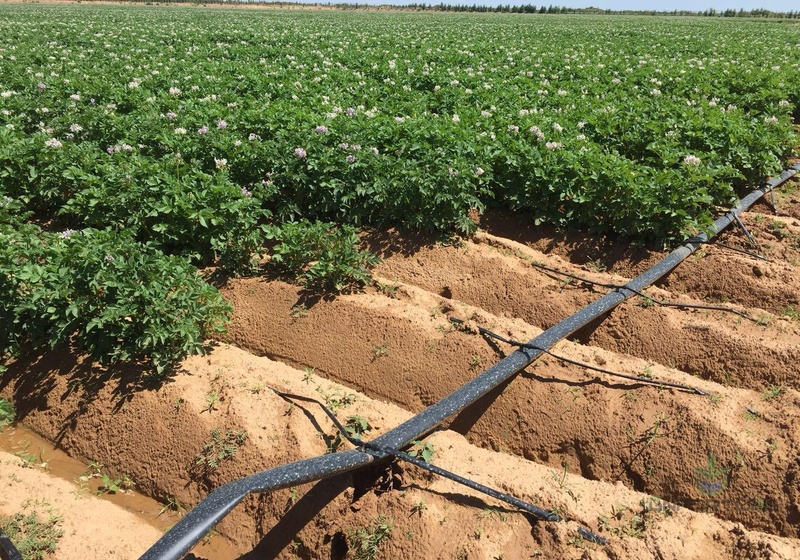
Drip irrigation tape network laid out in a field cropThe Irrigation System from Tank to Dripper
Every layout, from a 500 m² nursery to a multi-hectare greenhouse, follows the same water path. Understanding it first makes the equipment list obvious:
| Stage | Component | Job | Buying note |
|---|---|---|---|
| 1. Source | Reservoir or tank | Holds water and nutrient solution | Size for at least one day of peak crop demand |
| 2. Pump | Centrifugal or turbine | Delivers flow at the needed pressure | Match to flow and head; oversizing wastes power |
| 3. Protection | Filters | Stop particles clogging emitters | Screen/disc for clean water; sand filter for ponds and algae |
| 4. Division | Mainline, submains, zone valves | Split water by crop zone | Let each crop stage run its own schedule |
| 5. Fertigation | Injector or dosing pump | Add nutrients proportionally | Venturi is cheap; dosing pumps hold accuracy |
| 6. Delivery | Drip lines, tape, emitters | Put water at the plant base | Match spacing and flow to crop and row length |
| 7. Control | Timer or controller | Runs cycles automatically | Start simple; automate as crop value justifies it |
This list is also the fastest way to scope a whole project — our turnkey greenhouse solutions bundle the irrigation chain with the structure. Remember that the chain fails at its weakest point: an excellent pump behind an undersized filter still ends in clogged drippers.
Core Equipment: Pumps, Filters, Fertigation, and Control
Pumps. Greenhouse pumps are selected on flow and head, not horsepower. Calculate the flow across all zones and the pressure needed at the farthest dripper, then add 10–15% margin. A pump pinned to the top of its curve all season fails early; a badly oversized one wastes power you then regulate away.
Filters. The filter is cheaper than the emitters it protects and is the first thing buyers under-spec. Screen and disc filters handle clean borehole or municipal water; surface water with algae or silt needs a sand filter. Fit pressure gauges on both sides — a growing differential tells you when to clean before flow drops.
Fertigation. Injection runs from a simple venturi drawing from a concentrate tank to a dosing pump governed by EC and pH probes. A venturi with manual checks is a defensible year-one choice; multiple zones and different crops justify EC/pH-controlled fertigation for consistency. Ready-made configurations are listed on our irrigation systems page.
Control. Control grows from a per-zone timer into full greenhouse automation — EC/pH control, drain monitoring, and climate-linked scheduling. Buy the controller that matches your longest cycle, not the five-year feature list.
Drip Lines, Drip Tape, and Emitters for Greenhouse Rows
The delivery layer is where irrigation equipment becomes crop-specific. Row length, slope, and container type decide the choice:
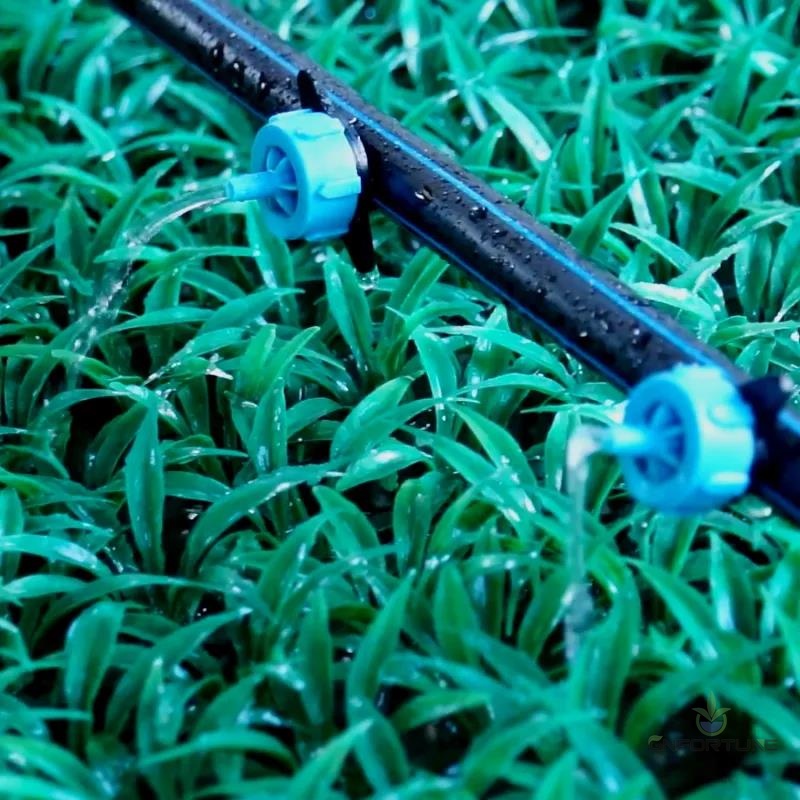
Pressure-compensating drip emitter watering plants in a greenhouse- Pressure-compensating (PC) drip line holds the same flow across long rows and gentle slopes; it is the standard where rows run 30 m or longer.
- Non-PC drip line is cheaper and fine on short, level runs, but flow falls off along the row as pressure drops.
- Drip tape is thin-wall, low-cost, and usually treated as a single-season product — in a permanent greenhouse, proper PE drip line wins on cost per season.
- Button and outlet emitters feed pots and buckets, typically two outlets per plant — the delivery method for drip-irrigated Dutch bucket growing.
Greenhouse drip systems generally run emitters at 1–4 L/h with inline spacing of 20–50 cm matched to the crop. The term drip irrigation equipment covers emitters, line, connectors, and the filters upstream that keep them clear — buy them as a matched set from one spec so the flow math holds across the zone.
| Delivery option | Typical use | Life | Trade-off |
|---|---|---|---|
| PC drip line (16 mm) | Long rows, slopes, permanent greenhouses | Several seasons with flushing | Higher cost per meter, even flow |
| Non-PC drip line | Short level rows | Several seasons | Low cost; flow falls off along the row |
| Drip tape | Field rows, seasonal crops | 1 season typical | Cheapest; replace each cycle |
| Button/outlet emitters | Pots, Dutch buckets, containers | Years with cleaning | Per-plant delivery; labor to place |
Pipes decide pressure loss across the site. Submain sizing and pipe material choices are covered in our farm irrigation pipes guide.
What You Can Skip When You Start
New-farm budgets carry items that look essential on paper but do not earn their keep in year one. Common deferrals:
- Per-zone EC/pH automation. One fertigation unit and a manual testing routine can carry a single crop through its first season; add automatic correction when zones multiply.
- A sensor network before you understand your drain. First learn what the crop does on a simple timer with regular drain checks; automation layered on an unproven schedule automates the wrong answer.
- Sand filters for clean water. If the source is borehole or treated municipal water, a screen or disc filter at the right micron rating is enough; upgrade when algae becomes real.
- Remote monitoring in season one. Start with a controller you can read on site; add remote access once the operation runs reliably.
The budgeting rule we repeat on every project: spend year-one money on the parts that touch every plant — pump reliability, filtration, and even drip delivery — and defer the parts that only touch the data. Farms lose money from uneven water delivery, not from missing graphs.
If the greenhouse structure is still being planned, design irrigation with it: drain slopes and pipe runs are cheaper on paper than in concrete. Run the system design process before ordering hardware.
Agricultural Irrigation Equipment: Budget per Hectare
Cost per hectare is the honest basis for comparing options, because quotes differ in automation level and pipe quality. Indicative ranges for a commercial greenhouse — reservoir, pump, filter, mains, fertigation, delivery, and control — vary with region, water source, and row configuration:
| Setup level | What it includes | Indicative range per hectare |
|---|---|---|
| Essential | Pump, filter, mains, manual valve zones, drip lines, simple timer, manual fertigation | ≈ $8k–$15k |
| Standard | Automated zone valves, proportional fertigation, EC/pH control, PC drip line | ≈ $15k–$30k |
| Advanced | Full automation, drain monitoring, climate-linked scheduling, remote access | ≈ $30k–$60k |
Treat these as budgeting ranges, not quotes — equipment, freight, and installation vary by region and season. Run the numbers against crop revenue in the hydroponic farm ROI guide before setting the level; in most new projects the bottleneck is utilization, not the pump.
FAQ
What irrigation equipment do I need to start a commercial greenhouse?
A: The minimum working chain is a reservoir, pump, filter, mainline and zone valves, drip lines or emitters, and a timer. Add fertigation and EC/pH control as the crop program demands it.
Do I need pressure-compensating emitters?
A: If rows run 30 m or longer, or the site has any slope, yes — PC emitters hold flow across the row. On short, level runs, cheaper non-PC line performs well.
Can I use municipal water directly?
A: Yes, with filtration and dechlorination if needed. Fit a filter rated below the emitter opening, and check pH, EC, and chlorine before the first season.
Should I use drip tape or drip line in a greenhouse?
A: In a permanent greenhouse, PE drip line lasts several seasons and usually wins on cost per season. Drip tape suits field rows and crops where re-laying each cycle is acceptable.
How much water does a hectare need per day?
A: It varies with crop, stage, and climate — a mature crop can use tens of cubic meters per hectare per day in peak summer, far less in winter. Size reservoir and pump for peak demand, then schedule from measured drain.
Send Your Greenhouse Layout for an Irrigation Equipment List
Once your layout, water source, crop plan, and agricultural irrigation equipment scope are fixed, send your greenhouse layout for an irrigation equipment list through the quote form — include row or bench spacing and your automation level, and we will return a tank-to-dripper equipment list with pump sizing, filtration, valve zoning, and delivery lines priced for year one.