

A new commercial hydroponic project almost always starts with the same question: which structure do we build it under? The four options buyers weigh are a glass greenhouse, a multi-span arch house, a high tunnel, and a simple polytunnel. They are not interchangeable — each sets a different ceiling on climate control, capital cost, and the crops you can run. This guide lines them up so the structure you choose matches the crop, the climate, and the payback you plan for.
What Each Structure Actually Is
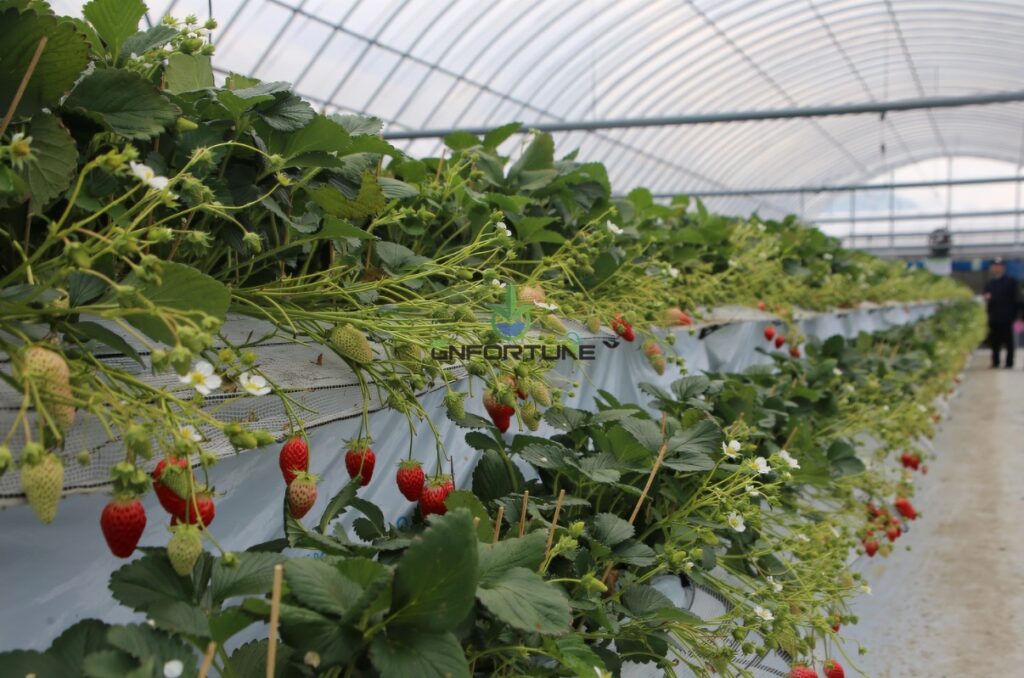
Arched poly greenhouse interior showing crops, structure and roof ventilationThe terms get used loosely, and that confusion costs real money. Before any cost comparison, lock the definitions:
- Glass greenhouse: a permanent galvanized steel frame, glazed with tempered or float glass, on a concrete foundation. Built for year-round production with full HVAC, supplemental lighting, and CO₂ enrichment. The long-life end of the spectrum.
- Multi-span arch greenhouse: a multi-bay steel frame with arched or A-frame roofs, covered with double-layer inflated film or 8–16 mm polycarbonate (PC) sheets. The default mid-range commercial structure in most hydroponic turnkey projects.
- High tunnel: a single-span Quonset- or gothic-arch steel tube frame covered with single or double polyethylene film. No foundation, no HVAC, mostly natural ventilation through roll-up sidewalls and end doors.
- Simple polytunnel (low tunnel / hoop house): small-diameter pipe hoops, single film, low headroom. Used for season extension, hardening-off, and propagation, not full-cycle production.
On site we often see buyers order a “greenhouse” and receive a high tunnel. The frame weight, foundation, covering, and equipment allowances are not cosmetic differences — they change the load rating, the wind and snow rating, the equipment you can hang, and what the local authority will permit. Lock the spec on paper before you lock the price.
Construction Cost per Square Meter
Cost per square meter is the most useful unit for an initial comparison, but only when each line includes the same scope: frame, covering, foundation, doors, and base ventilation. Ranges below reflect 2024–2026 commercial turnkey quotes for covered footprint only — HVAC, benches, and hydroponic systems are quoted separately.
| Structure | Typical cost (USD/m², 2024–2026) | Main cost drivers |
|---|---|---|
| Glass greenhouse | 80–150 | Aluminum/steel frame, tempered glass, concrete foundation, gutters, sealants |
| Multi-span arch (PC or inflated film) | 45–80 | Steel frame density, PC sheet thickness, foundation type, roof vents |
| High tunnel (single-span, film) | 15–35 | Tube gauge, ground anchors vs base plates, single vs double film, roll-up sides |
| Simple polytunnel (low tunnel) | 5–15 | Pipe diameter, film grade, end-wall construction, none to minimal framing |
Two cost facts that move the headline number a lot: site preparation and foundation can add 5–15 USD/m² on sloped or soft ground, and wind and snow ratings are not free — a 0.5 kN/m² snow upgrade on a multi-span house can add 8–12% to the steel weight alone. Ask for the rated load on the quotation, not on the brochure.
Lifespan, Covering Cycles, and Maintenance
Structure life and covering life are two different numbers, and buyers confuse them every season. The frame may run for 20 years; the plastic skin is a recurring cost on a 3–7 year cycle. Plan depreciation against the covering cycle, not the frame.
| Structure | Frame life | Covering life | Annual maintenance hot spots |
|---|---|---|---|
| Glass greenhouse | 20+ years (galvanized steel) | 20+ years (glass; broken panes are spot-replaced) | Sealant re-pointing every 8–10 years, glass breakage, gutter cleaning |
| Multi-span arch (PC sheets) | 15–20 years | 10–15 years (PC), 7–10 years (double inflated film) | PC yellowing and impact damage, film inflation fan replacement, foundation bolts |
| High tunnel (single-span, film) | 10–15 years (heavy-gauge tube) | 3–5 years (single film), 4–7 years (double film with proper inflation) | Film replacement, zipper and roll-up side wear, anchor re-tensioning after wind |
| Simple polytunnel (low tunnel) | 3–5 years (light pipe) | 1–2 years (thin film) | Frequent re-covering, hoop straightening after snow, end-wall plastic |
The big-ticket write-off is the covering. A high tunnel at 25 USD/m² with film replaced every four years carries an effective covering depreciation of about 6 USD/m² per year — before labor. Run that number before you fall in love with the cheapest frame.
Climate Control Capability
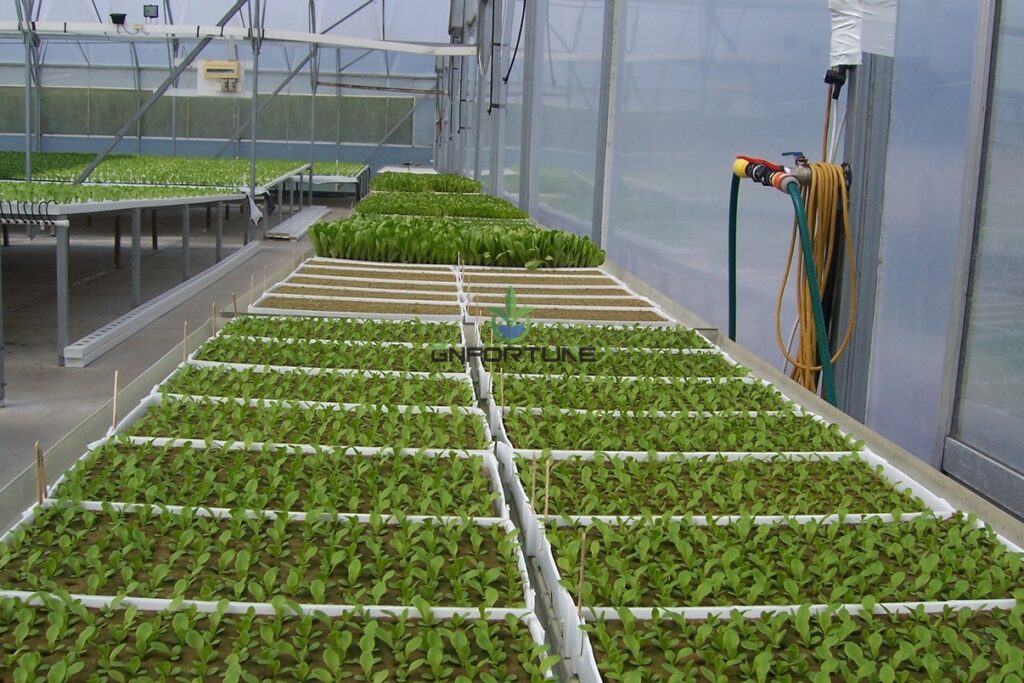
Venlo glass greenhouse interior with high-end climate control infrastructureThis is the section that decides what you can grow. Each structure has a hard ceiling on the equipment you can hang, the air you can move, and the precision you can hold through the year.
| Structure | Temperature control | Humidity control | Lighting / CO₂ | Best climate region |
|---|---|---|---|---|
| Glass greenhouse | Full heating + cooling, year-round setpoints | Integrated dehumidification possible | Full supplemental LED/HPS + sealed CO₂ enrichment | Cold to temperate climates (Northern Europe, North America, North Asia); also Middle East with full HVAC |
| Multi-span arch | Heating + pad-and-fan or fog cooling; good summer performance | Ventilation-driven, moderate dehumidification | Supplemental LED feasible; CO₂ enrichment with care for venting | Temperate, Mediterranean, subtropical highland; most of the global hydroponic footprint |
| High tunnel | Passive: roll-up sides, end doors; optional low-wattage heaters | Ventilation only; humidity tracks outside air | Not practical to hang heavy lighting or run sealed CO₂ | Temperate shoulder seasons; semi-arid; mild-winter production |
| Simple polytunnel | Solar gain only; 1–3°C buffer above ambient | Saturates fast; condensation common | None practical | Warm climates only; propagation, hardening-off, short-cycle leafy greens |
If the crop plan includes a winter production cycle in a cold climate, a glass or multi-arch house with proper heating is the only honest answer. A high tunnel in a cold winter holds a few degrees above ambient at best and burns through film faster under snow load. The capex you save on structure you pay back in lost weeks of production. For matching structure to local climate, the greenhouse cooling guide covers tropical and Middle East sites, and the ventilation design guide shows how much air you can move in each class.
Which Structure for Which Project
The right structure follows the crop plan and the climate, not the other way around. A short decision tree from the projects we engineer:
- Propagation and nursery (seedlings, cuttings, young plants): simple polytunnel or low-cost high tunnel. Short cycle, low margin per square meter, mobility matters more than precision.
- Year-round leafy greens (lettuce, herbs, salad mixes) in a temperate climate: multi-span arch with inflated film, pad-and-fan cooling, optional LED. The default mid-budget answer.
- Tomatoes, cucumbers, peppers, strawberries in a temperate or Mediterranean climate: multi-span arch with PC or glass roof, full ventilation, full heating, supplemental lighting in winter.
- Year-round fruiting crops in a cold climate (Northern Europe, Canada, North China): glass greenhouse with full HVAC, supplemental lighting, and CO₂ enrichment. Only the glass envelope carries the equipment load year-round.
- Hot, arid climates (Middle East, North Africa, inland Australia): glass or multi-arch with full HVAC and pad-and-fan cooling. High tunnels overheat in these conditions and become unusable through summer.
- Research or trial runs: glass greenhouse for full environmental control; nothing else gives repeatable trial data.
The mistake we fix on site most often: a buyer built a high tunnel because the capex was attractive, then tried to add fans, screens, and lights to it. The frame is not rated for the load, the foundation is not in the right place, and the ventilation is half what the crop needs. The retrofit ends up costing more than a properly sized multi-span house would have cost on day one. Match the structure to the equipment list, not the other way around.
ROI: Revenue vs Depreciation
Payback is a function of three numbers: annual revenue per square meter, annual operating cost, and annual depreciation. The structure decision drives all three, and the cheapest frame is rarely the cheapest annual cost. A worked comparison for a 1,000 m² leafy-greens operation in a temperate climate, year-round production, 12 crops per year:
| Structure | Capex (USD/m²) | Depreciation / year (USD/m²) | Revenue / year (USD/m²) | Note |
|---|---|---|---|---|
| Glass greenhouse | ~120 | ~14 (frame + HVAC) | 90–140 | Highest capex and revenue ceiling |
| Multi-span arch (PC, HVAC) | ~70 | ~14 (frame + HVAC + film) | 70–110 | Best balance for most projects |
| High tunnel (no HVAC) | ~25 | ~7.5 (frame + film) | 35–60 (seasonal) | Lowest cost, climate-limited |
| Simple polytunnel | ~10 | ~6 (frame + film) | 15–30 (seasonal) | Propagation or season extension |
Note that on a per-square-meter basis the glass and multi-span houses carry a similar annual cost, but the glass house unlocks winter production at higher revenue. The high tunnel looks attractive on capex but pays back only when its seasonal limits match the market you are selling into. Work the numbers through our hydroponic farm ROI guide, and for whole-site buildout the turnkey greenhouse project page describes how structure, HVAC, and hydroponic system are quoted together. If a structure is already in mind, the commercial hydroponic systems catalog lists the equipment that fits inside each class.
FAQ
Is a high tunnel a greenhouse?
A: In everyday language, yes. In commercial hydroponic specification, no — a high tunnel has no permanent foundation, no integrated HVAC, and no engineered equipment load rating. The two are quoted, permitted, and depreciated differently.
What is the cheapest structure for year-round hydroponic production?
A: A multi-span arch greenhouse with double-layer inflated film and basic pad-and-fan cooling. Below that, you give up either the season (high tunnel) or the climate control (polytunnel) needed to run 12 crops a year.
How long does greenhouse plastic last?
A: A standard single polyethylene film lasts 3–5 years; an inflated double film with proper maintenance runs 4–7 years; an 8 mm twin-wall PC sheet runs 10–15 years. UV-stabilized films outlast off-brand film in the same climate.
What structure should I buy for a research or trial facility?
A: A glass greenhouse with full HVAC. Repeatable trial data needs repeatable climate, and the glass envelope is the only one that holds a setpoint through cold winters, hot summers, and high-light shoulder seasons.
Get a Structure Recommendation for Your Climate and Crop
Send your location, target crop list, and target production weeks per year through the quote form, and our team will return a structure recommendation with per-square-meter pricing, equipment list, and depreciation schedule. The same wholesale and shipping terms apply whether you need a 500 m² high tunnel or a 10,000 m² glass greenhouse.