

Greenhouse ventilation is the silent backbone of every hydroponic greenhouse. It controls temperature, humidity, CO₂ recovery, and disease pressure — four variables that decide whether a crop finishes strong or breaks down mid-cycle. A common mistake is to treat ventilation as “an open window when it gets hot,” but a real design means choosing vent area, fan capacity, and horizontal airflow layout so the climate stays uniform from the first row to the last. This guide walks through the engineering numbers that commercial projects use, not the simplified figures that fit on a poster.
Why Ventilation Is More Than “Open the Window”
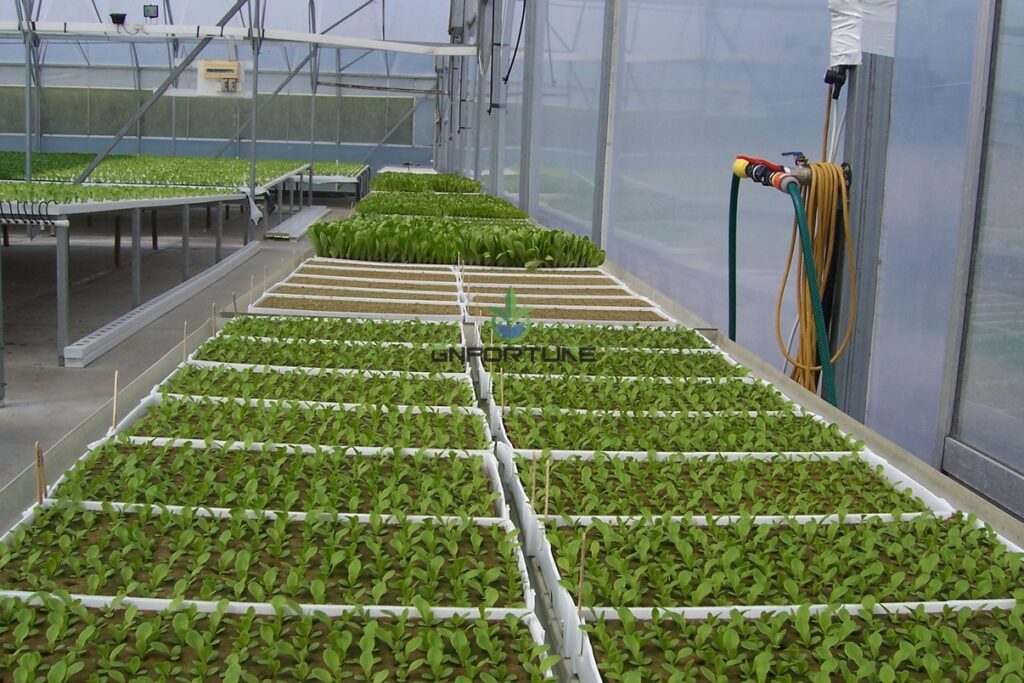
Large commercial greenhouse with rolling benches and continuous roof vent bandA ventilation system does four jobs at once. Treat them as one coupled problem:
- Temperature control. full sun can push a closed greenhouse 8–12°C above outside air in under an hour; ventilation pulls that heat out before it stresses the canopy.
- Humidity control. a full tomato canopy can push relative humidity above 85% at night; without airflow that humidity condenses on leaves and opens the door to botrytis and powdery mildew.
- CO₂ management. enrichment is wasted the moment fresh air rushes in, so ventilation rate and CO₂ injection must be coordinated. In sealed greenhouses, ventilation is the only way to drop CO₂ back to ambient during cooler hours.
- Uniform climate. hot and cold pockets translate directly into uneven ripening, uneven EC uptake, and inconsistent fruit size.
We size for the worst hour of the year, usually the hottest summer afternoon, and check the system against that case. If it performs in July, it underperforms in winter, which gets a separate chapter further down.
Roof Vents vs Side Vents: Vent Area to Floor Ratio
The first number on any greenhouse ventilation layout is the vent area to floor ratio. For a hydroponic greenhouse using natural and mechanical ventilation together, 20–25% of the floor area is the working range. Lower than that and you cannot move enough air on the hottest afternoons; higher than that and you spend on vents that rarely get used.
- Roof vents (continuous ridge): the most efficient opening because warm air rises and escapes passively. A continuous ridge vent on both sides of the ridge gives roughly twice the area of a single ridge and is the default for modern commercial hydroponic ranges.
- Side vents (roll-up or flap): useful at low vent angles when outside air is cooler than the canopy. Side vents alone rarely move enough air for hot summer conditions, which is why most ranges combine them with roof vents and exhaust fans.
- Single-side vs double ridge: single-side ridge cuts motor cost in half but limits peak airflow. For crops that demand strict summer cooling (tomatoes, cucumbers, peppers in warm climates) the double ridge is worth the premium.
The first engineering check we run on a new layout: total vent opening area ÷ floor area. If the answer comes in below 18%, we raise it before we talk about fans. Most “the fans are not strong enough” complaints on audits turn out to be a vent-area bottleneck a few bays away.
Vent placement also has to interact with structural members, the screen system, and the irrigation header routing. A vent panel that opens into a pipe rail is a vent panel that does not open fully, so the vent layout belongs on the same drawing as the screen and the heating pipe run.
Exhaust Fans: CFM and Static Pressure
Once the vent layout is set, exhaust fans carry the rest of the load. Sizing follows two numbers: air change per hour (ACH), and the static pressure the fan has to push against.
| Season / condition | Target ACH | Typical driver |
|---|---|---|
| Hot summer peak (closed screens) | 60–90 | Sensible cooling of full canopy |
| Mild summer shoulder | 30–45 | Humidity control during day |
| Winter minimum | 1–2 (continuous low stage) | Humidity dump at night |
| Sealed greenhouse with CO₂ | 10–20 (controlled leak) | Maintaining enrichment window |
To turn ACH into CFM: convert greenhouse volume to cubic feet (m³ × 35.31), divide by 60 to get CFM at 1 ACH, then multiply by the target ACH. A 1,000 m² greenhouse at 4 m ridge is 4,000 m³, about 2,350 CFM at 1 ACH. At 60 ACH the system needs roughly 141,000 CFM total, which lands in the four to six belt-drive exhaust fans typical of a range that size. The exact count depends on duct layout and static pressure.
Static pressure matters as much as airflow. A fan rated at 30,000 CFM at 0.05 in water gauge loses a meaningful share of that flow once insect screens and shutters are in line. Plan on 0.10–0.15 in water gauge working pressure for a screened greenhouse; for ranges with both screens and light-deprivation curtains, 0.20 in water gauge is the realistic budget. Fans selected without that headroom run hot, draw more amperage, and quietly deliver 10–20% less air than their nameplate.
The exhaust side also has to be balanced against intake. We size the intake vent area to roughly 1.2–1.5× the fan face area so inlet air does not pinwheel back through the nearest opening. This is where pair-ventilation (fans on one wall, intake vents on the opposite wall) outperforms the same fans on a single long wall, especially in ranges longer than 40 m.
Horizontal Airflow Fans (HAF): Sizing for Uniformity
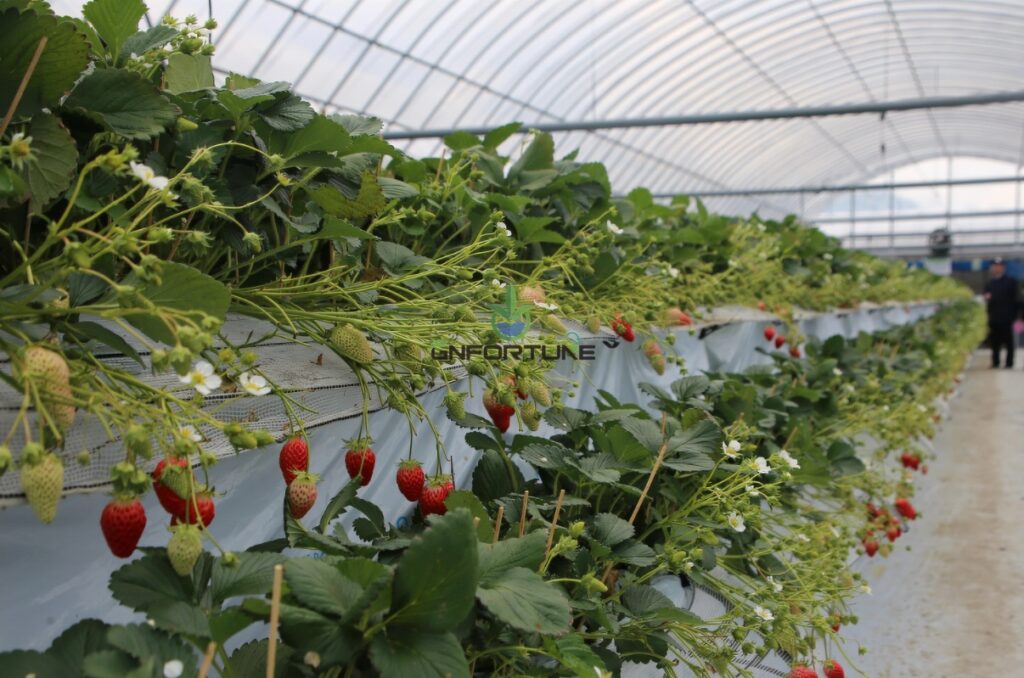
Arched roof greenhouse with open ridge vent showing natural ventilation structureExhaust fans handle bulk air change; HAF fans handle uniformity. A horizontal airflow (HAF) system moves air in a horizontal loop above the canopy so every plant sees the same temperature, humidity, and CO₂ as the next one. Without it, the hottest and coolest spots can differ by 4–6°C and ripening becomes uneven.
- Coverage rule of thumb: one HAF fan per 300–400 m² of floor area for the typical 1 hp axial fan circulating in a loop pattern. Smaller fans in tightly spaced rows give slightly better uniformity than larger fans at wider spacing.
- Mounting height: about 3 m above the floor for a 4–5 m ridge greenhouse, just above head height and below any screen or curtain track. This puts airflow through the canopy zone without blasting leaves directly.
- Layout pattern: alternating fans blow in opposite directions along the length of the greenhouse, creating a continuous horizontal loop. A poor layout leaves dead zones in the corners, easy to spot with a smoke pencil on commissioning day.
- Variable speed: EC fans with 0–10 V control let the grower drop airflow in cold weather, when the canopy does not need full circulation and heat loss is painful.
HAF sizing also has to coexist with the screen system. A blackout screen that hangs into the HAF zone disrupts the loop and causes stratification above and below the screen.
Cold-Climate Minimum Ventilation
Winter ventilation is the opposite problem from summer. Growers who design only for July end up with humidity problems in January: when outside temperature is 0–5°C and the canopy is transpiring, the air at leaf level reaches 95–100% RH and stays there all night. Botrytis on strawberries, leaf mold on lettuce, and botrytis on tomatoes all start in this condition.
Minimum ventilation handles it. The goal is 1–2 air changes per hour, continuously, for as many hours as humidity exceeds 85%. Practically that means a small continuously-running exhaust stage (often a single variable-speed fan at low speed) and a matched intake vent that does not dump cold air directly on the canopy. Two design notes that matter:
- Intake position. cold winter intake should come in high and mix with warm air under the roof before reaching the crop. A high side vent or a perforated polyethylene tube above the crop is the usual answer.
- Heating coordination. minimum ventilation pulls heat out of the greenhouse along with moisture, so the heating pipe work has to be sized to top that loss back up. We size heating for the minimum-ventilation load, not the closed-house load, and that single change fixes most winter humidity problems at the source.
Common Mistakes We Correct on Audits
Field audits keep returning to the same handful of mistakes:
- Sensors in the wrong location. a sensor in direct sun or right next to an intake vent reads the wrong climate. The fix is a shaded aspirated box halfway between two HAF fans.
- HAF fans out of phase. two adjacent fans blowing the same direction leave a dead strip between them. A strip of ribbon tape on the wire shows the problem; alternating direction or adding a vane fixes it.
- Screen partially closed in summer. an insect screen left at 70% closure in July strips 25–30% off the rated exhaust airflow and overheats the greenhouse. Screens belong fully open or fully closed in the cooling season.
- Vent and heater fighting each other. a vent set to open at 26°C while a heating loop targets 22°C on a cool morning oscillates the room through the vent threshold. Separate the control curves.
- Undersized wire. a 1.5 hp fan at 100 m of undersized cable loses voltage and quietly loses RPM. We check cable run against amp tables on every audit, because “fan runs but airflow is weak” never shows up on a controller alarm.
Most of these are configuration fixes, not hardware retrofits. That is also what we mean when we say greenhouse ventilation design starts on the drawing board, not in the parts catalog.
FAQ
What is a good vent area to floor ratio for a hydroponic greenhouse?
A: 20–25% of total floor area. Below that, fans cannot move enough air on the hottest day; above that, you spend on vent area that rarely opens.
How many air changes per hour does a greenhouse need in summer?
A: 60–90 ACH in peak summer for warm-climate ranges, 30–45 ACH in shoulder seasons, and 1–2 ACH in winter just to dump humidity.
How far apart should HAF fans be spaced?
A: One 1 hp fan per 300–400 m² in an alternating-direction loop. For a 1,000 m² greenhouse, three fans per side blowing in opposite directions make a continuous loop.
Can roof vents alone cool a hydroponic greenhouse?
A: In mild climates, sometimes. Above 30°C summer, roof vents alone cannot hold canopy temperature; exhaust fans are needed alongside.
How do I stop winter humidity without losing heat?
A: Run continuous low-stage minimum ventilation (1–2 ACH) and feed cold intake air high so it mixes before reaching the canopy. Size heating to top up this continuous loss. Closing the vent to save heat usually causes more botrytis than it saves energy.
Get a Vent and Fan Layout for Your Range
Send your greenhouse dimensions, ridge height, screen spec, and target crop through the quote form and our team will return a vent-area calculation, exhaust fan schedule with CFM and static pressure numbers, HAF layout, and intake-vent positioning — the same engineering inputs we use for our own turnkey greenhouse projects. If your climate runs hot most of the year, the calculation pairs naturally with the cooling layouts for hot climates covered in our previous guide.