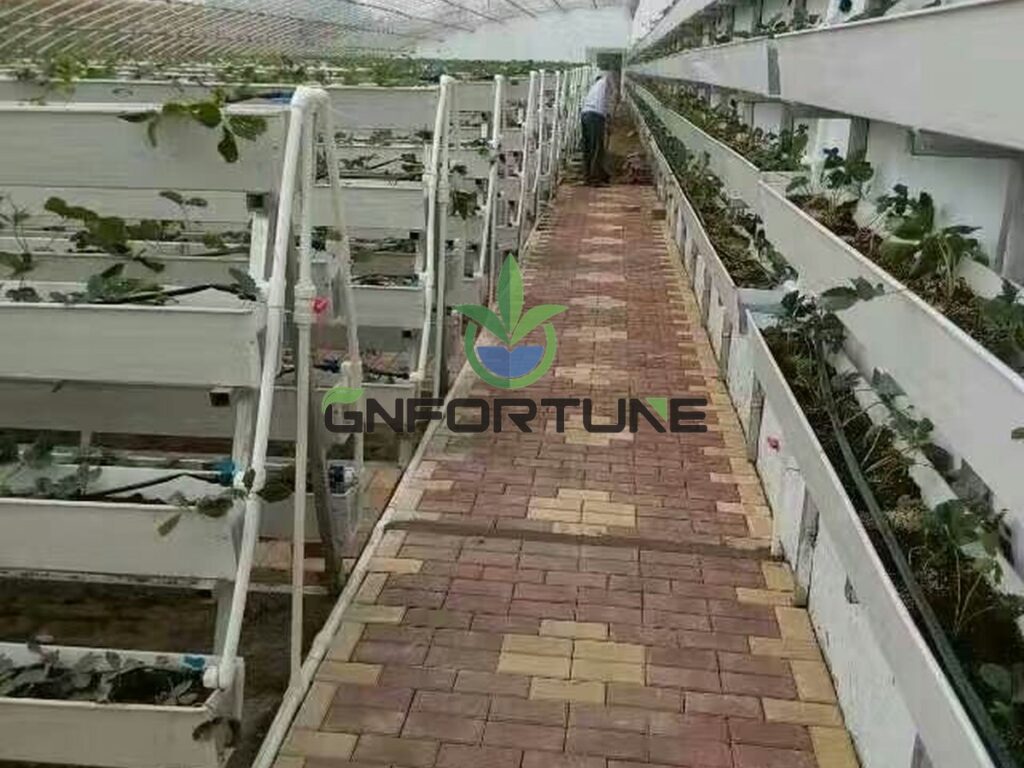
One pump, six zones, and no two zones the same size. Somewhere between the pump and the first row, a length of pipe with six take-offs has to turn one flow into six, at pressures close enough that the smallest zone is not drowned while the largest starves. That length of pipe is a zone manifold, and on most farms it is built from whatever tees were on the shelf, spaced where the branches happened to fall.
What a Zone Manifold Has to Deliver
Four things, and only one of them is about flow. Each branch must receive its design flow at a pressure close to the others, the header must not waste head, every branch must be isolatable, and the arrangement must leave room to measure.
- Header velocity of roughly 1.0–1.5 m/s at design flow, and never above about 2.0 m/s, keeps friction loss modest and noise down.
- Header loss as a planning target of 0.1–0.2 bar across the whole manifold, so the pump head is spent on the field rather than on the pipe.
- Pressure spread between the first and last branch of a few percent, not a few tenths of a bar.
- A straight run of five to ten diameters upstream of any meter or pressure gauge, so the reading means something.
Why the Last Branch Gets Less
Water takes the easiest path, and in a straight header the easiest path is the first tee. Every metre downstream adds friction, so pressure falls along the header and each successive branch sees a little less. On a short header with two branches the difference is negligible; on a 12 m header feeding six zones it can reach 10–15% of flow on the far end.
Four layouts correct it, with different costs.
| Layout | Pressure spread, first to last | Cost | Best fit |
|---|---|---|---|
| Straight header, direct return | 5–15% | Lowest pipe cost | Two or three zones on a short header |
| Reverse return (equal path length) | 1–3% | 20–30% more pipe | Four or more zones of similar size |
| Tapered header, stepped diameters | 2–5% | Moderate, more fittings | Long headers carrying large total flow |
| Balancing valve on each branch | Correctable to under 3% | Valve cost plus setup time | Retrofits and genuinely uneven zones |
| Flow splitter head | 3–5% per outlet when resistances match | Low | Identical rows fed from one line |
Reverse return is the honest fix where zones are similar: the water travels the same distance to every branch, so friction differences cancel. It costs pipe and looks untidy, and it removes the need for most balancing.
Sizing Each Branch, Not the Average
Branch diameter is set by the flow that branch must carry, at a velocity that keeps loss reasonable. Sizing every branch to the largest one wastes material; sizing them all to the smallest starves the big zones.
- 25 mm branch: roughly 2.5–3 m³/h at 1.5 m/s.
- 32 mm branch: roughly 4–4.5 m³/h.
- 40 mm branch: roughly 6.5–7 m³/h.
- 50 mm branch: roughly 10–11 m³/h.
These are planning figures for a smooth bore at 1.5 m/s; check against the supplier’s friction table before fixing the schedule. Where a branch feeds a long row of outlets, the loss along that row matters as much as the loss to it, as covered in irrigation distribution uniformity. The same arithmetic applies to the header, where the diameter must carry the sum of all open branches — and where the worst case is every zone open at once, not the average day.
The Pressure Loss Budget

A manifold is one line in a budget that starts at the pump and ends at the emitter. Writing the budget down is the only way to know whether a 0.15 bar manifold loss is acceptable or fatal.
- Static lift: sump level to the highest outlet.
- Filtration: 0.2–0.5 bar across a loaded filter, depending on element type and mesh.
- Main and manifold: 0.1–0.3 bar combined on a well-sized layout.
- Branch and valve: 0.1–0.2 bar, including the solenoid or ball valve.
- Outlet or emitter: whatever the device requires, often 0.1–0.5 bar.
Add those and compare with the pump’s duty head. If the total lands within about 10% of the pump’s maximum, there is no margin left for a dirty filter or a partly closed valve, and the manifold will be blamed for a problem that belongs to the pump selection.
Flow Splitters: Equal Shares Only When Resistance Is Equal

A splitter divides one incoming flow into several outlets through a shaped head, with no valves and no adjustment. It is cheap, compact and reliable — on one condition: the downstream resistance of every outlet must be nearly identical.
Where rows are the same length, the same channel section and the same height, a splitter holds shares within a few percent. Where one outlet feeds a shorter row or a lower tier, the split follows the resistance, not the geometry of the head. That is why splitters work well on identical gutter rows and badly on a mixed planting where one line serves two crops.
Splitter heads also have a minimum flow for stable division. Below roughly half design flow the pattern becomes uneven, which matters on a system that runs at low demand overnight.
Balancing and Recording the Result
Whatever the layout, the manifold is finished only when each branch has been measured. The sequence takes an afternoon on a new house and prevents a season of arguments.
- Open every branch and record inlet pressure at design flow.
- Measure flow at each branch in turn, with the others in their normal state, using a clamp-on or inline meter.
- Adjust the branch with the greatest deviation first, then re-measure the neighbours — throttling one branch raises pressure for the rest.
- Mark every valve position and photograph the manifold, so the settings survive the first maintenance visit.
If a branch cannot be brought into line however far its valve opens, the header is undersized for that branch and no setting will recover it. That is the moment to check velocities and diameters rather than to keep turning valves, because a manifold that needs a fully open branch plus a throttled neighbour is really telling you the pipe schedule was wrong.
Valve adjustment technique has its own detail, covered in zone balancing valves and flow setting. The layout rules that decide whether a manifold can be balanced at all are in pipework runs and manifold layout.
A zone manifold is not plumbing detail; it is the point where one pump’s output becomes the crop’s ration. Size the header, choose the return arrangement, measure every branch, and the uneven zones stop being a problem the valves have to solve every week.
FAQs About Zone Manifolds
Is reverse return worth the extra pipe?
For four or more similar zones on a header longer than about 8 m, usually yes: it brings the first-to-last spread down to a few percent and removes most balancing work. On two zones, it rarely pays.
What header velocity should we design for?
Around 1.0–1.5 m/s at design flow, and never above about 2.0 m/s. Higher velocity costs head, adds noise and makes the manifold sensitive to small changes downstream.
Can one balancing valve fix an undersized header?
It can redistribute what the header delivers, at the cost of extra head loss. If the header is too small, throttling every branch to protect one leaves the pump working against a restriction it was not selected for.
When is a flow splitter better than a manifold with valves?
When the outlets feed identical rows and no adjustment is expected. Where rows differ in length, height or crop, a valve on each branch is the only way to hold the shares.
How many branches can one manifold serve?
There is no fixed limit, but beyond about six to eight the header grows long enough that friction spread matters and reverse return becomes the practical choice. Grouping zones into two manifolds often beats one long header.
Related Reading
- Solenoid Valves in Hydroponics: Specifying Zone Valves and Manifolds — The valve side of the same assembly
- Hydroponic Flow Meter Guide — Measuring each branch during balancing
- Mixed Crop Hydroponic System Zoning — When one line should not serve several crops
- Multi-Tier Irrigation: Pressure and Drainage — Why a splitter struggles across tiers
- Hydroponic System Zoning: Keeping One Fault From Taking the Whole Crop — How far a single manifold should reach
Next Step: What to Send for a Quotation
A manifold is quoted from a zone schedule, not from a sketch. Send the flows and the geometry, and the header and branches can be sized in one pass.
Specifying a manifold? For RFQ or project consultation, send: number of zones and design flow for each; whether flows are similar or uneven; distance from pump to the first and last branch; main and branch diameters planned; valve type and actuation; pressure available at the manifold inlet; meter and gauge positions wanted; future zone additions planned; delivery schedule; and the budget band. G AND N FORTUNE LIMITED supplies manifolds, branch assemblies, valves and fittings fabricated to a zone schedule, with the sizing checked against the pump duty you provide.