

Rockwool is the most widely used growing medium for commercial crop starts because it turns seedling care into a repeatable process: every plug wets the same, drains the same, and roots out on the same schedule. Get the format, the buffering, and the fertigation right in the nursery, and transplanting becomes a routine calendar event rather than a gamble. This guide walks through rockwool plugs, cubes, and slabs for propagation — how to prepare them, what EC and pH to run, when to transplant, and how to size a nursery for a 1-hectare operation.
Rockwool Growing Medium Formats: Plugs, Cubes, and Slabs
Rockwool propagation products differ by the job they do. Plugs start seed or cuttings; cubes carry young plants to transplant; blocks and slabs hold crops through finishing. Sizes below are typical ranges — confirm the exact dimension with your supplier, since each brand cuts its own profile.
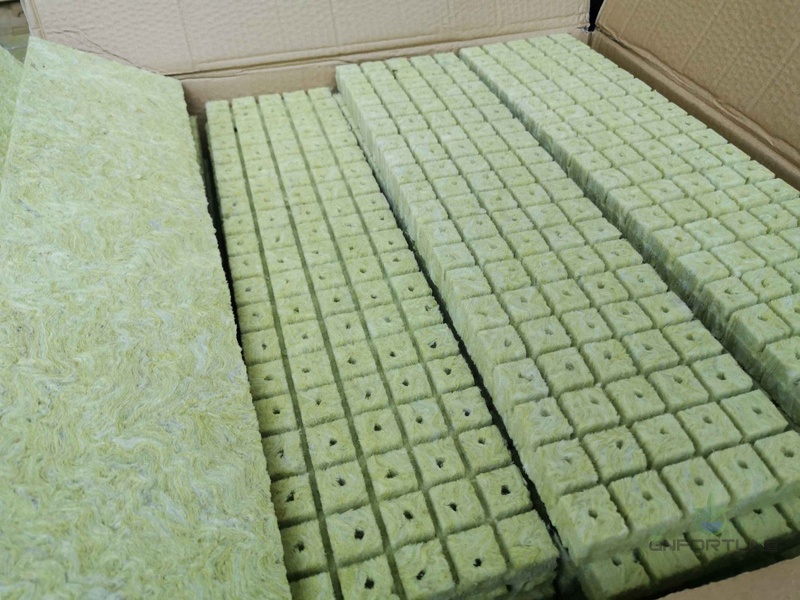
Rockwool cubes neatly packed in a box for commercial propagation| Format | Typical size | Job | What it holds |
|---|---|---|---|
| Plugs | About 2 cm diameter | Seed germination and cutting rooting in trays | One seedling or cutting until the first roots hold the plug |
| Cubes | 2.5–5 cm across | Young plants between propagation and transplant | Starter plants for NFT channels and bucket systems |
| Blocks | 7.5–10 cm | Fruiting crops before slab planting | Tomato, cucumber, and pepper plants with true leaves |
| Slabs | Roughly 100 × 15 × 7.5 cm | Finishing medium, not propagation | Long-season fruiting crops on gutters with drippers |
Match the format to the transplant point in your system. A leafy program that drops seedlings straight into NFT channels usually needs cubes only; a tomato program that holds plants for weeks before slab planting needs blocks. Start from when the crop must be transplant-ready and work backward. For context on where rockwool sits among all commercial substrates, see the hydroponic growing media guide.
How to Pre-Soak and pH-Buffer Rockwool Before Planting
Raw rockwool runs alkaline — typically pH 7.5–8.5 — because of residual compounds from manufacturing. Plant roots in that pH range cannot take up iron and manganese, which is why pre-soaking is not optional. The standard nursery routine:
- Soak with a buffered solution. Prepare nutrient solution adjusted to pH 5.0–5.5, at the EC you will run during propagation. Submerge or top-water the plugs and cubes until fully saturated.
- Hold for several hours, ideally overnight. Buffering is not instant; the fibers exchange slowly. Overnight at greenhouse temperature gives consistent results.
- Drain before planting. Let the free solution run off so cubes are at a healthy water content, not waterlogged. Check the drain pH on a sample — it should read near 5.5–6.0. If it still reads above 6.5, repeat the soak.
The nursery rule worth printing on the wall: buffer today’s batch and plant tomorrow. Nurseries that skip the overnight soak to save a day buy back that day several times over in uneven germination, iron deficiency in week two, and culls at transplant.
Pre-soaking also makes rockwool consistent to handle. Dry cubes wick unevenly when irrigated in the tray, and the dry spots never fully recover — wetting them once, properly, at the start is cheaper than managing wet and dry zones for weeks.
Fertigation During Propagation: EC and pH Parameters
During propagation the plant has a tiny root system, so solution strength and frequency must be tuned to the stage. The parameters below are general starting points for commercial nurseries — adjust to your water quality and crop:
| Stage | EC (mS/cm) | pH | Irrigation approach |
|---|---|---|---|
| Seed germination / fresh cuttings | 0.5–1.0 | 5.5–6.0 | Light mist or top-water; keep moist, never saturated |
| Plug to cube stage | 1.0–1.5 | 5.5–6.0 | Top-water to slight drain; let cubes dry back between events |
| Cube to block, pre-transplant | 1.2–1.8 | 5.5–6.2 | Fertigate to 10–20% drain to keep salts moving |
Watch the run-off, not the tank. The drain EC from a cube tells you whether the root zone is accumulating or depleting salts; rising drain EC means the irrigation strength is too high or the frequency too low. Root-zone temperature matters as much as solution strength — rockwool roots stall below roughly 18 °C (64 °F) and grow fastest in the 20–24 °C range, so heat the nursery floor or air before pushing more EC at the plants.
When to Transplant: Cube-to-System Timing
Transplant timing is a root-readiness decision, not a calendar guess. The reliable signs:
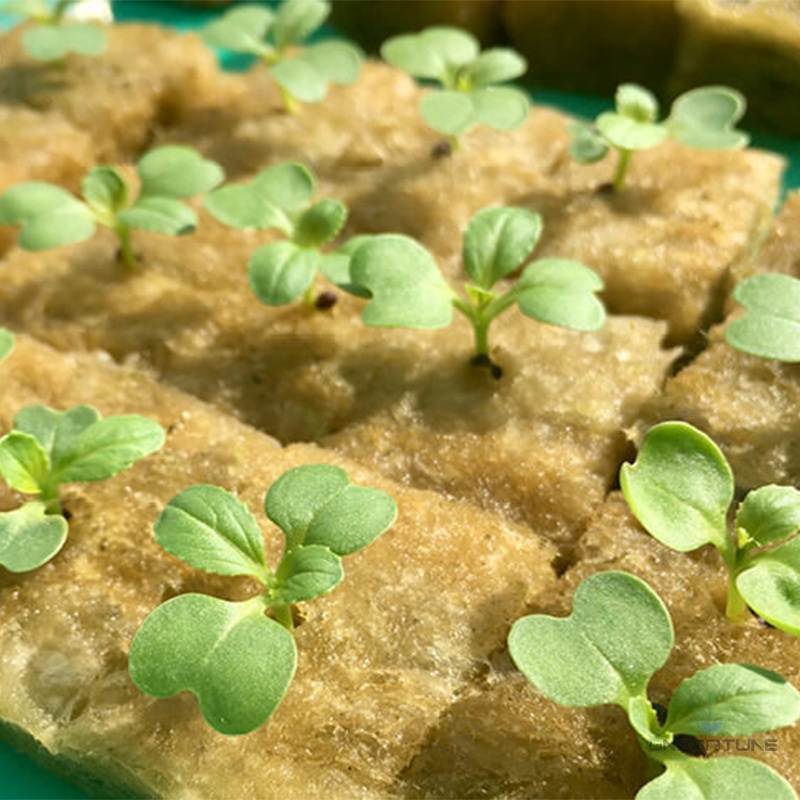
Seedlings sprouting from rockwool cubes in propagation- Roots visible and white at the outside of the cube — several root tips, not just the first one. Transplanting at the first visible root risks setting the plant back while it re-roots.
- The plant holds a true-leaf stage appropriate to the crop. Leafy greens move at two to four true leaves, roughly 10–14 days after sowing in good conditions. Fruiting crops wait until two to four true leaves and a sturdy stem — often three to four weeks.
- The system is ready. A cube transplanted into an NFT channel that is not yet cycling, or a bucket with no drip schedule, sits and suffocates. Prepare the receiving system before the batch reaches transplant size.
For leafy greens, the cube is a small part of the NFT story — see the NFT channel range and the lettuce in NFT guide for channel spacing and transplant density. For fruiting crops in perlite or coco, set the cube into the bucket lid so its base sits in the new medium and drippers water onto the cube for the first days — the Dutch bucket system page covers that transition in detail.
Scaling Propagation for a 1-Hectare Greenhouse
A nursery is sized by transplant throughput, not by floor area instincts. Work the arithmetic: assume your production area needs about 20,000 transplant-ready plants per week for leafy greens on a continuous harvest cycle. With a two-week dwell in propagation, the nursery must hold roughly 40,000 cubes at any moment — that is about 400 standard 1020 trays at 100 cubes per tray, or the equivalent on flood benches.
- Stagger the batches. Sow in weekly blocks so transplant day is a rolling event, not a monthly panic. Fixed weekly blocks also smooth labor demand across the nursery.
- Separate functions. A germination zone (warm, humid, low light) followed by a hardening zone (brighter, drier, more airflow) is cheaper to build and easier to operate than one all-purpose room.
- Automate the repetitive parts. Mist control, fertigation scheduling, and environmental set-points run reliably on controllers — see the greenhouse automation page for what belongs on a controller and what still needs hands.
Where does the budget go wrong? Almost always in the hardening zone. Growers add germination capacity and then discover that cubes cannot wait on crowded benches while the production area catches up. Give the hardening stage its own space and its own airflow before you expand anything else.
FAQ
What is the difference between rockwool plugs and cubes?
A: Plugs are small cylinders used to start seed or root cuttings in trays; cubes are larger blocks that carry the young plant to transplant. A leafy program usually runs plugs into cubes, while direct sowing into cubes works for some crops.
Do I have to pH-buffer rockwool every time I buy it?
A: Yes, for propagation formats. Raw rockwool arrives alkaline, and pre-soaking each batch with pH 5.0–5.5 solution overnight is the standard nursery step. Skipping it shows up as uneven starts and micronutrient deficiency in week two.
How do I know when a cube is ready to transplant?
A: Transplant when several white root tips are visible on the outside of the cube and the plant has reached its true-leaf target. Waiting a few days past readiness beats transplanting on the first visible root.
How does rockwool compare with peat based growing media for propagation?
A: Both hold water well; rockwool wins on uniformity and rewetting consistency, while peat based growing media are lighter and biodegradable. Peat arrives acidic and needs liming and buffering, and its sourcing is restricted in some markets — many nurseries switched to rockwool for batch consistency and stable pricing. For the full head-to-head with coco and perlite, see our substrate comparison guide.
Can I reuse rockwool cubes in the nursery?
A: Not practically. Used cubes carry root debris and salt, and their structure degrades. In a propagation room the cube cost is small relative to crop value — treat plugs and cubes as single-use.
Request Bulk Rockwool Pricing and Nursery Layout Advice
Once your throughput math fixes the number of plugs, cubes, and slabs per week, the remaining questions are price, packaging, and layout. Send your crop plan, weekly transplant target, and greenhouse floor plan, and request bulk rockwool pricing and nursery layout advice through the quote form — we will size the germination and hardening areas, specify the rockwool growing medium formats and quantities, and quote the whole propagation package together.