

Rockwool vs Coco Peat vs Perlite: Which Substrate Fits You
Rockwool, coco peat, and perlite answer the same question differently: how do you keep water and air at the roots of a commercial crop. Rockwool stores a lot of water very uniformly, coco buffers between irrigation events with some chemistry of its own, and perlite gives drainage and oxygen without holding much of anything. The right soilless potting medium for a site is the one whose behavior matches the irrigation system, the labor available, and the crop cycle — so this comparison looks at behavior first and brand loyalty last.
The Short Answer: Which Soilless Potting Medium Fits Your Crop
Three starting positions cover most commercial programs. Use them as defaults, then read the detail below before you order.
| Crop pattern | System | Default substrate | Why |
|---|---|---|---|
| Tomatoes, long-season fruiting | Slabs on gutters with drippers | Rockwool or coco slab | Big water buffer, uniform wetting across the season |
| Peppers, cucumbers in buckets | Dutch bucket systems | Perlite, or perlite-heavy coco/perlite blend | Drainage first; bucket roots hate standing water |
| Strawberries on gutters | Gutter/rack layouts | Coco slab or coco/perlite blend | Water holding across warm afternoons; see the strawberry gutter guide |
| Short leafy cycles | NFT | Rockwool or coco starter cube only | Roots finish in the solution film, not in media |
Every line above is a starting point, not a law. Greenhouses switch between rockwool and coco slabs regularly, and buckets run fine on coco/perlite blends when the drippers are scheduled for the blend. What you cannot do is treat all three as interchangeable — they hold water on completely different timetables.
Rockwool: Pros, Cons, and Handling Notes
Rockwool is spun basalt fiber, pressed into cubes, blocks, and slabs. Its engineering strength is uniformity: factory-made pores wet and drain the same in every unit, which makes irrigation scheduling predictable across a whole greenhouse.
- Pros: high water holding with reliable rewetting, clean and inert starting point, excellent wicking for propagation, and a proven track record in tomato and cucumber slab programs.
- Cons: raw rockwool runs alkaline (pH around 7.5–8.5) and must be pre-soaked and buffered down to about 5.5 before planting; the fibers produce dust and irritation, so wet handling and masks matter; and it is not biodegradable, so disposal is a real line item.
- Handling notes: soak slabs or cubes with a buffered nutrient solution at EC 2.0–2.5 for several hours before setting plants, then check the drain pH and EC. Cubes are the standard propagation format — see rockwool for commercial propagation for the plug and cube routine.
Rockwool is usually replaced after one to two crop cycles. Some programs reuse slabs after steaming, but fiber collapse and salt accumulation in the base make reconditioning a judgment call — when in doubt, compare the cost of steaming against the price of new slabs.
Coco Peat: Buffering, EC, and the Batches That Burn Roots
Coco peat (coir) is ground coconut husk with high water holding and, in good grades, surprisingly good air porosity. It behaves as a mild ion exchanger: it holds onto cations such as calcium and magnesium and can release or trap them depending on what is in the solution.
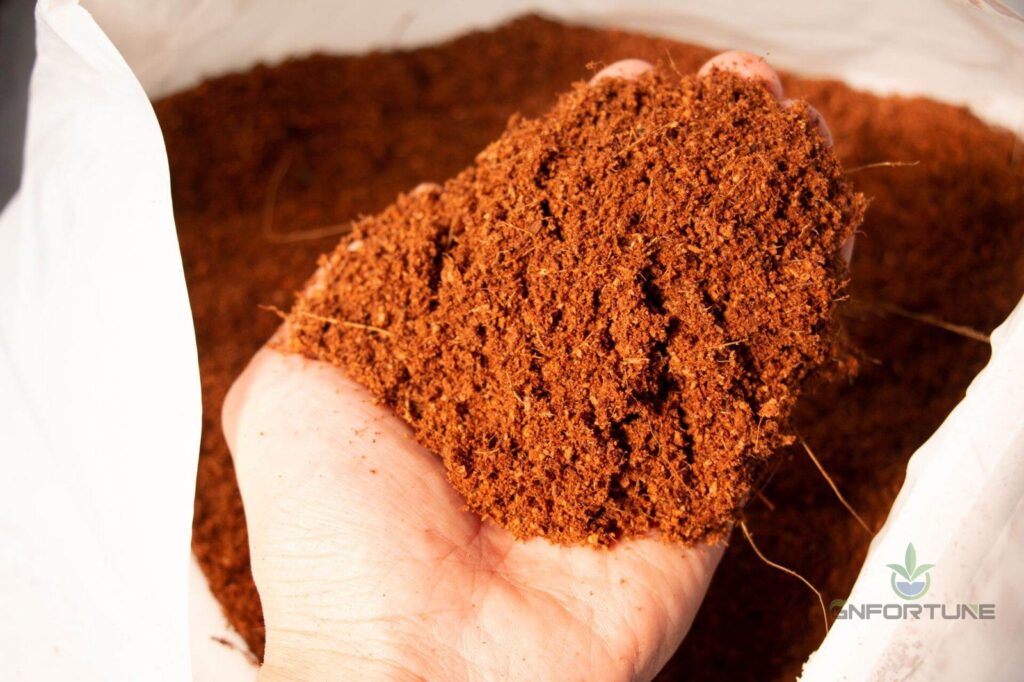
Hand holding coco peat substrate for hydroponics- Buffering is non-negotiable. Raw coir carries residual sodium and potassium from processing. If those salts are not washed out and the material not loaded with calcium before sale, the first crop faces high EC at the root and calcium deficiency symptoms — the classic “burned roots from the bale.” Buy pre-buffered material or buffer it yourself with a calcium-rich soak before planting.
- Check EC differently than with perlite. Because coco exchanges ions, the drain EC drifts over the season. Read the run-off trend, not a single sample, and keep irrigation water EC 0.2–0.4 higher than you would run in an inert medium to keep calcium moving.
- Batch quality varies by source. Coco from different origins differs in fiber-to-dust ratio, and dusty batches hold water too well and block drippers. Ask for a sieve analysis or a settled-drain test before committing to a container quantity.
Service life is one to two full cycles in most slab programs before fibers break down and drainage falls. The broader media landscape, including where coco fits against peat and bark, is covered in our hydroponic growing media guide.
Perlite and Perlite Substitutes: Drainage Without Weight
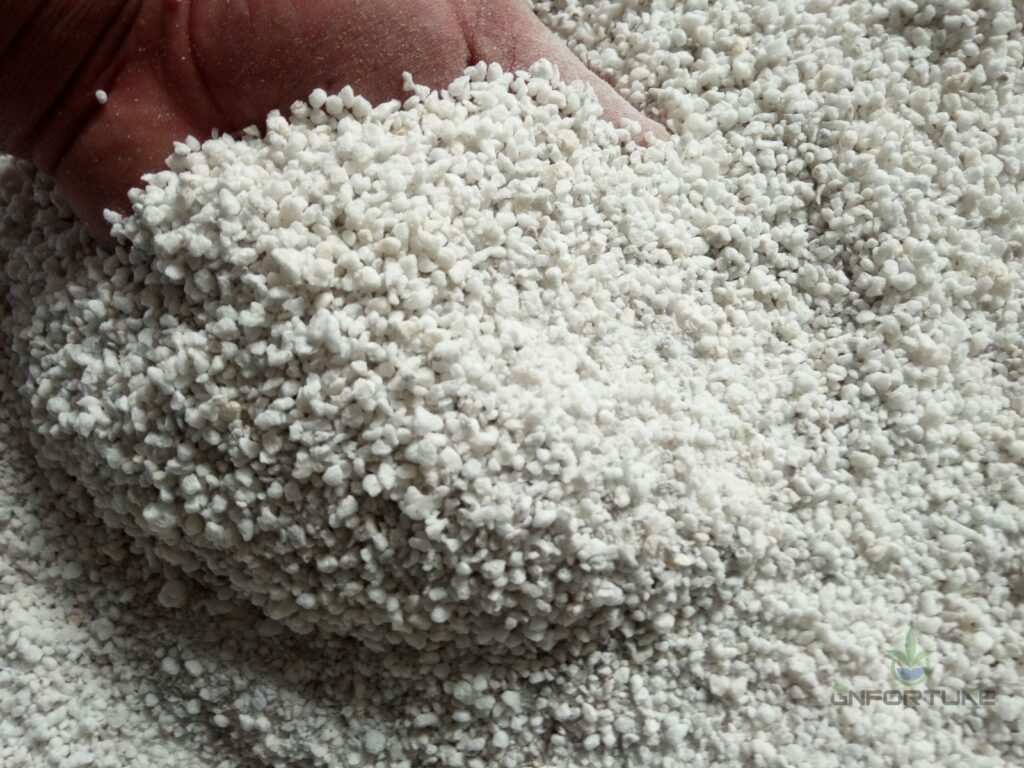
Perlite is expanded volcanic glass, roughly 1–6 mm in horticultural grades, that holds almost no water and creates large air spaces wherever it sits. In Dutch buckets it is the dominant fill precisely because of that behavior: drippers can run frequently without drowning the root zone, and the bucket stays light enough for one person to handle. If your grower is asking whether a perlite substitute could work, the reasons are usually dust, floating, or price.
Hand holding perlite hydroponic substrate showing particle size| Substitute | Why growers switch | The trade-off |
|---|---|---|
| Pumice | Same drainage, less dust, denser so it stays put | Heavier buckets; higher freight cost per volume |
| Coarse sand / gravel | Locally cheap in some regions | Heavy; needs careful grade control for drainage |
| Rice hulls (parboiled) | Renewable, light, cheap in rice regions | Breaks down in one season; may raise pH early |
| Clay pebbles | Heavier media for flood trays and beds | Low water holding; not a direct perlite match |
Two perlite complaints are worth engineering around rather than switching substrate. Floating matters only where media is flooded — in ebb and flow trays, cap the perlite with a coarse layer or choose a denser substitute. Dust is a handling issue: wet the perlite before pouring, use a mask during transfer, and keep handling indoors or downwind.
What Happens When You Mix Them Wrong
Mixing media is common and usually sensible — coco/perlite blends are a standard bucket fill. The failures we fix on site trace back to four specific mistakes rather than to the idea of mixing itself:
The field pattern behind most “crop looks fine but yield is off” calls: a medium change without an irrigation change. Rockwool at 60–80% water holding and perlite at 20–30% cannot run on the same timer; when a grower switches buckets from perlite to a coco-heavy blend and keeps the old schedule, the root zone goes anaerobic in two weeks. Re-time the drippers before the roots ask for it.
- Fine particles at the drippers. Unwashed coco dust or fine perlite grades migrate to the bottom of the bucket and clog emitters — the classic reason bucket lines drip unevenly. Wash coco, use coarse perlite grades, and fit filters. The irrigation side of bucket growing is covered in the drip irrigation for Dutch buckets guide.
- Stratified layers. Filling a bucket with a coarse bottom layer and fine top layer creates a perched water table at the interface — the bottom stays wet while the top dries. Blend thoroughly instead of layering.
- Salt zones at media boundaries. Placing a rockwool cube on coco or perlite without matching EC creates accumulation at the interface as solution stops at the change in pore size. Keep cube and finish media on the same EC program.
- Wrong drain percentage for the blend. A coco-heavy mix needs a higher run-off percentage (roughly 20–30%) than pure perlite to flush accumulating ions — measure drain volume, not just drain EC.
Whatever substrate you land on, test the first batch at small scale before converting a whole greenhouse. Fill sample buckets with your actual media, run the actual drippers for a week, and measure drain EC and drain percentage before scaling the order.
FAQ
Which substrate is best for Dutch bucket peppers?
A: Perlite or a perlite-heavy coco blend is the practical default — it drains fast, keeps buckets light, and tolerates frequent dripper runs. Keep at least 70% perlite if you blend.
Do I need to buffer coco peat myself?
A: Not if you buy pre-buffered material from a supplier who documents it. If the bale is raw, soak it with a calcium-rich solution and check the drain EC before planting — unbuffered coco burns roots.
Can I reuse rockwool slabs?
A: Some programs reuse slabs after steaming, usually for one extra cycle. Fiber collapse and salt build-up at the base make reconditioning a judgment call; compare the cost against new slabs.
Why does perlite float in my flood tray?
A: Perlite is so light it lifts on flood cycles. Cap it with a coarse layer, or switch the tray to a denser perlite substitute such as pumice or clay pebbles.
How do I know a coco batch will clog my drippers?
A: Ask the supplier for the fiber-to-dust ratio or a sieve analysis, wash the coco before use, and run a short bucket test with the actual drippers before scaling up.
Tell Us Your Crop and System — We Will Recommend the Media Mix
Send your crop, system type, dripper flow rate, and water quality through the quote form, and we will recommend the media mix and irrigation schedule that fit — including the drain percentage to target in the first season. Because the medium is a recurring purchase, the mix recommended on paper is the mix quoted for delivery, so the second order matches the first.