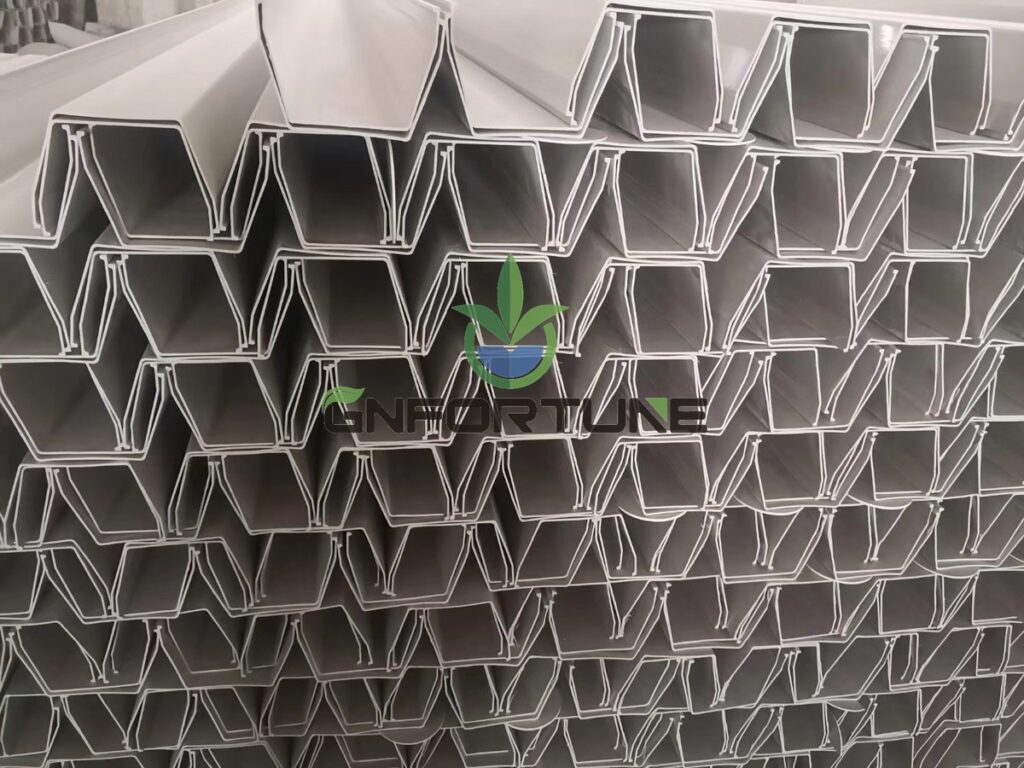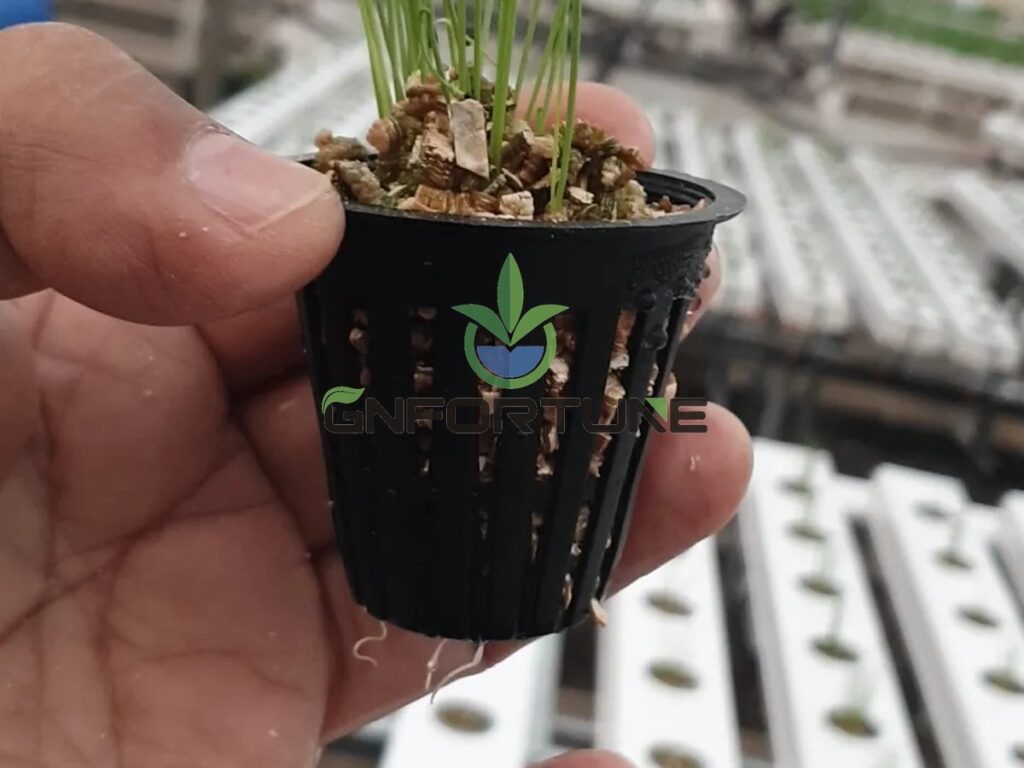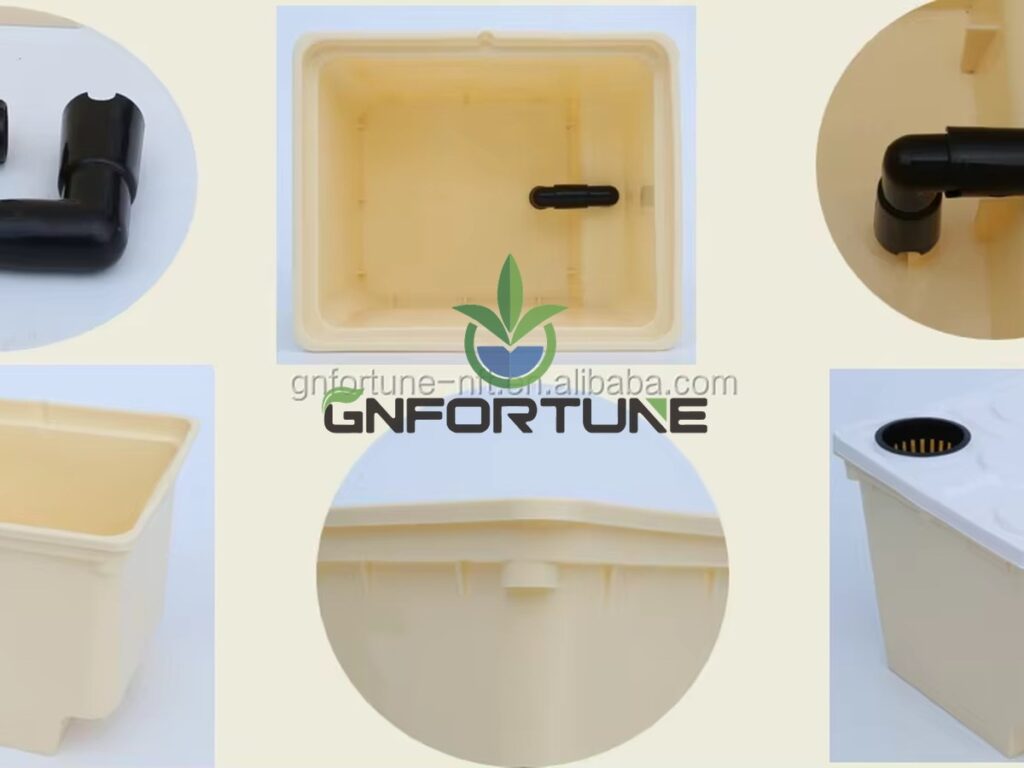
A channel order that arrives without the right NFT channel accessories stops a farm faster than any crop problem. Buyers spend weeks on profile and wall thickness, then discover on installation day that end caps are sold loose, joiners are a separate line item, and the outlet grommets were never quoted. This guide sets out what a complete package should contain, how each accessory behaves after two or three seasons, and how to size a spares kit from row length and plant site count.
What ships with the channel and what does not
A standard channel quote covers extrusion metreage, profile and wall thickness in most cases. It rarely covers the parts that turn that extrusion into a working hydraulic unit. That gap is the single most common procurement surprise in a first NFT build, and the reason buyers end up short on the NFT channel accessories that should have been in the kit from day one.
Typical “channel only” pricing excludes NFT channel end caps, joiners and couplers, channel grommets, support clips, mounting brackets, outlet and drain fittings, and the screws or rivets that hold the whole assembly to the frame. Some suppliers bundle a starter bag; most do not, and the bag is usually sized for a demo bay, not a 3,000-channel house.
Ask one question before comparing prices: is this a channel price or a complete hydroponic fittings kit price, and if it is a kit, what exactly is in the box. Two quotes with a 12% price difference often differ by 20% of the fittings list, which flips the comparison entirely. Buyers still shaping the overall package can use the profile and container logic in our NFT channel wholesale guide before fittings enter the conversation.
End caps, end plates and how channels are closed
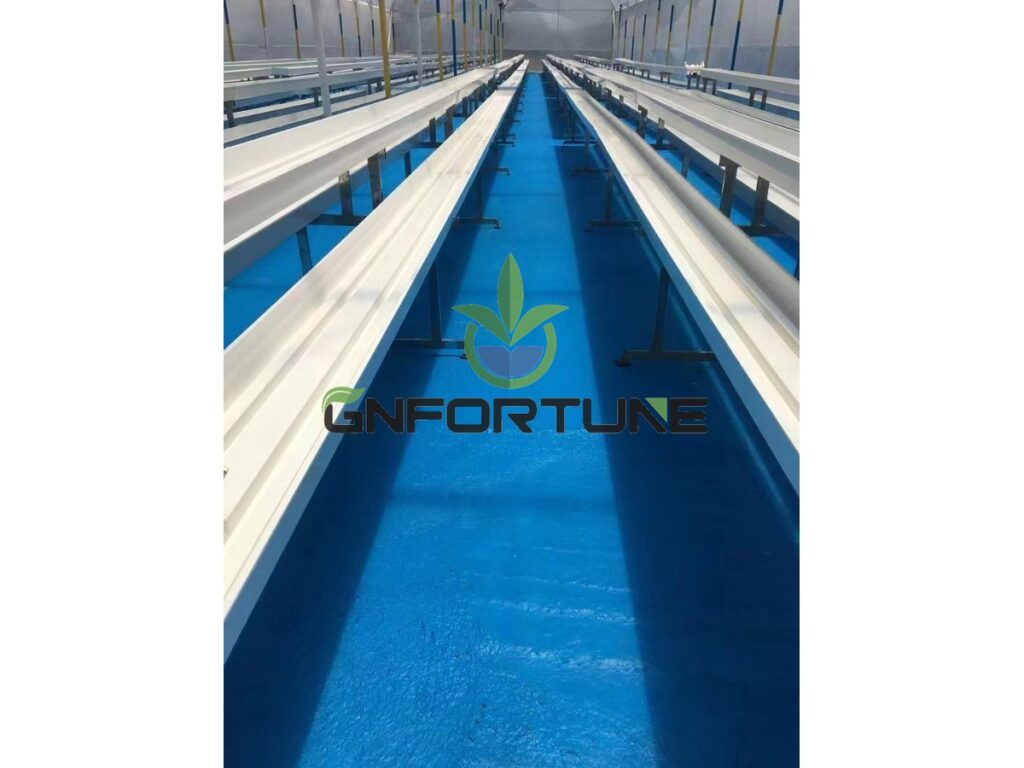
An NFT channel end cap closes the upstream end of a channel so solution cannot spill over the lip and the designed slope stays intact. Every leaking cap at the head of a row becomes a wet walkway and a slow drain on the tank.
Three closure methods appear in commercial channels:
- Snap-fit cap — pressed onto the profile end; fast to install and easiest to remove for cleaning, but the elastomer lip hardens over time.
- Screw-fit cap — fixed with two to four stainless screws; holds under vibration and the holes are factory-drilled for repeat removal.
- Solvent-welded end plate — permanent bond for continuous runs cleaned by pushing a swab from the open end.
Material match matters more than most buyers expect. A cap moulded in a different polymer expands at a different rate, and after two harsh winters the joint opens at the seam rather than at the gasket. Order caps in the same PVC or PP grade as the channel, with the cap ID within roughly 0.5 mm of the channel OD. Caps drilled on site to accept an outlet crack at the first thermal cycle — always specify a factory-moulded port.
Connectors, couplings and joint design
An NFT channel connector joins two channel sections into one hydraulic run. In a 30 m row built from 2 m sticks, that is fifteen joints carrying the same flow and the same slope tolerance as the channel body — and every one of them is a candidate leak or a biofilm trap.
Two families dominate commercial builds:
| Joint type | How it works | Trade-off |
|---|---|---|
| Internal sleeve coupler | Slides inside both channel ends; no external profile bump | Reduces internal cross-section; root mat and debris can catch on the sleeve lip |
| External overlap coupler | Wraps the outside of both ends with a clamp or gasket | Keeps the flow path clear; adds a visual joint and a stress point at each clamp |
| Solvent-welded collar | Permanent bond over both ends | Strongest joint, but the run cannot be dismantled for cleaning or re-layout |
For leafy crops the internal sleeve is common because the low root mass rarely reaches the sleeve lip. For wider profiles and heavier root systems, the external coupler keeps the wetted section uniform and avoids a permanent ledge. The curved base on a patented profile — covered in our note on patented NFT channel design — changes where the film sits, so confirm the coupler matches the specific profile rather than a generic 100×50 mm assumption.
Place joints at frame support points, never mid-span. A joint on an unsupported section flexes under load, and a flexing joint opens its gasket within a season. The sizing logic behind agricultural pipe and fittings types applies here too: match the fitting to the actual profile, not to the nominal label.

Grommets, clips, fixings and fasteners
A channel grommet seals every penetration through the channel wall — outlet fittings at the low end, dosing or sampling ports along the run, and any sensor probe entry. A grommet is the cheapest line on the fittings invoice and it protects the most expensive one — the channel and the crop standing in it. It is also the item most often left off the purchase order.
Durometer is the specification that matters. Too hard and the grommet cracks the channel wall as it seats; too soft and it extrudes out under pump pressure within weeks. Specify the grommet for the wall thickness and working pressure, and keep a spare bag on site — installation crews lose them at a rate no planning sheet predicts.
Support clips carry the channel on the frame, typically at one clip per metre, tightening to roughly 1.5 clips per metre on wide profiles or across a bench joint. Stainless 304 is the practical minimum for wet zones; zinc-coated fasteners fail in a humid greenhouse within two seasons and stain the channel. Use screws where the assembly will be serviced, rivets where it will not.
Sizing the spares kit by row length and plant sites
An NFT spare parts list is not a fixed bundle. It is a count built from the number of channels, the number of penetrations and the number of joints in the actual layout. The planning assumption used on most commercial builds is to hold 5–8% of the fittings value as first-year spares, split by part type according to how often each fails or goes missing.
| Part | Base count | Suggested spare % | Why |
|---|---|---|---|
| End caps | 2 per channel | 10% | Snap-fit lips harden; caps get damaged during cleaning |
| Connectors / couplers | 1 per joint | 15% | Gaskets fail first; occasional breakage on re-layout |
| Grommets | 1 per penetration | 20% | Smallest part, highest loss rate, degrades with sanitiser exposure |
| Support clips | 1 per metre | 10% | Crews forget to refit after transplant; UV embrittlement on exposed runs |
| Screws / fasteners | 1 per clip and cap | 25% | Dropped, stripped, or left in a pocket |
A worked example keeps the arithmetic honest: a house with 3,000 channels has 6,000 end-cap positions, so 10% spares means 600 caps. If the same house runs 45,000 plant sites at 15 sites per channel with two grommet penetrations per run, the grommet base count is 6,000 with 1,200 spares. Neither figure is large next to the extrusion invoice, but both decide how quickly a leak gets fixed on a Sunday morning.
Spare counts should also follow the manifold layout rules used on the site. Every manifold junction adds a penetrations cluster, and every cluster needs its own grommet and clip allowance. Store the kit in labelled bins, one per part number, bin label matching the purchase order line — that single discipline removes most of the “we have it somewhere” delays.
Common failure modes on real farms
The same handful of failures show up across sites, and every one of them traces back to a fitting decision made at order stage rather than at installation.
- Loose end caps after 8–12 months. Snap-fit lips relax through summer-winter cycles; switch to screw-fit caps on head ends, or replace the snap caps annually.
- Biofilm at internal couplers. The sleeve ledge catches root fragments; external couplers or a flush port at each joint solve it.
- Grommets hardening in unheated winter houses. Specify a cold-flex grade where the house drops below 8 °C.
- Caps drilled on site for outlets. The drill leaves a stress riser; always specify a factory port.
- Missing clips after transplant. Crews remove clips to lift channels and do not refit them; the run sags, the gradient drifts, and the outlet end starves. Count clips back in at the end of each transplant.
None of these failures is expensive to prevent at order stage; all are expensive to fix mid-cycle. When the channel shipment is dispatched direct from the factory — as described in factory direct dispatch — fittings can be packed in the same container so the install crew is never waiting on a second shipment.
FAQs About NFT Channel Accessories
Do end caps come with the channel order?
Usually not, unless the quote is explicitly a channel kit. Most extrusion prices are per linear metre and exclude caps, couplers, grommets and clips. Confirm the inclusion list in writing before comparing supplier prices.
Can I use standard plumbing end caps instead of the factory part?
Only if the polymer and dimensions match. Plumbing caps are commonly moulded in a different grade, and the mismatch shows as a leaking seam after the first thermal cycle. Order the factory cap for the specific profile.
How many spare grommets should I hold per 1,000 plant sites?
Plan on one grommet per penetration plus 20% spares. A 1,000-site block typically has two penetrations per run, so the spare count lands near 15–20 grommets per 1,000 sites, more where dosing or sampling ports are dense.
Are solvent-welded joints better than gasketed couplers?
Welded joints are stronger and never leak at the gasket, but they cannot be dismantled for cleaning or re-layout. For a farm that expects to reconfigure rows, gasketed external couplers are the more practical choice despite the higher maintenance load.
What should be in the equipment room from day one?
A labelled bin per part number holding caps, couplers, grommets, clips and fasteners at the percentages above, plus one spare outlet fitting per manifold. That kit covers the first year of routine failures without a second order.
Related Reading
- Hydroponic NFT Channels Wholesale: Bulk Buying Guide — Bulk buying guide for the channels these parts are meant to fit
- NFT Channel Sizes: 100x50mm vs 73x62mm Compared — Channel size comparison, and why accessory fit follows the profile
- Critical Spare Parts for Hydroponic Farms: A Stock List Built on Downtime Risk — A downtime-based spare parts stock list for hydroponic farms
- How to Install NFT Channels: Layout, Slope & Flow Rate Guide — Installation, slope and flow rate: where accessories get stressed
- How PVC NFT Channels Are Extruded: Wall Thickness, UV Stability and the Tolerances That Matter — How channels are extruded, and the tolerances accessories have to bridge
Next Step: What to Send for a Quotation
A fittings quote is only accurate when it is built from the actual layout. Suppliers who quote from a profile photo alone will either over-supply or miss a part, and both outcomes cost the buyer time.
To price a complete NFT channel accessories package, send: total channel linear metres and channel count, profile type and wall thickness, number of rows and average row length, plant sites per channel, number of manifold junctions and outlet points, greenhouse dimensions and target commissioning date, and the spares percentage your maintenance plan requires. With those inputs a supplier can quote caps, couplers, grommets, clips and fasteners as a single matched kit rather than a list of guesses. Send the layout drawing with the RFQ and ask for the fittings list to be itemised per channel — that is the format that survives a site audit.