A fertigation skid is almost always plumbed into water the farm already uses — a mains top-up, a borehole, a tank that also feeds washdown taps. That shared pipework is a cross-connection, and it is why backflow prevention fertigation belongs in the specification rather than bolted on at commissioning. Once supply pressure drops while the injector side still holds pressure, flow reverses and concentrated nutrient moves toward a pipe meant to carry clean water only.
It is written for engineers, growers and procurement teams specifying injector lines, and covers how reversal happens, how an air gap differs from a check valve and a mechanical preventer, where each device sits, and whose signature confirms the assembly.
Why Nutrient Solution Reverses into Clean Water Lines
Reverse flow needs one condition: higher pressure on the fertilizer side than on the supply side. Two mechanisms create that gradient — backsiphonage, where supply pressure collapses and suction pulls solution backwards, and backpressure, where a pump or elevated tank pushes solution into a line at lower pressure.
Backsiphonage is the case most people picture: a mains break, or a tank drained for cleaning. Backpressure is the more common farm event, because fertigation pumps, booster sets and head tanks all sit downstream of the injection point — an injector paused mid-feed while the irrigation pump runs produces exactly that gradient.
The conditions worth walking your own line for:
- Shared washdown supply — a hose bib teed off the injector line is a cross-connection whether or not the hose ever reaches a tank.
- Two water sources — municipal and borehole meeting at one manifold create two paths rather than one.
- Injection straight into a mains-fed line — the configuration most regulators treat as high hazard.
- Hoses that can reach a nutrient tank — exposure exists whether or not anything goes wrong.
- Head tanks and elevated mix tanks — static head pushes back with every pump off.
A commercial house with borehole backup, a washdown ring main and a hose long enough to reach the mixing tank has most of the list at once.
Air Gap, Check Valve or Backflow Preventer: What Each One Does
An air gap physically separates the two systems with no moving part to fail. A check valve keeps the line pressurised and relies on a loaded seal closing against reverse flow. A mechanical preventer adds two independent checks plus a relief stage venting to atmosphere if either leaks. Most codes rank these options.
| Protection method | Mechanism | What it cannot do | Where it is typically used |
|---|---|---|---|
| Air gap | Physical break between outlet and flood-level rim | Holds no line pressure | Filling an open stock or mixing tank |
| Atmospheric vacuum breaker (AVB) | Air inlet opens on pressure loss | No backpressure protection; not under continuous pressure | Downstream of a solenoid or hose bib |
| Pressure vacuum breaker (PVB) | Spring-loaded air inlet, pressurised | No backpressure protection | Points above grade with test access |
| Double check valve assembly (DCVA) | Two spring-loaded checks in series | No visible sign if both leak | Moderate hazard, testable location |
| Reduced pressure zone assembly (RPZ) | Independent checks plus relief valve venting to drain | Needs clearance, drain capacity and room for test cocks | High-hazard potable connections |
Terminology varies: the names above follow North American plumbing practice, while European schemes classify connections by fluid category. Either way the specification should name the classification and the accepted assembly list.
The selection logic is short. Air gaps remove the risk but break pressure, so they only work where the stream discharges into an open vessel. Check valves preserve pressure but depend on a clean, moving seal. An RPZ assembly keeps both checks independent and leaks to drain rather than failing closed.
Where the Device Goes on a Fertigation Line
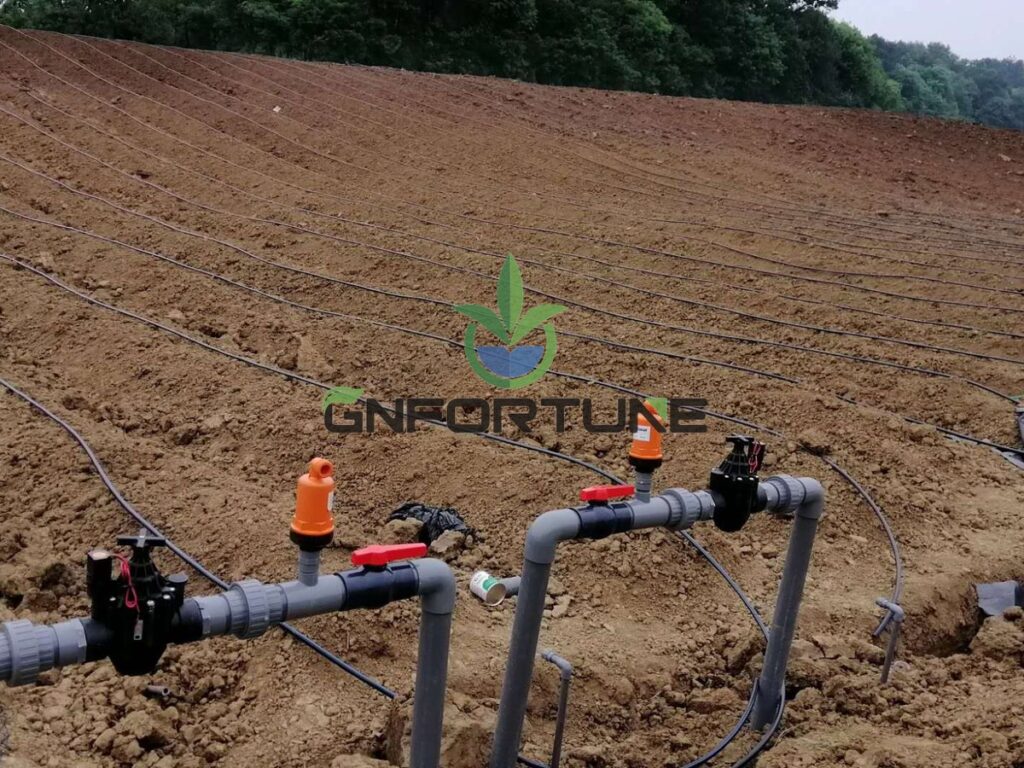
Protection sits upstream of the injection point, on each clean-water branch feeding it — not downstream on the fertilized line. Two sources feeding one injector means two devices.
- Isolate each source where it joins the manifold — municipal, borehole and rainwater each separately.
- Protect before every fitting that can hold reverse flow: injector tee, tank fill, hose bib, drain.
- Keep vacuum breakers above the highest downstream outlet — a few hundred millimetres as a planning allowance, with the local figure overriding it.
- Give RPZ relief ports a drain line that cannot be submerged or blocked.
- Leave clearance for test cocks, isolation valves and repair — devices needing dismantling to test do not get tested.
On the air-gap route the fill spout must discharge above the flood-level rim by a locally set distance, so that dimension has to be fixed before pipe heights are cut — adding clearance above an installed tank rarely works.
Filtration and Water Quality Decide Whether the Seal Holds
Every device here except the air gap depends on a seal moving freely, and grit or crystallised fertilizer stops it. Upstream filtration belongs to backflow prevention as much as to emitter protection.
Source decides the filter class: borehole water carries sand and iron, surface water carries silt and organic fines, mains water carries occasional debris after network works. Matching screen, disc or media filtration to that load is covered in the filtration comparison, and the same logic applies upstream of the injector.
The less obvious failure is chemical: concentrate drying on a seal leaves scale, and a thin crust will hold a spring-loaded check open. Periodic flushing and a look at the relief port tell you more than the outside of the body does.
Two consequences follow: specify wetted materials against the actual concentrate range, acid included where pH correction is dosed, since some elastomers and brass grades do not survive it; and put the device where a monthly glance will happen.
Who Confirms Which Assembly Your Region Requires
The local water authority or plumbing regulator confirms it, based on hazard classification rather than installer preference. Get that answer in writing before the manifold is fabricated.
In North America the assembly class normally traces to plumbing code and its referenced certifications, reviewed for imported installations under the regime covered in plumbing codes for hydroponics equipment. European schemes start from fluid categories. Where no list is published, the water utility still decides, so its letter is the deliverable to request.
Then name four items in the order: hazard classification, certified standard, who supplies the test certificate, and who pays the annual retest. Without those lines, the cheapest device quoted is usually the one nobody can certify locally.
Inspection Intervals and What to Record
Licensed-tester regimes set a fixed interval — annually is the common default — and visual checks happen far more often on a working site. Confirm the binding interval locally before writing it into a maintenance plan.
- Monthly: check relief ports for weeping, look for corrosion and leaks at the body, confirm nothing has been plumbed around the device.
- Quarterly: exercise isolation valves so test cocks still turn when needed.
- Annually: formal test with a documented figure for each check, in the certificate format required.
- After an event: any supply interruption, freeze or modification warrants a retest.
Records should carry device serial, test values, date, tester licence number and corrective work — those fields answer the insurer’s question later. Repair kits and check modules belong on the same stock list as pump seals and solenoid coils.
Getting Backflow Prevention Fertigation Right Before Commissioning
Treat this as three linked decisions made early: which connections count as high hazard, which protection method each accepts, and where devices fit with clearance for testing. Model numbers, pipe sizes and ownership of the retest follow once those three are settled by whoever carries the liability.
Retrofits are what happen when this is skipped. Re-plumbing a manifold to accept a certified assembly costs far more than leaving clearance from the start, and work on the injection point means re-verifying dosing accuracy.
Backflow prevention fertigation is cheapest at design stage. The useful habit: walk the potable runs looking for hoses and tees — the connections that create exposure while every pump is healthy, and cost nothing to fix during design.
FAQs About Backflow Prevention on Fertigation Lines
Is a check valve enough for a fertigation line?
Only where the authority classifies the connection as low to moderate hazard and accepts a testable double check assembly. A single spring check is rarely accepted against a potable connection.
Do we need protection if we only use rainwater?
If there is genuinely no potable connection on site, the statutory requirement usually falls away. Any backup top-up or future municipal link restores it, so most farms specify protection once rather than reopen the plumbing later.
How often should assemblies be tested?
Annually is the common default under licensed-tester regimes, with a monthly visual check. The figure that binds your site comes from the utility or code, so confirm rather than inherit one.
Can the injector sit below the mixing tank?
Elevation above the receiving liquid level is part of how these devices work. Below the flood-level rim they will not protect, so check it before fixing pipe routes.
Who pays when a retrofit is ordered after inspection?
Whoever the contract names. Installations built without certified protection become a variation, and unless the RFQ specified the assembly, supplier scope is usually silent on the cost.
Related Reading
- Fertilizer Injectors for Hydroponic Farms: The Full Guide — Injector types and sizing, and how the injection point shapes the rest of the line
- Hydroponic Water Treatment: RO, UV and Ozone — Where treatment sits in the source-to-emitter path and what each stage removes
- Solenoid Valves in Hydroponics: Specifying Zone Valves and Manifolds — Zone valve and manifold layouts that keep protection accessible for testing
- Hydroponic Spare Parts Inventory: Annual Maintenance Plan for Commercial Farms — Where repair kits and check modules belong in the annual stock plan
- Hydroponic System Commissioning: Installation Sequence, Testing and Site Acceptance — The acceptance tests to run before a fertigation line is signed off
Next Step: What to Send for a Quotation
Protection is quoted against the connection, not the pump. Suppliers cannot guess which class your authority accepts, so send the classification with the enquiry.
Specifying an injector line? For RFQ or project consultation, send: greenhouse dimensions and available area; crop and target output; injector type and dosing range; number and type of water sources (municipal, borehole, rainwater); the hazard classification your utility has stated, or confirmation that none has been issued; any governing plumbing or certification standard; whether this is new build or retrofit to an existing manifold; automation level requested; delivery schedule; and the budget band. G AND N FORTUNE LIMITED supplies injector assemblies, valves, filters and matching pipework as part of hydroponic project packages, quoted to those parameters.