

The Two Weeks That Decide the Next Ten Years
Commissioning is where a good design either proves itself or quietly gets blamed for a bad installation. It is also the shortest phase of the project and the one most often compressed when the schedule slips — which is how farms end up debugging hydraulics with plants already in the channels.
Treat commissioning as a defined scope with named tests, acceptance criteria and signatures, not as “the supplier’s engineer will come and start it up.” This guide sets out the sequence, the tests that actually catch problems, the documents to require at handover, and the punch-list discipline that gets defects fixed while the team is still on site.
Phase 1: Pre-Installation Checks
| Check | Criteria | Why it matters |
|---|---|---|
| Foundation survey | Column base within ±5 mm in plan, ±3 mm in level | Everything downstream inherits this error |
| Material receipt | Count against packing list; inspect for transit damage; photograph | Transit claims are time-barred; document before unloading is finished |
| Specification match | Material certificates, channel dimensions, wall thickness, UV rating | Verify against the datasheet you approved, not against the invoice |
| Services readiness | Water, power, drainage, compressed air available and tested | The most common cause of a stalled commissioning week |
| Storage conditions | Channels and plastics under cover; no point loading on stacked goods | Sun and stacking damage before installation is common and invisible later |
Phase 2: Mechanical and Hydraulic Installation
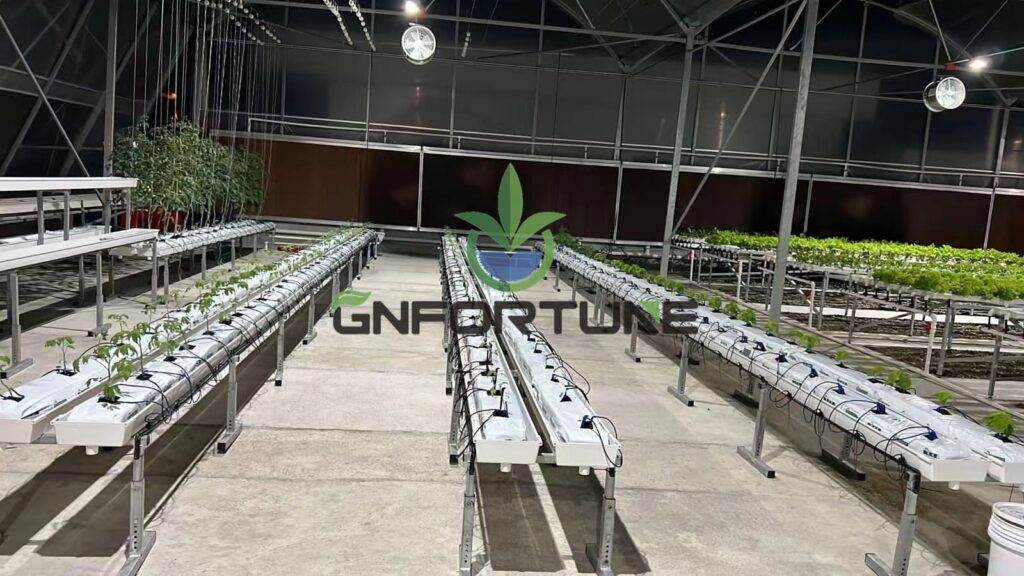
- Structural first: frame, then gutters and racking, then services. Never hang irrigation from a structure that is still being aligned
- Set gutter slope from a survey, not from eye. For NFT, verify as-built slope over the full run and record it — see our NFT installation guide for the target values
- Support pipework independently. Pipe weight belongs on supports and hangers, not on channels, tanks or fittings
- Keep the tank room dry and serviceable. Space around pumps for removal, drainage at floor level, and lighting to work by
- Label everything. Zone numbers on valves, direction arrows on pipes, equipment IDs on panels. An unlabelled plant room costs hours on every fault
- Install isolation and drain points at every low point and at every piece of equipment that will ever need service
Phase 3: Testing Before Water
| Test | Method | Acceptance |
|---|---|---|
| Pressure test | Fill and pressurise to 1.5× working pressure, hold, observe | No pressure loss and no visible leakage over the hold period |
| Electrical test | Insulation resistance, earth continuity, rotation check on three-phase motors | Within code limits; correct rotation before coupling |
| Control panel test | I/O check: every sensor and actuator exercised and confirmed | Every point responds and reads plausibly, including spares |
| Safety systems | E-stops, level switches, flow switches, door interlocks, alarms | Each device trips the correct action and annunciates |
| Valve and actuator test | Open/close/fail position under power and on power loss | Fail-safe position matches the design intent |
Phase 4: Wet Commissioning
- Flush before filling. Construction debris, swarf and flux do not belong in emitters; flush mains to waste before connecting zone outlets
- Fill and vent systematically. Air locks masquerade as blockages; vent at high points and at every riser
- Balance the zones. Measure flow at the head, middle and tail of every zone and record valve positions once balanced
- Verify emitter output. Collect and measure at representative emitters; the acceptance figure is uniformity, not the pump discharge reading
- Verify the far end. Channel outlet flow and root-zone EC at the furthest point are the numbers that matter
- Check return capacity. Supply exceeding return capacity backs up end caps and floods walkways at peak flow
- Run the dosing system on water only before introducing concentrated stock; verify injection rate and check for siphoning
- Charge and test sanitiser dosing with the correct safety interlocks and a measured residual at the far end
Phase 5: Crop Readiness
| Item | Criteria before planting |
|---|---|
| Solution quality | EC and pH at target, stable over 24 hours, water analysis on file |
| Temperature | Root-zone temperature within the crop target band, logged over 24 hours |
| Uniformity | Emitter and channel output within the agreed uniformity band |
| Alarms | Every alarm tested end to end, including the call-out path to a mobile phone |
| Redundancy | Standby pump, backup power and emergency irrigation exercised under load |
| Documentation | O&M manuals, as-built drawings, calibration certificates, spares list on site |
| Training | Operating staff signed off on daily, weekly and emergency procedures |
Documents to Require at Handover
- As-built drawings: layout, hydraulics, electrics, foundation and structural connections
- Equipment datasheets and material certificates, matched to what was actually installed
- Test records: pressure test, electrical test, flow balance, emitter uniformity, calibration certificates
- O&M manuals with the maintenance schedule and the spare parts list with part numbers
- Controller configuration backup, setpoint schedule and alarm escalation list
- Warranty terms in writing, including what voids them — see our guide to reading supplier drawings and datasheets
- Punch list with owners and dates, and a retention arrangement that keeps it alive until closed
The Punch List Is the Point
- Walk the site with the installer before their team demobilises, and write every defect down with a photo
- Classify defects: safety, crop-critical, cosmetic — and fix in that order
- Set a date for each item and a named owner, not a general undertaking
- Link final payment to closure. A retention held until the punch list is closed is the only lever that reliably works
- Re-walk before release. Half of the items on a punch list are re-opened if nobody re-inspects
FAQ
How long does commissioning a commercial hydroponic system take?
Typically two to four weeks for a multi-zone greenhouse: about a week of mechanical completion and dry testing, a week of wet commissioning and balancing, and a further week to stabilise solution chemistry and train staff before planting. Compressing that usually costs more later.
What is site acceptance testing?
A defined set of tests with pass criteria, witnessed and signed by both parties: pressure and electrical tests, flow balance and emitter uniformity, alarm and fail-safe verification, and a stable 24-hour run at target EC, pH and temperature.
Should I plant before commissioning is finished?
No. Plants in the channels make every subsequent fix slower and riskier, and they convert a hydraulic problem into a crop problem. Hold planting until uniformity, alarms and redundancy are verified.
Who supplies the water and power during commissioning?
The owner, in almost all contracts. Confirm capacity, quality and connection dates in writing early: unavailable services are the single most common cause of a lost commissioning week.
What should trigger withholding final payment?
Any open punch-list item classified as safety or crop-critical. Cosmetic items can carry a small retention with an agreed closing date, but nothing that affects production should be outstanding at handover.
Do I need the supplier’s engineer on site?
For first commissioning, yes — especially for controller configuration, dosing calibration and redundancy testing. Budget for it in the project cost rather than treating it as an optional extra.
Get the Commissioning Scope Written Into the Contract
Send your project scope and layout through the quote form. We will return a commissioning plan with test procedures, acceptance criteria, a handover document list and an on-site engineering scope you can attach to the purchase order.