

When a hydroponic equipment order goes wrong, the failure rarely starts on the production floor — it starts in the documents signed before anything was built. The technical package a supplier issues with a quotation, typically a hydroponic system CAD drawing set, a bill of materials (BOM), and component datasheets, is the clearest evidence available of what you are actually buying. A buyer who can read that package can compare quotes honestly, catch missing scope before it becomes a change order, and hold both sides to the same numbers after delivery. This guide walks through what a complete package contains, how to read each document, and the red flags that suggest the supplier has never fully engineered the system they are selling.
What a Serious CAD Package Should Contain
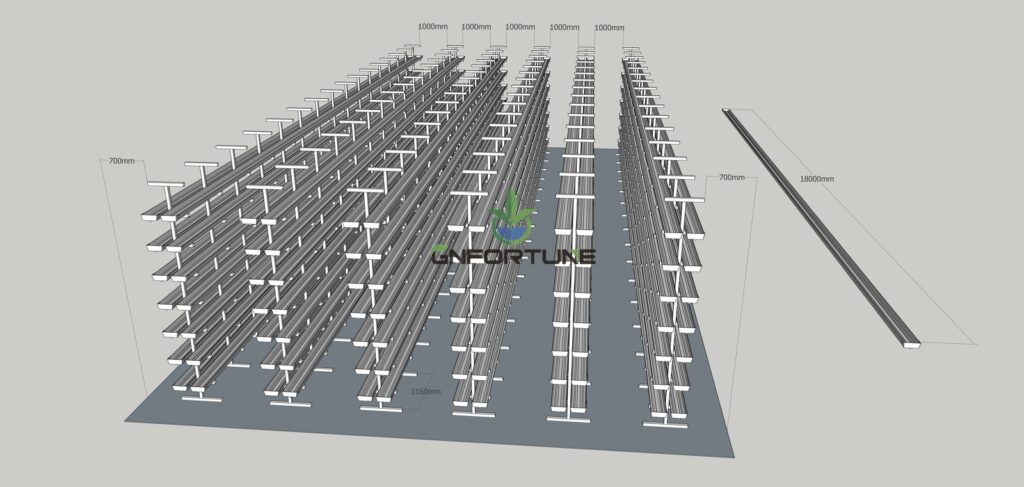
Three-dimensional CAD render of a multi-span greenhouse system, showing the level of detail a serious supplier CAD package should containFor a commercial greenhouse or indoor growing installation — NFT lines, Dutch buckets, ebb and flow tables, or a vertical system — a complete drawing set from the supplier should include at minimum:
- General arrangement (GA) plan: the whole growing area from above, with channel rows, tables, aisles, and equipment positions dimensioned.
- Elevation drawings: side views showing channel heights, support stands, and vertical clearances to structure and light fixtures.
- Section details: cut-views through critical joints — channel to return line, stand to floor, table to drain — where installation mistakes actually happen.
- Irrigation schematic: the flow logic: pump, filter, manifolds, supply and return lines, valve positions, and where water enters and exits each bay.
- Electrical layout: pump and controller positions, supply points, and which side of the scope each connection belongs to.
- Support and structure drawings: stand spacing, anchoring, and rated loads for benching and multi-level racks.
- Loading plan: how the order packs into containers, with piece counts per container — the honest test of whether the supplier has shipped this configuration before.
- Title block and revision index: scale, units, drawing numbers, revision dates, and a named engineer responsible for the set.
The revision index matters more than buyers expect. A supplier who issues revision 3 with a dated changelog is running an engineering process; a supplier whose only drawing is an undated PDF that “reflects the latest design” is running a sales process. When this package feeds a full layout exercise, it belongs alongside the inputs described in the hydroponic engineering input list — the site and climate data you provide determine what the drawings should show.
Reading the Layout Drawing: Dimensions, Slopes, and Channel IDs
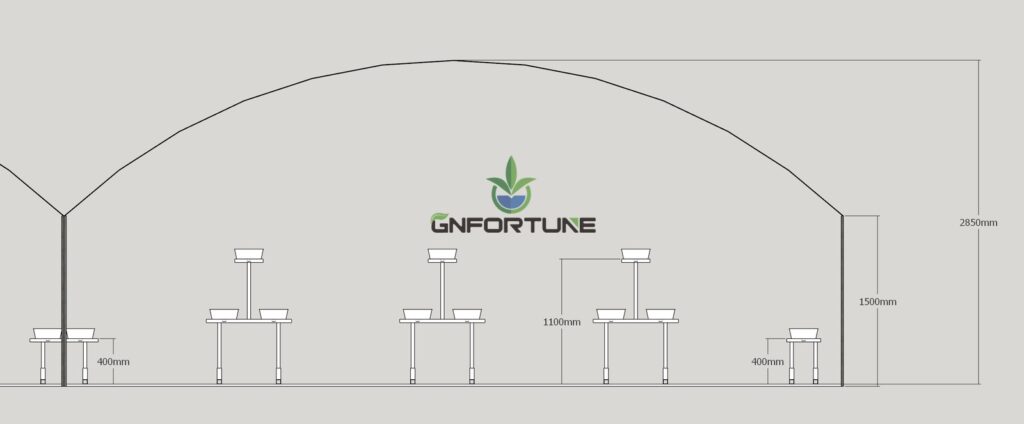
CAD elevation cross-section drawing of an arched greenhouse with crop rows, dimensions, and column spacing annotatedThree things on the GA plan deserve a careful read. First, dimensions against your own building drawings, not against marketing floor areas. Check post positions, door swings, and the actual internal clear width — the classic discovery is a channel run that fits the drawing’s “20 m bay” but not the 19.4 m bay the greenhouse actually has. Second, slopes. NFT and drain lines should carry an annotated slope, normally 1–2% for NFT runs and return lines; a drawing with no slope callouts is a drawing that has never been installed level. Third, channel IDs. Every channel, table, and bucket line should carry a reference code that appears again in the BOM, so that “channel type C-102” on the drawing and “C-102” on the packing list and the BOM are provably the same object.
Also check what the drawing does not show. Aisles should be dimensioned wide enough for harvest trolleys — a 60 cm aisle on paper becomes a bottleneck that costs labor every single day. Drain direction arrows should exist, and the reservoir position should make gravity returns possible without a lift pit that nobody quoted.
Reading the BOM: Specs, Tolerances, and Missing Items
A bill of materials is the commercial heart of the package because it is the list that determines price, spares, and what arrives in the container. Read every line for four fields: part identifier, material specification, quantity, and scope — whether the supplier provides it, the buyer provides it, or it is excluded. Then read the list for what is missing, because the missing lines are where the budget leaks:
- Consumables: gaskets, seals, joining clips, fasteners, and thread sealant are unglamorous lines that are quietly omitted from cheap quotes and purchased separately at retail prices later.
- Spares: a supplier confident in a product line normally offers a suggested spares package (pump seal kit, spare valves, spare end caps). No spares offer can mean no field history.
- Excluded scope: electrical supply to the panel, water supply to the reservoir, and civil works are legitimately often excluded — but exclusions should be written as lines, not discovered at installation.
- Tolerances: lengths and thicknesses with no tolerance (for example, “channel length 6000 mm” versus “6000 +0/−10 mm”) cannot be rejected at inspection, because anything delivered technically meets the spec.
A BOM that lists specifications rather than brand-generic descriptions (“UV-stabilized PVC channel, 2.5 mm nominal wall” rather than “growing channel”) is one you can take to inspection. That difference, more than price, is what separates a hydroponic system BOM you can enforce from one you can only argue about.
Reading the Datasheet: Materials, Thicknesses, and Flow Rates
Datasheets are where claims about materials and performance should be testable. Four elements decide most disputes:
| Element | What to check | What a serious datasheet shows |
|---|---|---|
| Material and grade | Polymer type, UV stabilization, food-contact suitability | Named resin or grade class, e.g. UV-stabilized PP or PVC, with food-contact compliance stated for wetted parts |
| Wall thickness | Nominal thickness and tolerance | A number with a tolerance range — not “heavy duty” |
| Load and deflection | Rated load per support span under wet weight | Load rating with the span it applies to; deflection limit at full load |
| Flow and pressure ratings | Flow rates and pressure class for channels, valves, and fittings | Ratings with the test condition stated, ideally backed by a third-party or factory test report |
Where a datasheet claims a performance number — a flow rate, a load rating, a lifespan — the follow-up question is what test backs it. Reputable manufacturers supplying OEM and custom production runs maintain test reports for exactly these questions and can produce them on request; the inability to do so tells you the number was written for the catalogue, not measured in a lab.
An advisory habit worth forming before your next purchase: the thinnest technical package and the lowest quotation are usually the same document. When comparing suppliers, compare the drawing sets line by line before comparing the prices line by line — a quote that looks 15% cheaper often just has fewer channels, fewer fittings, and no drawings behind it. The package is the price.
Red Flags Before You Sign a Pro Forma Invoice
Seven signals that a technical package is not what it should be:
- No revision index or dates — you cannot establish which version is current, so no drawing can ever be enforced.
- Mixed units with no statement — channel lengths in feet, tank volumes in liters, and head in meters in the same set, with no primary-unit declaration, is a sign of an assembled-not-engineered package.
- A BOM marked “subject to change without notice” — the supplier is reserving the right to deliver different materials than quoted.
- No tolerances anywhere — every dimension nominal, every material generic; nothing can be rejected at inspection because nothing was ever specified.
- No test reports for performance claims — flow rates and load ratings that exist only in the catalogue.
- Rendered images instead of dimensioned drawings — attractive perspectives are marketing; a project needs plans, sections, and elevations with dimensions.
- Refusal to attach the drawings to the contract — the package exists for quotation but is excluded from the pro forma invoice terms, meaning it governs nothing once payment is made.
A Buyer’s Checklist: Twelve Questions to Ask Any Supplier
Before signing, put these twelve questions in writing and keep the answers with the contract file:
- Can you provide the full drawing set (GA, elevations, sections, irrigation schematic) with a revision index?
- Who engineers the layout, and is that engineer reachable for questions during installation?
- Which items on the BOM are excluded from your scope?
- What tolerances apply to channel length, wall thickness, and stand height?
- What test reports back the flow and load ratings in the datasheet?
- Which polymer and stabilizer grades are used, and are wetted parts food-contact compliant?
- What is the suggested spare parts package for the first two years?
- How is the order packed, and what is the piece-count list per container?
- What slope and support spacing does the layout assume, and who verifies them on site?
- What happens if delivered items do not match the drawings or BOM?
- Will the drawings and BOM be attached to the pro forma invoice as contract documents?
- Who owns the drawings after purchase, and in what format are they issued?
A supplier with real engineering behind the product answers these without drama — for most of them the answer already exists in a document that simply gets attached to the reply. That speed of answer is itself a signal: the system design resource covers what good design input looks like from the buyer’s side, and the questions above are the mirror image from the supplier’s side.
FAQ
Should a supplier give me native CAD files?
A: Dimensioned PDFs to scale are standard and usually sufficient for installation and coordination. Native files are reasonable to request if your own engineers will modify the layout, but expect them to be a negotiated item rather than a default deliverable.
What is the difference between a datasheet and a BOM?
A: The datasheet describes what each component is — material, thickness, ratings. The BOM lists how many of each component the order contains and who supplies what. You need both, and they must cross-reference each other cleanly.
Are drawings a contract document?
A: They should be. Attaching the drawing set and BOM to the pro forma invoice is what makes the specification enforceable at inspection and delivery. A package that exists only in email threads governs very little.
What if a supplier refuses to issue detailed drawings?
A: Treat it as a serious red flag. Drawings are cheaper for a supplier to produce than equipment is for you to replace, and refusal usually means the system has not been fully engineered, or that the delivered product would not match a drawn one.
How detailed should the loading plan be?
A: Detailed enough to reconcile at the port: piece counts per container, per item, matching the BOM. It is the cheapest verification that what was ordered is what shipped.
Get the Twelve-Question Checklist Before You Sign
Request the 12-question supplier checklist through the quote form, and if you already have quotations in hand, send them the same way — the team will review the technical package behind your quotes and flag what is missing, what is vague, and what it will cost you after delivery, before you sign an order rather than after.