

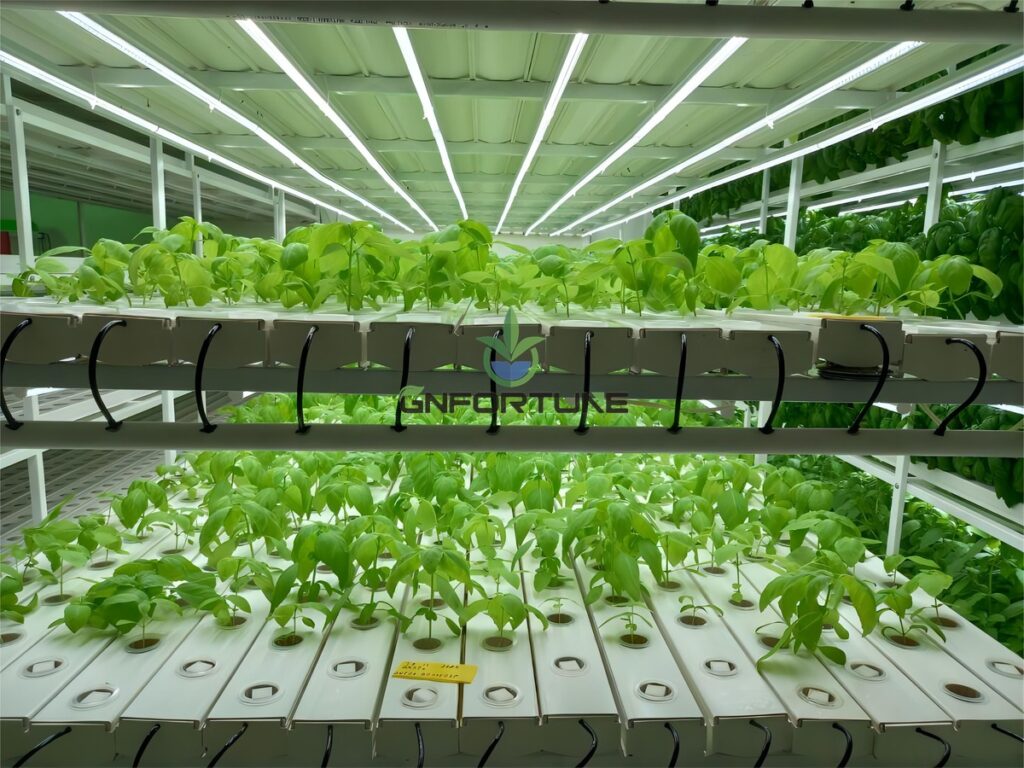
Quick answer: hydroponics (NFT channels, dutch buckets, DWC) is the proven commercial default — the lowest-risk, best-supported path to revenue. Aeroponics mist-feeding delivers impressive water efficiency and clone/root-crop results but adds equipment fragility and management load that makes pure-play commercial farms rare. Aquaponics adds fish to the loop — compelling for integrated-agritourism and education economics, harder to justify on vegetable margins alone. Most commercial operators should start hydroponic; the other two earn their place in specific business models.
The Three Systems in One Table
| Criterion | Hydroponic | Aeroponic | Aquaponic |
|---|---|---|---|
| How roots are fed | Flowing or standing nutrient solution | Nutrient mist in air, timed cycles | Fish waste converted by bacteria to plant feed |
| Commercial track record | Deep — industry standard globally | Thin — niche producers, seed potato, clones | Mixed — successful but specialist |
| Equipment complexity | Moderate — pumps, filtration, dosing | High — mist nozzles, high-pressure pumps, timers | High — fish tanks + biofilter + plant system |
| Primary failure mode | Power outage (NFT ~30 min; DWC hours) | Nozzle clog / mist failure (minutes of buffer) | Biology crash — bacterial cycle or fish health |
| Management skill needed | Agronomy + basic maintenance | Agronomy + precision equipment care | Agronomy + aquaculture + microbiology |
| Revenue streams | Crops | Crops (premium claims) | Crops + fish |
| Best-fit business | Commercial greens/vine production | Seed stock, clones, showcases, research | Education, agritourism, integrated food brands |
Aeroponics: Real Strengths, Real Fragility
Aeroponics suspends roots in air and mists them on timed cycles. The water-efficiency numbers are genuinely excellent and oxygen access is unbeatable — which is why it shines in plant propagation, clone production and seed potato programs, where the crop value justifies the equipment attention.
The commercial catch is fragility: every mist cycle is a single point of failure. A clogged nozzle bank or a timer fault starves roots in minutes — no media, no tank, no buffer. Scaling that risk across a full commercial greenhouse means duplicating high-pressure pumps, redundant timers and disciplined nozzle maintenance. Some operations manage it well; most farms we’ve watched attempt full-scale aeroponics spent their first two years becoming maintenance experts instead of growers.
Aquaponics: Two Businesses in One Loop
Aquaponics couples fish tanks with plant production — fish feed becomes bacterial-converted plant nutrient, plants clean the water for fish. It’s elegant, sustainable and genuinely fascinating to operate. The commercial reality is that you’re running two livestock businesses plus a microbiology lab, and each has its own failure schedule:
- Nutrient levels follow fish feeding, not crop stage — you can’t push EC for fruiting the way hydroponics can
- The bacterial cycle (ammonia → nitrite → nitrate) takes weeks to establish and punishes restarts
- Fish and vegetables each have their own markets, pricing and buyers — double the sales work
Where aquaponics genuinely wins: operations whose revenue is partly experience — farm tours, education contracts, restaurant sales of “our fish and our greens” as one story. As pure vegetable production it underperforms hydroponics on cost and control. If you’re planning an integrated operation, our aquaponics greenhouse solutions page covers the equipment side.
What We Advise Commercial Buyers
The decision rule we give every client: unless your business model specifically monetizes fish (aquaponics) or plant-propagation premiums (aeroponics), start hydroponic. It’s the only one of the three where the equipment, the agronomy and the market are all mature at commercial scale — and where support, spare parts and experienced staff exist anywhere you operate. You can add an aeroponic propagation zone to a hydroponic farm later; recovering a stalled project is far harder than expanding a working one.
Within hydroponics, the next fork is NFT vs dutch buckets vs DWC — covered in this comparison and this one.
FAQ
Is aeroponic produce better?
A: Quality claims mostly overlap with good hydroponic practice. Where aeroponics measurably wins is propagation and specific root crops. For leafy greens, hydroponic output is commercially indistinguishable.
Is aquaponic produce organic?
A: Depends entirely on your jurisdiction’s certification rules — the fish-feed inputs define eligibility. Never assume; check your local certification before building a business plan on the claim.
Can I combine systems?
A: Yes — a common layout is hydroponic main production with an aquaponic demonstration bay for visitors. Design them as separate loops.
Next Step
If the decision path points to hydroponics — as it does for most commercial buyers — explore our commercial systems or send your project basics through the quote form.