

An aquaponics greenhouse grows vegetables and raises fish in one recirculating loop: fish waste feeds bacteria, bacteria convert it to plant nutrient, plants clean the water for fish. Done right it’s a water-frugal, story-rich production system that sells premium produce and protein under one roof. Done naively it’s two failing livestock businesses strapped together. This page covers what we supply for aquaponic projects — and the honest engineering questions that decide whether your project is one of the good ones.
How the Integrated Loop Works
| System stage | What happens | Engineering notes |
|---|---|---|
| Fish tanks | Fish are fed; waste water carries ammonia | Tank volume and stocking density set the nutrient budget |
| Solids removal | Solids filter removes fish waste particles | Undersized solids removal is the #1 aquaponics failure we’re asked to fix |
| Biofilter | Bacteria convert ammonia → nitrite → nitrate | Cycling takes weeks; size for peak load, not average |
| Plant zone | Plants (typically media beds or raft/DWC) absorb nitrates | Leafy greens dominate; fruiting crops need supplemental feed |
| Return | Cleaned water returns to fish | Loop must close through all stages, every hour of every day |
The nutrient reality check: fish-driven nutrient levels track the fish feeding rate, not your crop’s growth stage. Fruiting crops (tomatoes, strawberries) generally need supplemental mineral feeding beyond what fish waste delivers — plan the dosing equipment for it rather than discovering it mid-season. Leafy greens are the natural aquaponic crop.
What We Supply for Aquaponic Projects
We manufacture and integrate the hardware side — the same commercial-grade equipment that runs our pure hydroponic systems, adapted to the aquaponic loop:
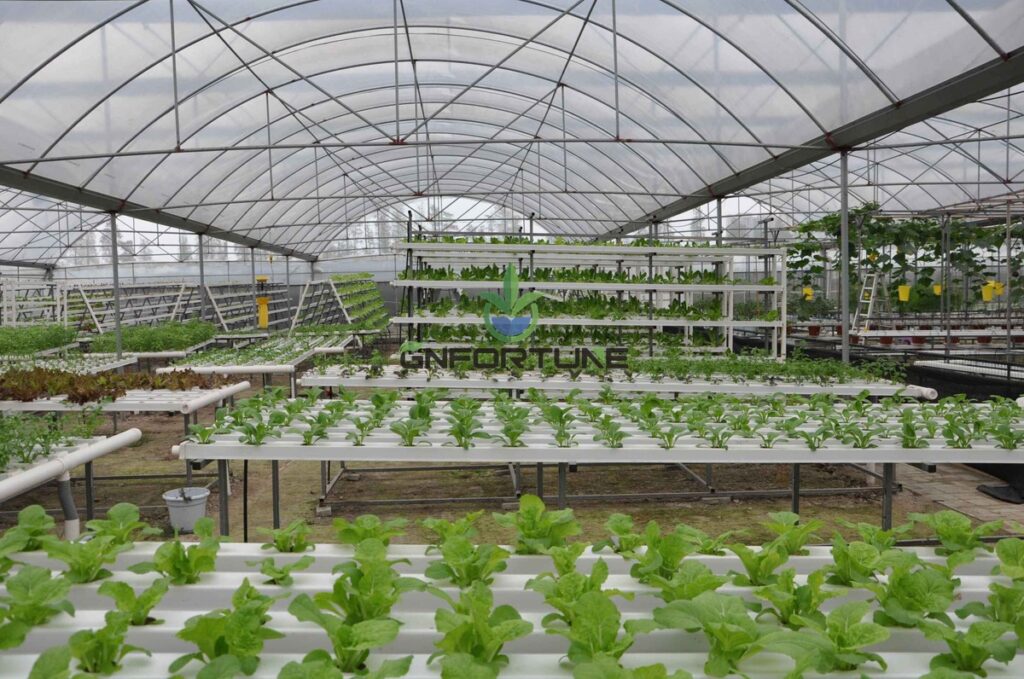
- Growing systems: NFT channels and media bed structures sized for the fish-side nutrient output
- Irrigation & filtration: solids filtration, biofilter media housings, pump sets with standby
- Water handling: pipe systems, valves and zone controls rated for continuous recirculation
- Greenhouse coordination: we design the plant-zone equipment to interface with your greenhouse contractor’s structure — see turnkey project delivery
Fish husbandry — species selection, stocking, health management — stays with your aquaculture specialist. We build the water loop; we don’t pretend a channel factory replaces a fisheries biologist.
The question to ask any aquaponics equipment supplier: “What happens to the plants when the fish side is under-fed, and what happens to the fish when the plants are between cycles?” A designed system has buffer tanks and contingency answers. Most failed projects we’ve reviewed had neither — they treated the loop as plumbing rather than the living balance it is.
Who Should Build One — Honestly
| Strong fit | Weak fit |
|---|---|
| Education & agritourism venues monetizing the story | Pure vegetable-margin operations (hydroponics wins on cost & control) |
| Farms with existing aquaculture expertise adding plant revenue | Teams with no aquaculture experience and no specialist partner |
| Brands selling integrated “fish + greens” baskets to premium buyers | Operations needing precise crop-stage nutrient control |
| Water-scarce regions wanting maximum output per liter | Investors chasing a single-figure ROI model |
For the full comparison with hydroponics and aeroponics, see aeroponic vs hydroponic vs aquaponic.
FAQ
Which fish work best?
A: Tilapia dominates warm-water systems; trout and perch suit cooler climates. Match species to your water temperature before anything else — the fish’s comfort range dictates more of the design than the plants do.
How long before the system is productive?
A: Biological cycling alone takes 4–6 weeks before plants can be added at full density; plan first revenue 3–6 months after build, and treat the first season as commissioning.
Can I run it hydroponically first and add fish later?
A: Yes — and we often recommend it. Design the loop with the biofilter and tanks included, run it hydroponically to prove the plant side, then introduce fish. The equipment is the same; only the nutrient source changes.
Plan Your Aquaponic Greenhouse
Send your site details, target crops and fish species (or “undecided”) through the quote form — we’ll return a plant-zone design integrated with your water loop, with the honest gaps marked for your aquaculture specialist.