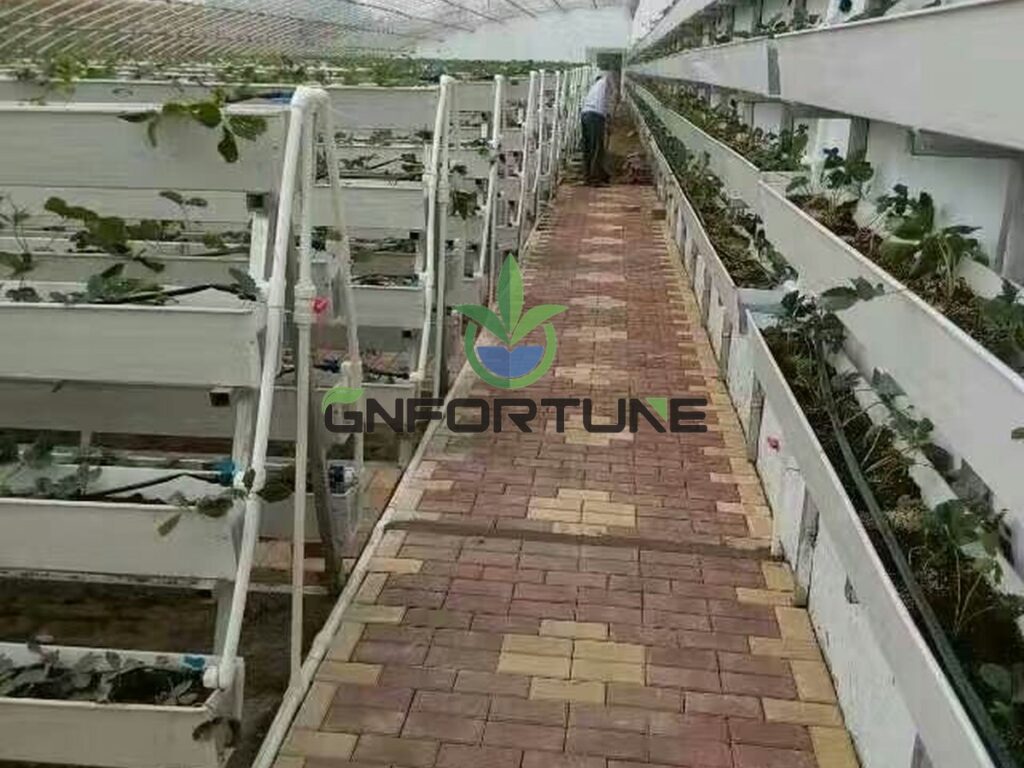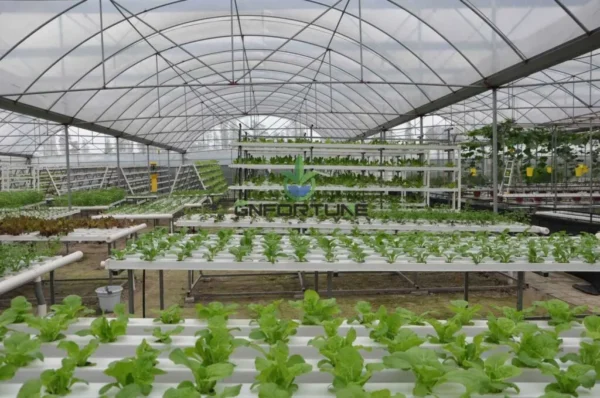
A commercial aquaponics system combines fish farming and soilless plant production in a managed water circulation system. Fish are raised in tanks, while plants grow in dedicated growing areas that receive nutrient-containing water from the aquaculture side.
The system depends on a carefully managed biological and mechanical process. Fish produce waste containing ammonia, mechanical filtration removes suspended solids, and beneficial bacteria convert ammonia into nitrite and then nitrate. Plants take up part of the available nutrients, while treated water is managed and returned to the fish-rearing system.
For commercial greenhouse projects, successful aquaponics design requires more than connecting fish tanks to growing channels. Fish production, filtration capacity, biofilter performance, plant requirements, water circulation, oxygen supply and monitoring must be planned as one coordinated operation.
This guide explains how commercial aquaponics systems work, which equipment components are required, how to plan fish and plant production, and what buyers should prepare before sourcing equipment for a new project.
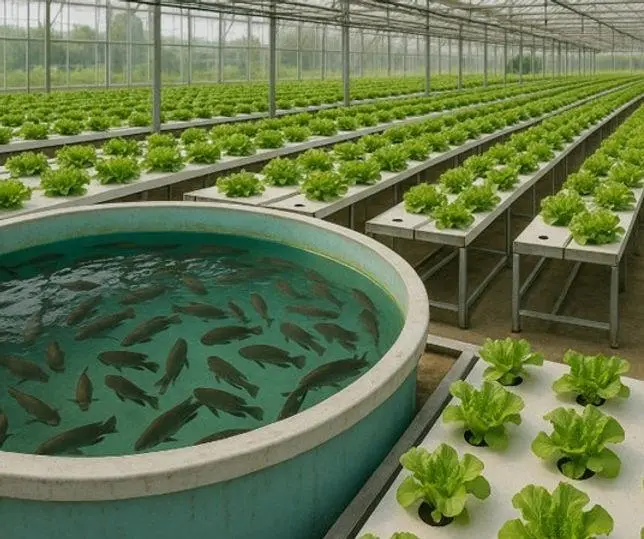
What Is a Commercial Aquaponics System?
A commercial aquaponics system integrates aquaculture and hydroponic plant production through managed water and nutrient circulation.
Unlike conventional hydroponics, where nutrients are supplied through a formulated nutrient solution, aquaponics uses nutrients generated partly through fish feeding and biological waste processing.
The fish-rearing environment and plant-growing environment have different operating requirements. Fish require suitable water quality, dissolved oxygen and species-specific conditions. Plants require adequate nutrients, root-zone oxygen, suitable temperatures and consistent irrigation.
A successful system must accommodate both sets of requirements without allowing one production area to compromise the other.
Commercial aquaponics projects may be developed for:
- Leafy vegetable production combined with freshwater fish farming.
- Greenhouse operations producing fish and vegetables for local markets.
- Educational and demonstration farms.
- Integrated agriculture projects in locations where water management is an important consideration.
- Farms seeking to diversify revenue through combined aquaculture and plant production.
The appropriate configuration depends on the target fish species, crop selection, production scale, available water, operating expertise and market requirements.
How a Commercial Aquaponics System Works
A commercial aquaponics system typically moves water through several connected treatment and production stages.
| System Stage | Main Function | Key Design Consideration |
|---|---|---|
| Fish tanks | Hold fish and receive feeding inputs | Tank volume, stocking density and water quality |
| Mechanical filtration | Removes suspended fish waste and uneaten feed | Solids loading, filter capacity and cleaning access |
| Biological filtration | Supports bacteria that convert ammonia into nitrite and nitrate | Biofilter capacity, oxygen supply and biological maturity |
| Plant-growing area | Uses available nutrients for crop production | Crop selection, planting density and growing method |
| Water circulation | Moves water between treatment and production zones | Pump capacity, pipe sizing and flow distribution |
| Monitoring and control | Tracks important water and operating conditions | Sensor placement, alarms and maintenance procedures |
Understanding the Aquaponics Nitrogen Cycle
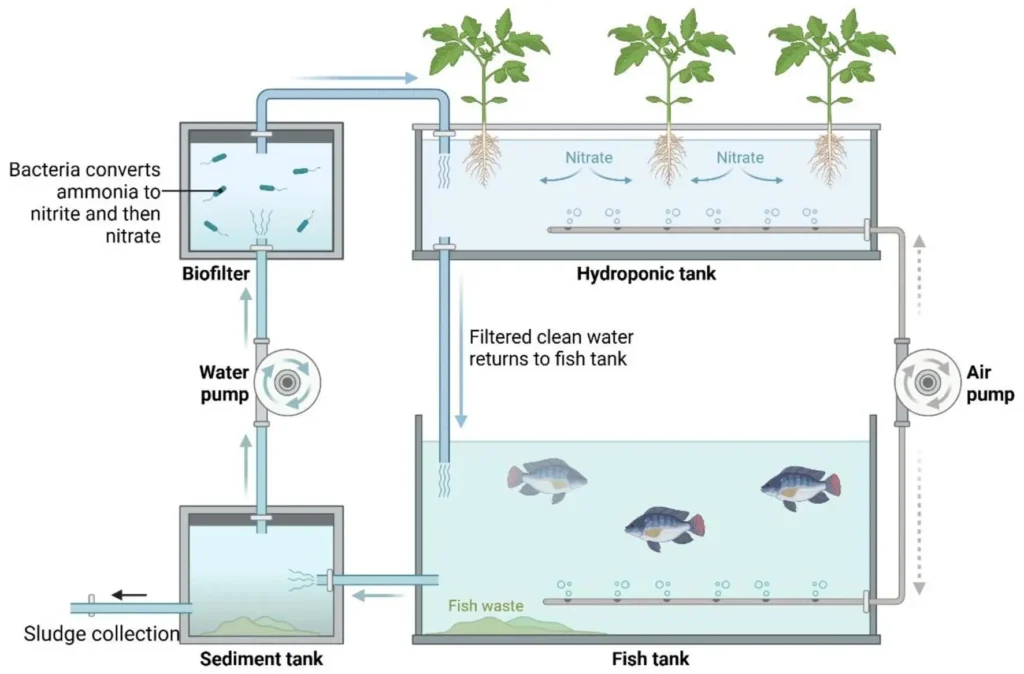
The nitrogen cycle is central to aquaponics operation.
Fish excrete ammonia through their metabolic processes, and additional nitrogen-containing waste enters the water from uneaten feed and organic material.
Beneficial nitrifying bacteria support two important conversion stages:
- Ammonia is converted into nitrite by ammonia-oxidizing microorganisms.
- Nitrite is converted into nitrate by nitrite-oxidizing microorganisms.
Plants can absorb nitrate and other available nutrients through their roots. Mechanical filtration also plays an important role because accumulated solids can increase organic loading and interfere with water treatment.
The biofilter must have sufficient biological capacity for the expected fish feeding load. Its performance depends on factors including surface area, water flow, dissolved oxygen, temperature, pH and system maturity.
A newly installed system should not be assumed ready for full fish stocking or full crop production immediately after construction. Biological cycling and commissioning should be completed under an appropriate management plan.
For a more detailed explanation, see our guide to the Nitrogen Cycle in Aquaponics.
Main Components of a Commercial Aquaponics System
The equipment configuration varies with production scale and system design. However, commercial projects generally require the following functional components.
Fish Tanks and Aquaculture Equipment
Fish tanks provide the controlled environment for aquaculture production.
Their dimensions and quantities should be determined by the target species, production cycle, stocking density, feeding rate and available water treatment capacity.
Important purchasing considerations include:
- Tank volume and dimensions.
- Material compatibility with the intended aquaculture application.
- Structural support and installation requirements.
- Water inlet and outlet arrangements.
- Drainage and cleaning access.
- Aeration and water circulation connections.
- Access for fish inspection and harvesting.
Tank capacity should not be used as the only basis for determining stocking density. Fish biomass, feeding rates, dissolved oxygen, waste production and filtration capacity must also be considered.
Mechanical Filtration
Mechanical filtration removes suspended solids before they accumulate in the biological treatment area or plant-growing zone.
Depending on the project, filtration may include settling equipment, screen filters, radial-flow separators or other suitable solids-removal arrangements.
When evaluating filtration equipment, buyers should confirm:
- Expected solids loading.
- Required flow rate.
- Particle removal requirements.
- Cleaning and sludge removal arrangements.
- Pressure loss and maintenance frequency.
- Compatibility with the overall water circulation design.
Inadequate solids removal can increase organic loading, create maintenance problems and affect water quality.
Biological Filtration
A biofilter provides a surface for beneficial bacteria involved in nitrification.
The filter should be sized according to the expected nitrogen load rather than selected only by its physical dimensions.
Important factors include:
- Maximum expected fish feeding rate.
- Ammonia and nitrite loading.
- Filter media surface characteristics.
- Water flow and oxygen availability.
- Operating temperature and pH.
- Biological start-up and commissioning requirements.
Biofilter capacity must be evaluated together with fish production plans. Increasing fish stocking or feeding without checking biological treatment capacity can destabilize the system.
Plant-Growing Systems and NFT Channels
The plant-growing area can use different configurations depending on crop type and production requirements.
Common approaches include:
- NFT channels for suitable leafy vegetables and herbs.
- Deep water culture or floating raft systems.
- Media beds for crops suited to substrate-based growing.
- Other growing arrangements selected according to the project design.
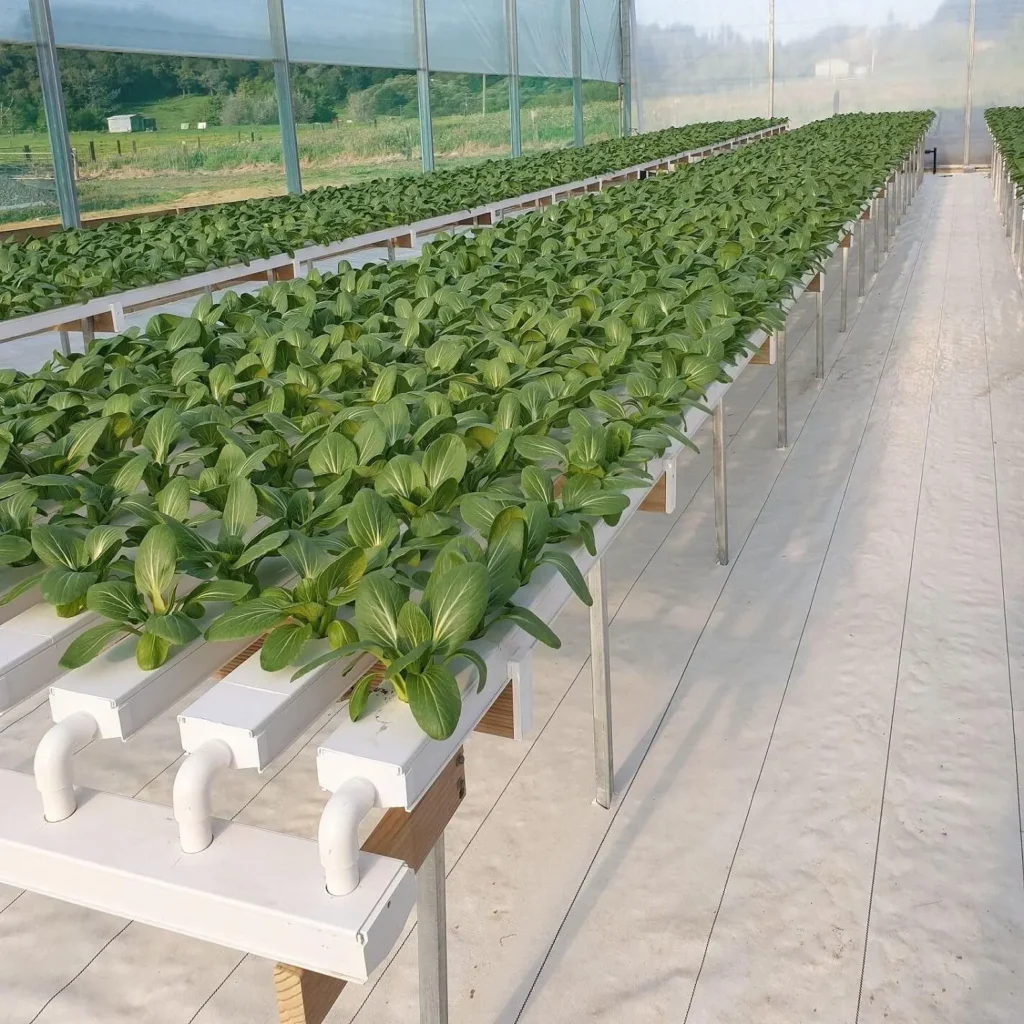
NFT channels can provide a compact growing arrangement for suitable crops, but they require appropriate water distribution, channel layout and root-zone management.
G&N Hydroponic offers an Aquaponics NFT Channel measuring 100 × 50 mm.
Buyers can review the Aquaponics NFT Channel 100 × 50 mm for product dimensions and purchasing details.
The channel is a plant-growing component. It does not replace the fish tanks, mechanical filtration, biofilter, pumps or other equipment needed for a complete aquaponics installation.
Water Circulation and Oxygen Supply
Water circulation distributes water between the fish tanks, treatment equipment and plant-growing area.
The circulation design should account for:
- Total system water volume.
- Required flow through each treatment stage.
- Pump operating head.
- Pipe length and diameter.
- Fittings, valves and flow restrictions.
- Backup arrangements for critical equipment.
Oxygen supply must also be considered independently. Water circulation alone does not guarantee sufficient dissolved oxygen for fish or beneficial bacteria.
Aeration equipment, monitoring arrangements and emergency procedures should be selected according to the fish species and operating requirements.
Designing a Commercial Aquaponics Greenhouse Layout
A commercial aquaponics greenhouse should be planned around the relationship between the fish-rearing area, water treatment equipment and plant production area.
The layout must allow the system to operate efficiently while providing practical access for feeding, inspection, harvesting, cleaning and equipment maintenance.
Separate the Main Operating Zones
A practical commercial layout can be divided into four functional zones.
1. Fish Production Zone
This area contains fish tanks, feeding equipment, aeration and the necessary access for fish inspection and harvesting.
2. Water Treatment Zone
Mechanical filters, biological filters, pumps and related equipment should be arranged to allow inspection, cleaning and maintenance.
3. Plant Production Zone
NFT channels, raft beds or other growing systems should be positioned according to crop requirements, greenhouse light conditions and harvesting workflow.
4. Monitoring and Service Zone
Electrical controls, water-quality monitoring equipment, chemical storage and maintenance access should be planned as part of the original layout.
These zones do not necessarily need to occupy separate buildings. Their physical arrangement should follow the intended water-flow sequence and operating workflow.
Plan Water Flow Before Selecting Equipment
The water-flow sequence should be mapped before final equipment dimensions are confirmed.
A simplified system may follow:
Fish tanks → Mechanical filtration → Biological filtration → Plant-growing area → Water management and return to fish tanks.
The actual arrangement may include additional filtration, degassing, aeration, temperature management, sumps or separate treatment loops.
For commercial projects, the design should also consider what happens during equipment maintenance, pump failure, power interruption or changes in fish and crop production.
Estimate Water Volume and Structural Requirements
Total system water volume affects tank selection, pump capacity, filtration requirements and structural loading.
For a rectangular tank:
Tank volume = Length × Width × Operating water depth
For example, a tank measuring 3 m long, 2 m wide and 1 m deep has a theoretical water volume of 6 m³.
This is approximately 6,000 litres before accounting for actual operating level, tank geometry and equipment displacement.
Water alone weighs approximately 1,000 kg per cubic metre. Structural support, tank installation, access platforms and equipment loads must therefore be evaluated before construction.
For multiple tanks, calculate each operating volume separately and account for interconnected water volumes where appropriate.
Balancing Fish Production and Plant Requirements
One of the most important challenges in commercial aquaponics is balancing fish production with plant nutrient demand.
Fish biomass alone does not determine how much nutrition is available to plants. Feeding rate, feed composition, waste processing, filtration performance and nutrient uptake all influence the system.
Understand the Fish-to-Plant Relationship
Fish feeding introduces nutrients into the system through waste and uneaten feed.
The amount of nitrogen available for plant uptake is influenced by:
- Fish species and biomass.
- Daily feed quantity.
- Feed protein content.
- Fish growth stage.
- Solids removal efficiency.
- Biofilter performance.
- Water replacement and nutrient losses.
Plant production must be evaluated against the nutrient supply generated by the aquaculture side.
A system that produces more fish waste than the biological and mechanical treatment stages can process may experience water-quality problems. A system with insufficient nutrient input may not provide the intended nutrient supply for the plant-growing area.
Consider Crop Nutrient Requirements
Leafy greens and herbs are common choices for aquaponics because their production requirements can be compatible with many fish-based systems.
However, different crops have different nutrient demands.
Fruiting crops such as tomatoes, peppers and strawberries may require additional nutrients or a different production strategy, depending on fish feed, water chemistry and the crop’s growth stage.
Any supplementation must be evaluated carefully to avoid creating unsuitable conditions for fish or disrupting biological processes.
Avoid Using a Universal Fish-to-Plant Ratio
There is no single fish-to-plant ratio that applies to every commercial aquaponics system.
A practical production plan should consider:
- Fish species and target harvest biomass.
- Daily feed input.
- Expected nitrogen production.
- Biofilter processing capacity.
- Crop type and planting density.
- Growing area and harvest schedule.
- Water-quality monitoring results.
For more detailed guidance, see our articles on Aquaponics Stocking Density and Best Crops for Aquaponics.
Choosing Fish and Crops for Commercial Aquaponics
Fish and crop selection should be made together rather than as two independent purchasing decisions.
Selecting Fish Species
Commonly considered freshwater species include:
| Fish Species | Typical Consideration | Main Selection Factor |
|---|---|---|
| Tilapia | Often considered for warm-water production | Suitable water temperature and local regulations |
| Trout | Considered for cooler-water systems | Reliable temperature control and high oxygen requirements |
| Catfish | Used in some freshwater aquaculture operations | Species-specific water quality and stocking management |
| Perch | Considered for certain cooler or temperate systems | Market demand and suitable growing conditions |
These are examples rather than a universal ranking of suitability.
Before selecting a species, evaluate local regulations, water temperature, fish availability, feed supply, market demand and the experience of the aquaculture operator.
See our Best Fish for Aquaponics guide for a more detailed comparison.
Selecting Commercial Crops
Common plant choices include:
- Lettuce and other leafy greens.
- Basil and selected culinary herbs.
- Pak choi and other suitable Asian leafy vegetables.
- Other crops evaluated against nutrient availability and growing conditions.
Fruiting crops can also be considered, but their nutrient requirements and production management may be more demanding.
The final crop plan should account for market size, harvest frequency, planting density, growing area and nutrient availability.
Water Quality, Filtration and System Monitoring
Water quality affects fish health, bacterial activity and plant production simultaneously.
A commercial aquaponics operation should establish a monitoring plan before introducing fish and crops.
Key Water Quality Parameters
| Parameter | Why It Matters | Monitoring Consideration |
|---|---|---|
| Dissolved oxygen (DO) | Supports fish respiration and aerobic biological processes | Monitor critical areas and periods of high demand |
| pH | Influences fish conditions, nitrification and nutrient availability | Monitor changes and avoid abrupt adjustments |
| Total ammonia nitrogen (TAN) | Indicates ammonia-related nitrogen loading | Track against species-specific operating limits |
| Nitrite | An intermediate product of nitrification | Monitor especially during system start-up |
| Nitrate | Indicates part of the processed nitrogen supply | Evaluate alongside plant uptake and water management |
| Water temperature | Affects fish metabolism, oxygen availability and bacterial activity | Set targets according to fish species and crops |
| Alkalinity | Helps buffer pH changes and supports system stability | Monitor as part of water chemistry management |
The correct operating ranges must be established according to the fish species, crop selection and biological filtration design.
Plan Monitoring and Emergency Procedures
Monitoring should not rely on occasional visual inspections.
Commercial operators should establish:
- A routine water-testing schedule.
- Records for fish feeding and biomass.
- Filter cleaning and maintenance records.
- Pump and aeration inspection procedures.
- Alarm arrangements for critical operating conditions.
- Backup power or emergency aeration planning where required.
- Procedures for isolating equipment during maintenance.
For systems using separate fish and plant water loops, a decoupled configuration may be considered when their operating requirements cannot be managed effectively through one shared loop.
Learn more in our guide to Decoupled Aquaponics.
Aquaponics vs. Hydroponics: Which Fits Your Business?
Aquaponics and conventional hydroponics both support soilless plant production, but they differ in nutrient supply, system management and equipment requirements. Understanding these differences helps commercial growers choose a production model that matches their investment objectives and operational capabilities.
| Comparison Factor | Aquaponics | Conventional Hydroponics |
|---|---|---|
| Nutrient source | Fish feed and biological waste processing, with possible supplementation | Formulated nutrient solution |
| Main production | Fish and plants | Plants |
| Biological management | Requires fish and nitrifying microbial management | Focuses on nutrient solution management |
| Water treatment | Includes fish waste removal and biological filtration | Depends on the hydroponic system configuration |
| Nutrient control | Influenced by fish production and water chemistry | Allows more direct control of nutrient formulation |
| Operating expertise | Requires aquaculture and plant production knowledge | Primarily requires plant production and nutrient management |
| Equipment requirements | Fish tanks, filtration, biofilters, circulation and growing systems | Reservoirs, pumps, growing systems and nutrient management equipment |
For businesses with aquaculture expertise, an established fish-production plan and access to markets for both fish and vegetables, aquaponics may offer an opportunity to diversify production.
By comparison, conventional hydroponics may be more suitable for operations focused on predictable plant production and direct control over nutrient formulations.
Aeroponics is another option for selected crops and growing environments. Its suitability depends on crop requirements, equipment investment and the operator’s technical capabilities.
For a broader comparison of these growing methods, read our Aeroponic vs. Hydroponic vs. Aquaponic guide.
Common Commercial Aquaponics Design Challenges
Commercial aquaponics projects involve biological and mechanical processes that must remain stable together.
The following problems should be considered during system planning and commissioning.
Insufficient Mechanical Filtration
When fish waste and uneaten feed accumulate, organic loading can increase and affect downstream water treatment.
The solution is to size and maintain mechanical filtration according to the expected solids load and feeding rate.
Inadequate Biofilter Capacity
A biofilter that cannot process the expected ammonia load may allow ammonia or nitrite to accumulate.
Biofilter capacity should be matched to the maximum planned feeding rate, with sufficient commissioning time before full production.
Low Dissolved Oxygen
Fish, beneficial bacteria and plant roots all depend on suitable oxygen conditions.
Aeration, circulation, monitoring and emergency procedures should be designed as part of the original installation.
Nutrient Imbalance Between Fish and Plants
Fish production does not automatically supply every nutrient in the quantities required by every crop.
Monitor nutrient conditions and develop a supplementation strategy that accounts for both fish safety and plant requirements.
Pump or Power Failure
Aquaponics depends on reliable water circulation and, in many configurations, continuous aeration.
Critical equipment should have an appropriate maintenance plan, alarm arrangements and backup procedures. Emergency aeration and backup power requirements should be evaluated according to the system’s actual operating risks.
Difficult Cleaning and Maintenance Access
Filters, tanks, pipes and growing channels require regular inspection and cleaning.
Equipment should be arranged so that operators can access service points without disrupting the entire production area unnecessarily.
What to Include in an Aquaponics Project RFQ
A detailed request for quotation helps equipment suppliers understand the actual project requirements.
Before requesting equipment pricing, prepare the following information.
| Information | What to Provide | Why It Matters |
|---|---|---|
| Project location | Country, local climate and installation environment | Evaluates environmental and logistics requirements |
| Project type | New greenhouse, farm expansion or pilot installation | Defines project scope |
| Fish species | Selected species or proposed alternatives | Determines aquaculture operating conditions |
| Fish production target | Planned biomass, stocking and feeding information | Supports filtration and water treatment planning |
| Plant production | Crop type, target quantity and harvest schedule | Determines growing area requirements |
| Greenhouse dimensions | Total area and usable production area | Supports layout planning |
| Fish tanks | Quantity, dimensions and material requirements | Establishes aquaculture equipment needs |
| Plant-growing system | NFT channels, raft beds or media beds | Determines plant-zone equipment |
| Filtration requirements | Existing equipment or proposed treatment arrangement | Clarifies system integration |
| Water circulation | Available water source, flow requirements and pipe layout | Supports pump and pipework evaluation |
| Project quantities | Estimated equipment quantities and delivery schedule | Supports quotation and logistics |
If available, provide a greenhouse drawing, preliminary system flow diagram, fish production plan and plant-growing layout.
These details help suppliers evaluate the relevant equipment and identify which parts of the project require input from an aquaculture engineer or specialist.
FAQs About Commercial Aquaponics Systems
What is a commercial aquaponics system?
A commercial aquaponics system combines fish farming and soilless plant production through managed water circulation and biological filtration. Fish waste contributes nutrients to the plant-growing area after appropriate treatment and biological conversion.
What equipment is needed for a commercial aquaponics system?
A typical system requires fish tanks, mechanical filtration, biological filtration, water circulation equipment, aeration, plant-growing equipment and water-quality monitoring. The exact configuration depends on fish species, production scale and crop requirements.
Can NFT channels be used in aquaponics?
Yes. NFT channels can be used as the plant-growing component of an aquaponics system when the water treatment, nutrient conditions, flow rate and crop requirements are suitable. They do not replace fish tanks, mechanical filtration or biological filtration.
Can aquaponics grow both leafy vegetables and fruiting crops?
Yes, but crop nutrient requirements differ. Leafy vegetables and herbs are common choices, while fruiting crops may require additional nutrient management and careful evaluation of their compatibility with the fish-production system.
Is aquaponics better than conventional hydroponics for commercial farming?
Not necessarily. Aquaponics combines fish and plant production but requires additional biological management and aquaculture expertise. Conventional hydroponics generally offers more direct control over plant nutrient formulations. The appropriate choice depends on production objectives, operating capabilities and market demand.
Plan Your Commercial Aquaponics Project
A successful commercial aquaponics project starts with a clear production plan, suitable fish and crop selection, and an equipment configuration designed around the required water-treatment process.
G&N Hydroponic provides hydroponic growing equipment and relevant product options for commercial growing projects, including Aquaponics NFT Channels.
For projects requiring fish tanks, filtration, biofilters, aeration or complete aquaculture integration, the equipment scope and technical responsibilities should be confirmed according to the project requirements and specialist involvement.
To discuss your plant-growing equipment requirements, provide your greenhouse dimensions, target crops, preferred growing system, estimated quantities and project location.
The G&N team can review the relevant product options and help clarify the equipment specifications needed for your commercial project.