

Quick answer: choose NFT channels for leafy greens and herbs (lettuce, basil, bok choy) at the lowest operating cost; choose dutch buckets for fruiting vine crops (tomatoes, peppers, cucumbers) that need root mass and anchorage. Most commercial farms over ~2,000 m² we’ve built run both. The wrong pairing — tomatoes in NFT channels or lettuce in buckets — is a mistake you pay for over every crop cycle.
This comparison comes from projects where we’ve installed both systems under the same roof. We’ll skip the marketing talk and show where each system wins, what it costs to run, and how to decide when your crop list includes both greens and vines.
Side-by-Side Comparison
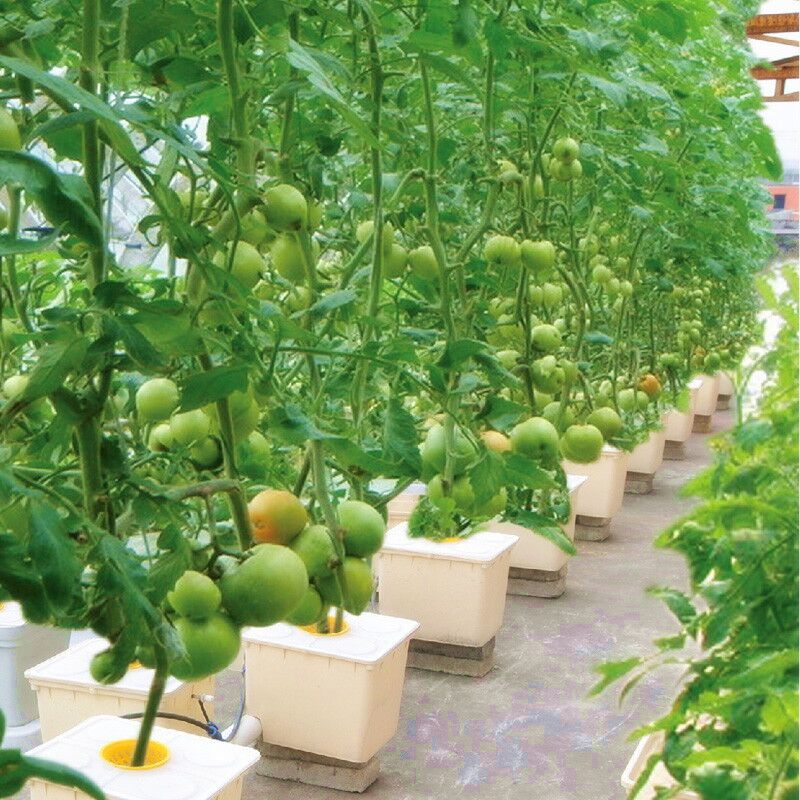
| Dimension | Dutch Bucket (Bato) | NFT Channel |
|---|---|---|
| Best crops | Tomatoes, peppers, cucumbers, eggplant | Lettuce, basil, herbs, leafy greens, bok choy |
| Root zone | Media-filled bucket (coco/perlite), drip-fed | Bare roots in thin flowing film |
| Cycle length | Long season (6–12 months) | Short cycle (3–6 weeks) |
| Initial cost per m² | Higher — buckets, media, trellis, stronger drip | Lower — channels, stands, pump |
| Operating cost | Media replacement every cycle; more labor per plant | No media; low power; easiest harvest |
| Power-outage tolerance | Hours — wet media buffers the roots | Minutes — no water held at root |
| Heat tolerance | High — media insulates roots | Low — film warms fast, needs cool reservoir |
| Labor at harvest | Heavy — long vines, supports, pruning weekly | Light — lift whole heads, replant same day |
| Typical revenue model | Fewer, higher-value plants per m² | High turnover, volume business |
When to Choose Dutch Buckets
Buckets earn their cost when your crop is a vine. Three conditions where the decision is settled:
- Your market wants tomatoes, peppers or cucumbers. These crops carry 5–10 kg of fruit per plant for months. A thin NFT film physically cannot anchor or feed that root mass.
- Your power is not bulletproof. A bucket of wet coco coir holds hours of buffer. NFT holds minutes. On sites with outages, that difference decides which system survives summer.
- Your summer is hot. Media buffers root temperature swings that would stress an NFT film. Hot-climate farms — the Middle East, Southeast Asia, southern US — lean buckets or run NFT only with chilled reservoirs.
When to Choose NFT
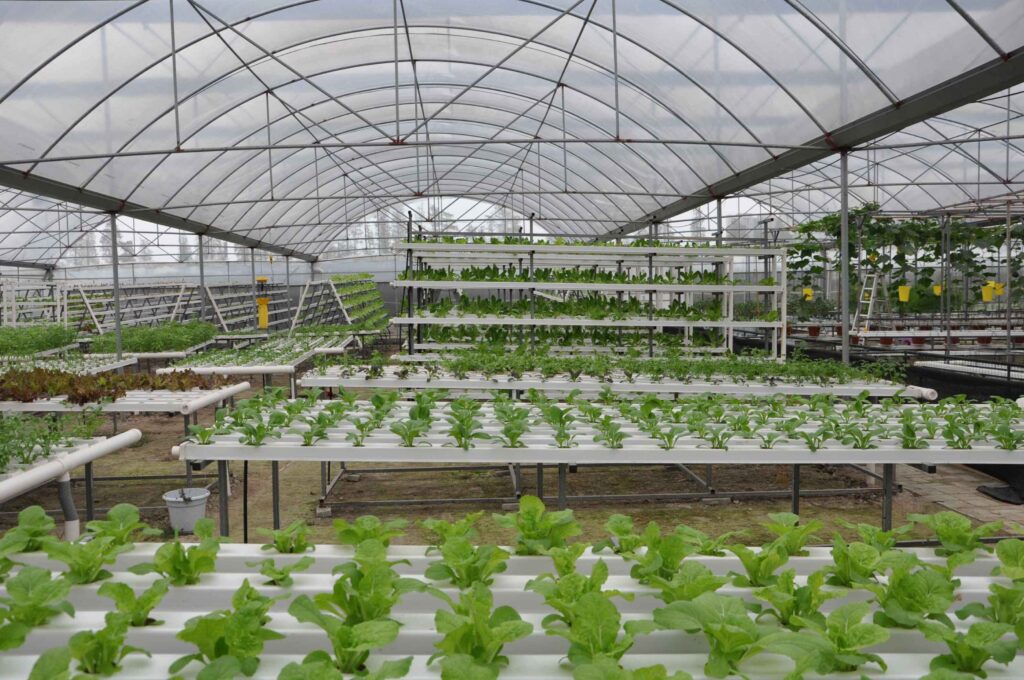
- Your business is leafy greens volume. A 30–45 day cycle means 8–10 crop turns a year. NFT’s low cost per plant and fast reset between cycles is what makes that math work.
- You want the lowest consumable cost. No coco, no perlite, nothing to buy every cycle except seed and nutrient.
- Labor is scarce or expensive. Harvesting lettuce from waist-height channels is among the fastest picking jobs in controlled agriculture — a real advantage where wages are high.
Mixing Both in One Greenhouse — The Design Most Farms Actually Need
Here’s what the “NFT vs dutch bucket” framing hides: on diversified farms, the answer is usually both. A layout we deliver often looks like this:
| Zone | System | Share of floor |
|---|---|---|
| Front zone (best light) | Dutch bucket tomato rows with trellis | 40–50% |
| Middle zone | NFT channels on multi-level stands, lettuce & basil | 35–45% |
| Back zone (propagation) | Seedling tables feeding both systems | 10–15% |
Engineering note: running both systems off one reservoir is a common and costly mistake. Tomatoes want higher EC (~2.5–3.5) than lettuce (~1.2–1.8); sharing a tank means one crop is always mis-fed. Split the irrigation into two nutrient loops from the start — retrofitting a split is far more expensive than doing it on day one.
Cost Reality Check
Budget bands we work with (equipment only, excluding greenhouse structure and installation):
- NFT channels: roughly $18–40 per m² of growing area depending on channel spec and stand height
- Dutch buckets: roughly $25–55 per m² including drip lines, return piping and media for the first cycle
- Shared infrastructure (tanks, filtration, dosing) is largely the same for both, which is one more reason to build them together
Exact numbers depend on channel profile, bucket wall spec, automation level and freight. Use these bands to sanity-check quotes — a “system” price far below these ranges is usually missing drip lines, filtration or stands.
FAQ
Can I switch from NFT to dutch buckets later?
A: You can add buckets in a separate zone, but you can’t convert channels into buckets. Decide zones at layout stage; the support structure and irrigation design differ.
Which system pays back faster?
A: NFT, usually — lower capital and faster cycles. Buckets compensate with higher revenue per plant on vine crops over a long season.
Do both systems use the same nutrients?
A: Same components, different targets. That’s why we design separate dosing loops — see our automation and nutrient control page.
Get Pricing for Both
Tell us your crop split (e.g., “60% greens, 40% tomatoes”), greenhouse size and location — we’ll return a layout with both systems, separate nutrient loops and a combined quote. Start on the quote page.
- NFT hydroponic systems — channels, kits, custom lengths
- Dutch bucket systems — complete tomato lines
- Growing tomatoes in dutch buckets: full guide