Agricultural Sprinklers: Types, Coverage and Buying Specs
An agricultural sprinkler is a pressurised nozzle that throws water through an arc, so one device covers a circle measured in metres rather than centimetres. The buying decision is not which head throws furthest; it is which head applies the target millimetres per hour evenly across a block at the pressure your pump actually holds. Field irrigation sprinklers are specified by four numbers: operating pressure range, flow at that pressure, throw radius, and thread standard. Layout, riser height and body material follow. This guide covers how to read a datasheet, how spacing and precipitation rate interact, and what to confirm before a container is booked.
What an Agricultural Sprinkler Does on a Farm
Overhead irrigation replaces rainfall with a controlled application rate. One head has to do three jobs: apply the daily depth evenly, stay below the soil infiltration rate, and do it with droplets that neither crust the surface nor bruise leafy crops.
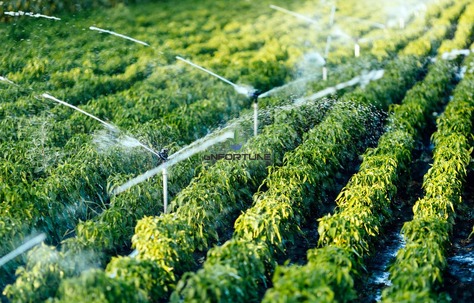
Sprinklers stay the right choice for broadcast field crops, germination, frost protection, and sites where a drip lateral per row is uneconomic. They lose to drip where water is scarce, foliage must stay dry, or fertigation precision decides the crop. Many farms run both; the irrigation systems supplied as matched sets cover both from one bill of materials.
Two numbers describe whether a set works. Distribution uniformity above roughly 80% is the usual commercial target; below about 70% a block matures in stages. Application rate must also sit under the infiltration rate, since a silt loam accepting 8 to 15 mm per hour will pond under 25 mm per hour.
Impact vs Rotor vs Spray Heads
The families differ in how they break up the stream, and that sets pressure demand, droplet size, filtration need and price.
| Type | Pressure | Flow per head | Radius and spacing | Best fit |
|---|---|---|---|---|
| Impact, brass or polymer | 2.0 to 4.0 bar | 0.5 to 4.5 m³/h | 10 to 25 m; 12 to 18 m | Portable field sets, gritty water, windy sites |
| Gear-driven rotor | 2.5 to 5.5 bar | 0.3 to 3.0 m³/h | 8 to 20 m; 10 to 16 m | Solid-set blocks where uniformity drives yield |
| Fixed spray or misting jet | 1.0 to 2.5 bar | 0.05 to 0.6 m³/h | 2 to 6 m; 3 to 6 m | Tunnels, germination, cooling |
| Big gun or travelling gun | 4.0 to 8.0 bar | 10 to 50 m³/h | 25 to 55 m; 30 to 60 m | Large open fields, low frequency |
Impact heads remain the workhorse for portable sets: tolerant of gritty water, stripped down with a spanner, cheap to rebuild. Trade-offs are noise, coarse droplets, and a bearing and spring that wear in a season.
Gear-driven rotors give a lower precipitation rate and a flatter distribution curve, which matters where infiltration limits the design. They want cleaner water and filtration sized to the rotor’s passages rather than to the pipe.
Spray heads suit close spacing. Fine droplets are both the advantage and the weakness: drift climbs with wind, and the small orifice needs regulation at the head.
Pressure, Flow and Throw Radius
Throw radius is a function of pressure, not a fixed property. A head quoted at 18 m at 3.5 bar throws materially shorter at 2.5 bar, and the far end of the block dries out first. Size the pump and mainline to hold pressure at the last head.
| Design check | Working range | Why it matters |
|---|---|---|
| Pressure at the furthest head | 85 to 90% of inlet pressure | Keeps radius and distribution inside the tested band |
| Impact head pressure | 2.0 to 4.0 bar | Below about 2 bar the stream breaks up and uniformity falls |
| Mainline velocity | 1.5 to 2.5 m per second | Limits friction loss and surge when zones switch |
| Flow tolerance between heads | plus or minus 5 to 7% | A wider spread defeats an otherwise good layout |
| Heads per zone | pump flow divided by head flow, less about 10% | Sets how many blocks can run at once |
Worked example: 30 m³/h of clean pump flow feeding impact heads at 1.2 m³/h supports 25 heads on paper. Leave 10% for filter loss and wear and the zone is 22 heads, roughly a 4 by 6 grid at 15 m spacing. Run it on your own duty point, because nozzle size moves the answer.
Pressure regulation pays for itself on long laterals and sloping ground: a regulator at 2.5 or 3.0 bar per head makes the radius predictable and caps the spike when one zone shuts.
Portable sets add one more variable: the supply hose, whose diameter and length decide whether the zone holds pressure. The layflat hose specs cover that selection.
Spacing Layout and Precipitation Rate
Spacing and precipitation rate are one equation from two sides. Rate in mm per hour is roughly 1,000 times head flow in m³/h divided by spacing squared in m², so tightening spacing raises the rate with the square of the change.
At 1.2 m³/h per head, a 15 by 15 m grid applies about 5.3 mm per hour and a 12 by 12 m grid about 8.3. Keep the rate below the infiltration rate with margin: sandy soils commonly accept 20 to 30 mm per hour, silt loams 8 to 15, clays 2 to 5.
The overlap rule is head-to-head coverage, spacing near 50 to 60% of the wetted diameter. On exposed sites tighten to 40 to 50%, because wind above roughly 10 to 15 km per hour distorts the pattern regardless of head quality.
Materials: Brass vs Plastic vs Stainless
Body material decides service life under UV, grit and fertilizer, and it drives unit price, weight and theft risk on unattended fields.
- Brass: the standard for impact heads, with long bearing wear. Weight invites theft, and acidic or high-chloride water needs a dezincification-resistant alloy.
- UV-stabilised engineering polymer: light and corrosion-free at a lower unit cost. Bearing and spring wear faster in sandy water, so confirm the UV package and grade.
- Stainless steel: aggressive water, coastal air or fertilizer injection. Highest unit cost, justified where replacement labour is expensive.
- Seals and springs: EPDM for standard water, nitrile where hydrocarbons are present, and stainless springs in any injected system.
- Nozzles: a nozzle worn 5% larger in diameter raises flow by roughly 10%, enough to break a zone’s pump budget. Order a spare set per block.
What to Ask a Supplier Before Ordering
The cheapest quotation usually differs on things that surface only at installation: thread standard, nozzle inclusions, spares and flow tolerance. Put those in writing before the deposit.
Read the flow table, not the catalogue photo. Two heads with the same nominal nozzle can differ by more than 10% in delivered flow, and a radius measured at one pressure says nothing about the radius at yours. Ask for flow at three or more pressure points and the tolerance band across a batch: a supplier with a test rig produces both, one without it sends a PDF.
- Thread standard: BSP or NPT stated on the quotation. Mixed threads are the most common reason an imported set cannot be installed on arrival.
- Nozzles: whether each head ships with a fitted nozzle, a full nozzle set, or bare.
- Flow tolerance: the permitted spread between heads in one batch, commonly plus or minus 5 to 7%.
- Material declaration: brass composition, UV stabiliser content, stainless grade for springs.
- Pressure and flow data: at three or more pressures, with radius stated at each.
- Spares and packing: springs, seals and nozzle sets at 3 to 5% of head count, risers and couplers included or listed separately, carton count matching the packing list.
Suppliers that manufacture in-house are easier to hold to those numbers than trading companies. G&N Fortune has built irrigation and hydroponic hardware since 1996, and sets are wet-tested in a 2,400 m² trial greenhouse before dispatch — a rig is what turns a catalogue curve into a flow table.
Frequently Asked Questions
What pressure do agricultural sprinklers need?
A: Impact heads run at 2.0 to 4.0 bar, gear rotors at 2.5 to 5.5 bar, fixed sprays at 1.0 to 2.5 bar. Design so the furthest head sees about 85 to 90% of the pressure at the first head.
How far apart should field sprinklers be spaced?
A: Common field layouts run 12 to 18 m between heads on a square or triangular grid, tighter on windy or sloping ground. Spacing must also keep the precipitation rate below the infiltration rate.
How many sprinklers can run on one zone?
A: Divide pump flow by the flow of one head at design pressure and leave about 10% for filter loss and wear. That result, not the pipe length, sets the zone size.
BSP or NPT — which thread should I order?
A: Match the thread standard already used on your risers and couplers, and state it on the purchase order. Mixing BSP and NPT in one shipment leaves a set that cannot be assembled on site.
Which sprinkler material lasts longest in the field?
A: Stainless lasts longest in aggressive or saline water, brass gives the best wear per unit cost on impact sets, and UV-stabilised polymer lowers weight and price where budget rules.
Request a Sprinkler Package Quote
A sprinkler purchase is cheap per unit and expensive to get wrong at scale: the wrong thread, the wrong nozzle band or an unregulated lateral shows up as a block that finishes in stages. Agricultural sprinklers specified as a matched set, with flow and spacing checked against the pump duty point, avoid that rework.
Send crop, block dimensions, soil infiltration rate, water source and pump duty point, and the team will return a head specification, spacing layout and precipitation rate check. To request a sprinkler package quote, include the riser thread standard used on site.