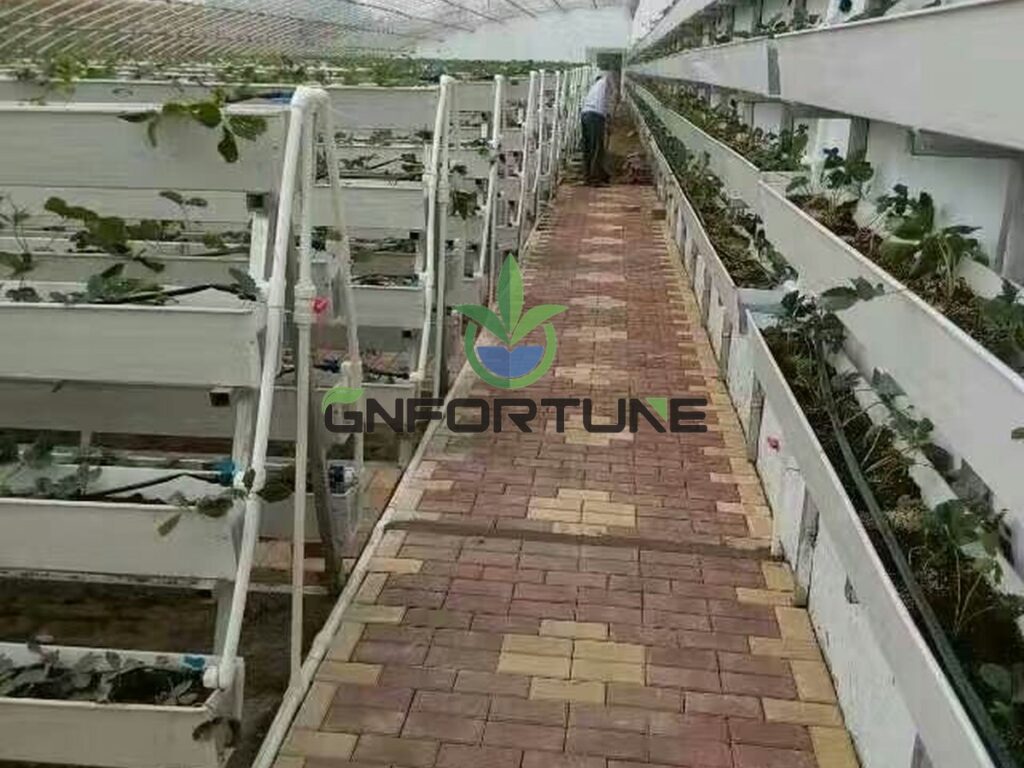
A 30 m channel run at a 1% fall should drop 300 mm from inlet to outlet. Nobody argues about the 300; the argument is about the millimetres, and that is where channel slope is actually decided. A support set 5 mm high in the middle of a row leaves a dip that holds a puddle, starves the roots of oxygen and collects a root mat, and it does so on a line whose overall fall still measures exactly right on the drawing.
What Slope Sets in an NFT Channel
At a fixed flow, slope decides film depth and velocity together. A steeper channel runs a thinner, faster film; a flatter one runs deeper and slower. Both are legitimate within a band, and outside it the crop notices.
- Below about 0.5%: the film slows, sediment and root debris settle, and the channel becomes a shallow stagnant trough rather than a flowing film.
- 1–2%: the common working range for 100×50 mm channels under leafy crops, giving a film that covers the base without pooling.
- Above about 3%: the film thins toward the inlet and the root mat at the high end can dry between irrigations, especially at low flow.
These are planning ranges for a clean channel with a mature canopy; the flow rate, channel section and crop all shift them. What does not shift is the requirement that the fall be continuous — no local reverse, no dip.
How Tolerance Accumulates
Error arrives in two forms, and they behave differently over distance. Systematic error — every bracket set 3 mm high because the laser datum was wrong — accumulates linearly: ten spans of 3 m carry the error the whole way. Random error — one bracket high, the next low — partly cancels, growing roughly with the square root of the number of supports.
| Error source | How it behaves over a run | Planning allowance | Visible symptom |
|---|---|---|---|
| Datum or level set wrongly | Accumulates linearly with every span | Check datum at both ends before fixing anything | Whole row too flat or too steep |
| Individual bracket height | Partly cancels, grows with square root of count | ±3 mm per support | Wavy film, uneven root wetting |
| Sag between supports | Local dip regardless of overall fall | Support spacing 1.0–1.5 m | Puddle at mid-span |
| Settlement after filling | Progressive, worst at the heaviest span | Re-check after two weeks | Fall that was right in March |
| Profile camber | Fixed per length, adds to installation error | Confirm extrusion tolerance with supplier | Film hugging one side |
The practical consequence: a ±3 mm bracket tolerance is fine on one span and not fine if the same 3 mm is repeated twenty times in the same direction. Installation discipline is about the datum, not about the bracket.
Measuring Slope Properly
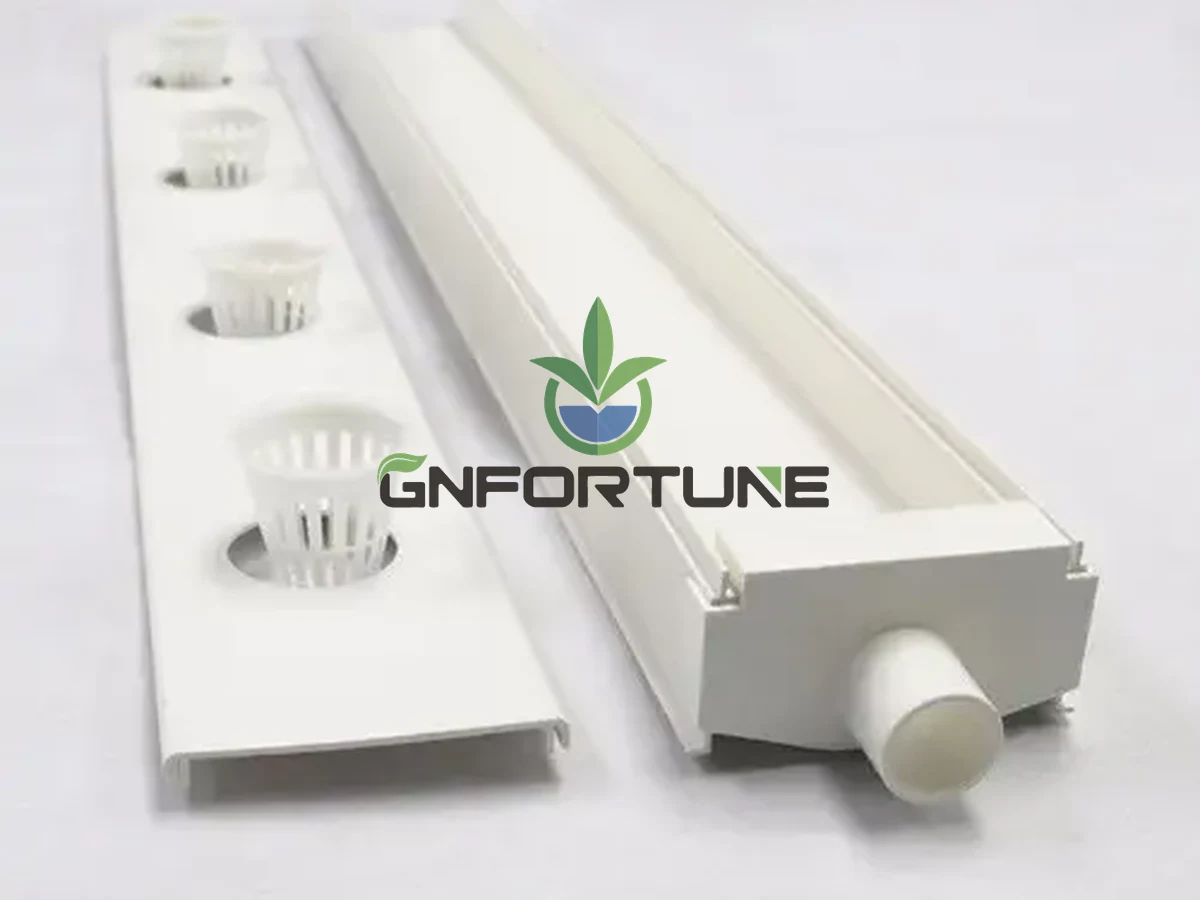
Eyeballing a channel against a string is how dips get installed. Three methods are worth the time.
- Laser level on a tripod at the low end of the row, reading a staff or rule at each support. Record the reading at every support, not just the two ends, and subtract to get the profile.
- Water level or a long spirit level for short rows, checked against a 3 m straight edge laid along the channel base.
- Digital protractor on the channel itself, useful for a quick check but blind to sag between supports.
Write the readings down. A row with a recorded profile can be corrected in an afternoon; a row with only an overall fall figure has to be re-measured from scratch.
The Local Dip: Small Error, Large Effect
A dip 40 mm deep over 2 m holds a film several times deeper than the design depth. Three things follow, and all three are expensive.
- Roots sit in water rather than in a film, and the root zone loses oxygen at the exact point where the mat is densest.
- Debris accumulates at the low point, feeding biofilm and blocking the flow path downstream.
- The downstream section starves, because the dip acts as a small reservoir that the flow has to fill before it continues.
The fix is mechanical, not hydraulic: adjustable hangers, shims under the bracket, or a continuous support rail that removes span sag altogether. Support hardware detail is covered in NFT channel support and hanging hardware.
Settlement: The Tolerance You Did Not Install
Every channel row settles when it is first filled, and it settles unevenly. A structure loaded with water, a crop and a worker on a ladder will move most where the span is longest or the ground is softest. A row that measured perfectly on a dry Friday can show a 10–20 mm dip after two weeks of operation.
Build the re-check into the programme: measure after the first fill, again after two weeks, and again after the first crop cycle. Adjusting a hanger is a ten-minute job; replacing a root mat that rotted in a puddle is not.
Flow and slope interact, and the sizing relationship between channel length, slope and flow is set out in NFT channel flow rate, slope and length, with the installation sequence in installing NFT channels.
What to Write Into the Specification

Tolerance only exists if it is written down. Four clauses cover it, and they are short enough to fit in a single paragraph of a technical specification.
- Design fall stated as a percentage with a tolerance, for example 1.0% ± 0.1% over the full run.
- No local reverse fall anywhere along the channel, and no dip deeper than 3 mm under a 3 m straight edge.
- Support spacing stated, with adjustable height of at least ±20 mm at each bracket.
- A measured profile at every support handed over at commissioning, with re-checks after first fill and after two weeks.
Without those clauses, slope becomes a matter of opinion at handover. A row that holds a puddle is “within tolerance” to an installer who reads only the two ends, and plainly out of tolerance to a grower watching the water sit still. The argument costs more than the correction, and it usually ends with a shim and a bad relationship.
At handover, walk the rows and watch the outlets. A film that pulses, or one that runs deep at the end of a row and thin at the start, is a slope problem long before it becomes a crop problem.
Channel slope is one of the cheapest things to get right and one of the most expensive to correct once a crop is in. The millimetres are decided by the datum and the bracket, not by the drawing.
FAQs About Channel Slope Tolerance
What slope should an NFT channel have?
A planning range of 1–2% for a 100×50 mm channel under leafy crops, with 1.5–3% on longer runs. Below 0.5% the film slows and sediment settles; above 3% the high end can dry at low flow.
How much error is acceptable between supports?
Roughly ±3 mm per support, provided the errors do not all run the same way. No dip should exceed 3 mm under a 3 m straight edge, since that is where puddles form.
Why does one section of a row hold water?
A local dip, usually from a bracket set low or a span that sagged after filling. It behaves as a small reservoir and starves the section downstream of it.
Can slope be corrected after planting?
Yes, if the hangers are adjustable and the row can be lifted empty. With a mature crop in place, correction usually waits for the turnaround window.
Does a steeper channel always drain better?
It drains faster but runs a thinner film, which can leave the root mat at the inlet under-wetted at low flow. Steepness is not a substitute for a continuous fall.
Related Reading
- NFT Channel Run Length Limits — How far a channel can go before slope stops being enough
- Irrigation Distribution Uniformity — Why the end of the line gets less, with slope as one cause
- Root Rot in Hydroponics: Pythium in NFT and DWC — What a stagnant puddle does to a root mat
- Hydroponic System Commissioning and Site Acceptance — Where the measured profile belongs at handover
Next Step: What to Send for a Quotation
Channels and supports are quoted together, because the tolerance lives in the support. Send the row layout and the slope requirement in the same enquiry.
Specifying an NFT house? For RFQ or project consultation, send: channel section and length per row; number of rows and tiers; design fall and tolerance; support spacing and structure type; whether hangers must be adjustable after installation; crop and expected root mass; flow rate per channel; floor or frame conditions; handover documentation wanted; delivery schedule; and the budget band. G AND N FORTUNE LIMITED supplies channels, hangers and support steel quoted as one system so the slope requirement has something to attach to.