

By the G&N commercial engineering team · First published: September 2026 · Reviewed for field accuracy
Pythium root rot is the single most expensive disease in commercial hydroponic lettuce and herb production. It does not arrive from outside the greenhouse the way an aphid outbreak does — it lives in the system, in the biofilm, and in the dormant spores that survive between cycles. Once the conditions are right, an outbreak can wipe out a bay of NFT lettuce in 72 hours. This article explains how the engineering team identifies, treats, and ultimately redesigns systems to break the cycle.
Why Root Rot Is the Most Expensive Disease in NFT and DWC
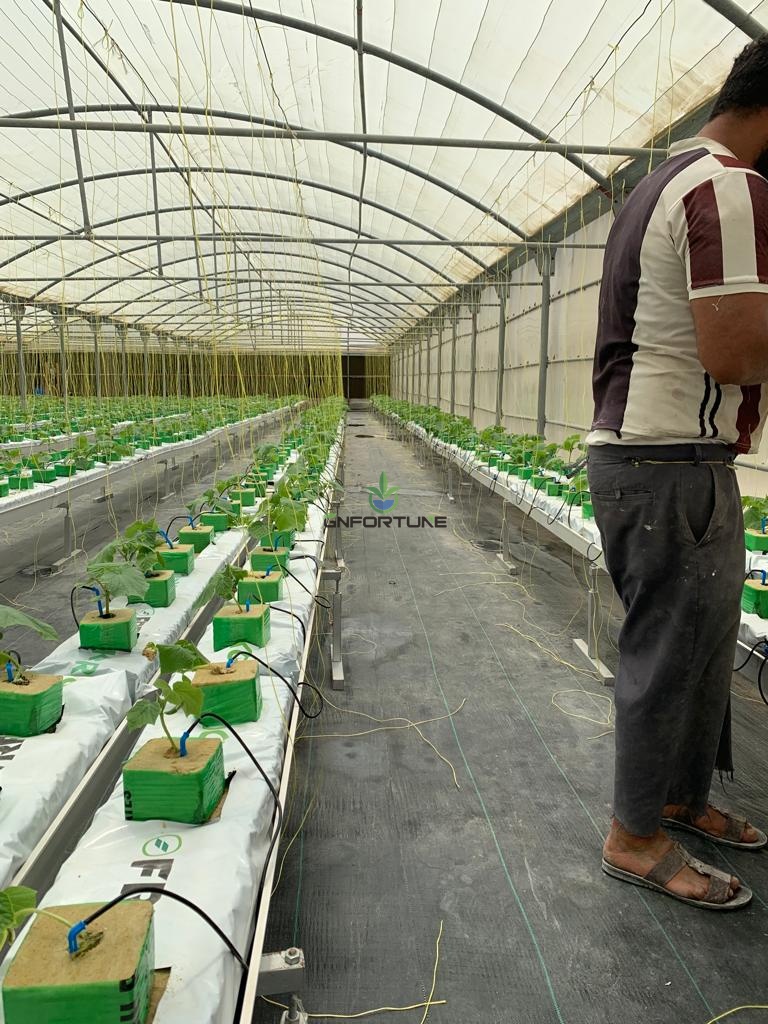
Commercial greenhouse with clean white growing rows after crop removal, used as the healthy baseline for root rot preventionOther diseases show up as visible damage on leaves. Pythium works on the roots first, which means a crop can look fine above the channel while the root mass below is collapsing. By the time the canopy wilts, the damage is already systemic. On a commercial NFT or DWC line, the cost stack is:
- Direct crop loss. Affected bays are often a total write-off; partial losses still fail buyer specs on root appearance.
- System downtime. Between-cycle sanitation adds days to the production calendar, and during that window the bay produces nothing.
- Recurrence cost. Pythium spores survive in biofilm, in rockwool, and in the rubber seals of NFT channels. A chemical treatment that ignores these reservoirs fails within two cycles.
The hard truth from projects we have audited: treating Pythium with fungicides alone is a losing battle. The pathogen returns because the engineering conditions that triggered it — high solution temperature, low dissolved oxygen, and dead-end biofilm — were never fixed. The farms that break the cycle treat the system, not the bottle.
The Three Early Signs: Brown Roots, Slimy Water, Wilting Tips
A grower who walks the greenhouse every morning catches Pythium early. Three field signs, in the order they usually appear:
- Brown or beige roots. Healthy roots on NFT lettuce and basil are white to pale cream. The first Pythium sign is a tan or brown discoloration starting at the root tips. Lift a plant or two out of the channel and look — do not judge by the canopy alone.
- Slimy channel water or biofilm on the channel wall. A faintly oily film on the inside of the NFT channel, especially in low-flow sections, is the biofilm that harbors Pythium zoospores. It appears days before root symptoms become obvious.
- Wilting at midday in an otherwise hydrated crop. When transpiration outruns what the damaged root system can supply, the plant wilts during the warmest hours even though the solution EC and pH look correct. By evening it may recover, masking the problem for a few more days.
On NFT lettuce and DWC basil crops, the same inspection SOP applies: random root sample at transplant, daily walk-through of the bay, and a quick film check on the inside of the channel wall. The first time any of these three signs appears, the response clock starts — not the next morning.
Water Temperature and Dissolved Oxygen as Root Cause
Two engineering variables decide whether Pythium gets a foothold: solution temperature and dissolved oxygen (DO). Both are controllable on a commercial hydroponic farm, which is why Pythium is fundamentally a design problem, not a biological one.
| Variable | Safe range for NFT / DWC | Risk threshold | Engineering response when out of range |
|---|---|---|---|
| Solution temperature | 18–22 °C | Above 24 °C for more than a few hours | Reservoir chiller, root-zone cooling loop, shade on the reservoir, or schedule the irrigation cycle to cool at midday |
| Dissolved oxygen at the outlet | 6–8 mg/L | Below 5 mg/L for more than an hour | Aeration in the reservoir, venturi in the irrigation line, deeper DWC tank with diffused air, or pump-side oxygen injection |
| Flow velocity in NFT | 0.5–2 L/min per channel | Below 0.3 L/min, or visible standing water | Re-pump, re-balance the manifold, add a slope check |
Pythium zoospores swim. They thrive in warm, low-oxygen solution where roots are already stressed. The fix is rarely a single piece of hardware — it is a combination of cooled reservoir, active aeration, and verified flow at the far end of every channel. The reservoir and pump sizing reference covers the calculations; the on-site discipline is to verify these numbers weekly, not just at install.
The Pythium Life Cycle: Where It Hides Between Cycles
Pythium is an oomycete — closer to a brown alga than to a true fungus. Its life cycle explains why a chemical-only approach fails:
- Zoospores. Free-swimming spores that move through water films on root surfaces and in biofilm. They are the infectious stage and the most vulnerable to sanitizer.
- Hyphae. Active growth in root tissue and in dead organic matter in the channel. Less vulnerable; needs contact time with the right sanitizer to be controlled.
- Oospores. Thick-walled resting spores that survive in dry channel sections, in the rubber gaskets of bulkhead fittings, in rockwool cubes, and in the biofilm at the bottom of the reservoir. The stage that survives a between-cycle sanitation pass.
The practical implication: a between-cycle cleaning that only circulates sanitizer through the bulk solution misses the oospore reservoirs. The fix is mechanical brushing of channel walls, gasket inspection, and reservoir drain-down — paired with a sanitizer that holds contact time across all surfaces, not just in the free water. The cleaning and sanitizing SOP covers the full step sequence.
The Treatment Ladder: H2O2, Beneficial Bacteria, System Reset
When Pythium is confirmed, we walk a three-step ladder. Each step has its place; the wrong step wastes time and money.
| Step | When to use | What it does | What it does not do |
|---|---|---|---|
| Stage 1 — Hydrogen peroxide shock | First sign of biofilm or root browning, before wilting is widespread | Oxidizes zoospores and young biofilm; resets redox potential of the solution | Does not reach oospores in gaskets and dry channel sections |
| Stage 2 — Beneficial bacterial inoculation | After the system is stabilized, during regrowth | Bacillus and similar strains compete with Pythium for root surface and exudates | Does not recover a system that is still hot and low-oxygen |
| Stage 3 — System reset | Recurring outbreaks within two cycles | Drain, brush, replace gaskets and any porous media, re-balance the reservoir | Costs a full cycle of production |
The mistake we see is growers skipping from Stage 1 straight to Stage 3 on the first outbreak, throwing away production capacity. Stage 1 plus Stage 2 catches most first-time events. Stage 3 is for systems that have proven they cannot self-correct — and at that point a redesign, not just a reset, is the honest answer.
How We Redesign DWC Tanks to Prevent Pythium
The most common structural cause of recurring Pythium is the DWC tank itself. Three changes that we routinely apply on redesign projects:
- Diffused aeration across the full bottom area. A single air stone in one corner leaves dead zones where DO drops below 4 mg/L within hours of pump failure. A perforated ring or a grid of air stones lifts DO uniformly.
- Rounded tank corners and a sloped floor to a drain. Square corners and flat floors trap organic debris and give Pythium a permanent reservoir. A continuous slope to a 50 mm drain lets the tank be fully emptied and brushed between cycles.
- Removable lid with food-grade gasket. A sealed but removable lid keeps light out, prevents evaporation loss of CO₂ from the solution, and lets the operator lift the lid for inspection without breaking the seal.
On the NFT side, the equivalent changes are: replace any translucent channel with opaque, add slope verification to the maintenance SOP, and install a manifold gauge so flow at the far end of the run is checked weekly. These are not glamorous retrofits; they are the reason some farms run Pythium-free for years while neighbors fight it every season.
FAQ
Can Pythium be cured without chemicals?
A: In mild, first-time outbreaks, biological controls plus environmental correction can resolve it. Recurring outbreaks almost always need a chemical sanitation pass plus the underlying engineering fix.
How fast does Pythium spread in NFT?
A: A bay can go from first visible root browning to total collapse in 48–72 hours at solution temperatures above 24 °C. Cooler solutions and good DO buy time but do not stop the spread on their own.
Does UV sterilization on the irrigation line kill Pythium?
A: UV kills free-floating Pythium zoospores effectively when properly sized to flow rate. It does not penetrate established biofilm or reach oospores in dry channel sections. UV is a supplement, not a cure.
Should I throw out the rockwool cubes after a Pythium outbreak?
A: Yes for confirmed-outbreak bays. Rockwool harbors oospores that survive sanitizer contact. Replace cubes and any other porous media (foam, phenolic foam) at the same time as the system reset.
Diagnose Root Rot and Propose a Redesign
Send photos of the affected roots, the channel wall, the reservoir, and your current solution temperature and DO readings, and the engineering team will return a diagnosis with the recommended stage of response. The same scoping process used for turnkey greenhouse design applies — start with the inputs collected for system design, then move to the quote form to begin.
— G&N Fortune Limited · hydroponic equipment manufacturer since 1996 · Reviewed by the engineering team