

By the G&N commercial consulting team · First published: September 2026 · Reviewed for field accuracy
Integrated pest management in a hydroponic greenhouse is not a calendar of pesticide sprays. It is a system of prevention, monitoring, biological control, and chemistry — sequenced so that the cheapest, least disruptive intervention runs first and chemistry runs last. On a commercial farm, IPM protects yield, residue compliance, and the buyer’s reputation with export customers.
Why IPM Beats Calendar Spraying in Hydroponics
Calendar spraying — a fixed pesticide every 7 or 14 days regardless of pressure — was the standard in protected agriculture twenty years ago. On a modern hydroponic farm it fails on three fronts:
- Resistance. Repeated applications of the same active ingredient select for resistant pest populations. After two or three years of calendar spraying, whitefly and thrips no longer respond to the products that once controlled them.
- Residue and market access. Export buyers in the EU, Japan, and the Gulf run multi-residue screens on produce. Calendar spraying produces residue profiles that fail these screens and lead to rejected shipments.
- Biological control collapse. Most calendar insecticides kill predatory mites and parasitic wasps alongside the target pest, causing a pest rebound two to three weeks after each spray.
The economic case for IPM is straightforward: monitoring costs less than spraying, biological control costs less than calendar chemistry, and residue compliance protects revenue that is far larger than the savings from skipping scouting. IPM is not the cheaper option this year; it is the cheaper option over the life of the farm.
The Four IPM Pillars: Cultural, Mechanical, Biological, Chemical
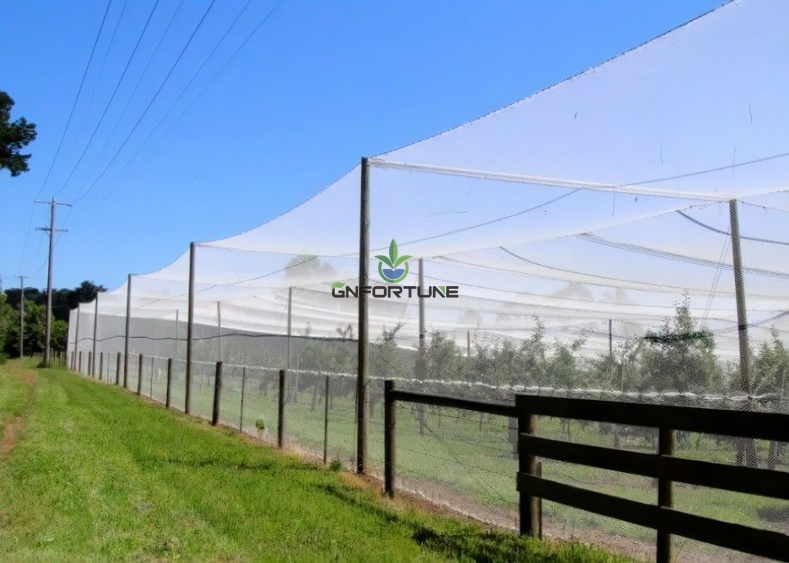
Orchard-scale white insect netting supported by poles, showing the physical barrier layer of IPMEvery IPM program we have designed rests on the same four pillars. The order matters — each pillar addresses what the previous one cannot:
- Cultural controls. Climate, sanitation, irrigation, and crop sequencing choices that make the greenhouse less hospitable to pests: humidity below 80% at night, screened intake air, and rotation to a non-host cover crop between cycles.
- Mechanical controls. Physical barriers and traps: insect screens on intake vents, double doors, yellow and blue sticky cards, and pheromone traps.
- Biological controls. Predatory mites, parasitic wasps, beneficial nematodes, and microbial agents released on a planned schedule.
- Chemical controls. Selective pesticides applied only when monitoring thresholds are exceeded, rotated by mode of action, and chosen for compatibility with the biological agents already in use.
On a hydroponic strawberry or herb line, all four pillars usually run together. The mistake is treating any one of them as the program; IPM is the integration of all four.
Scouting Routines and Yellow/Blue Sticky Cards
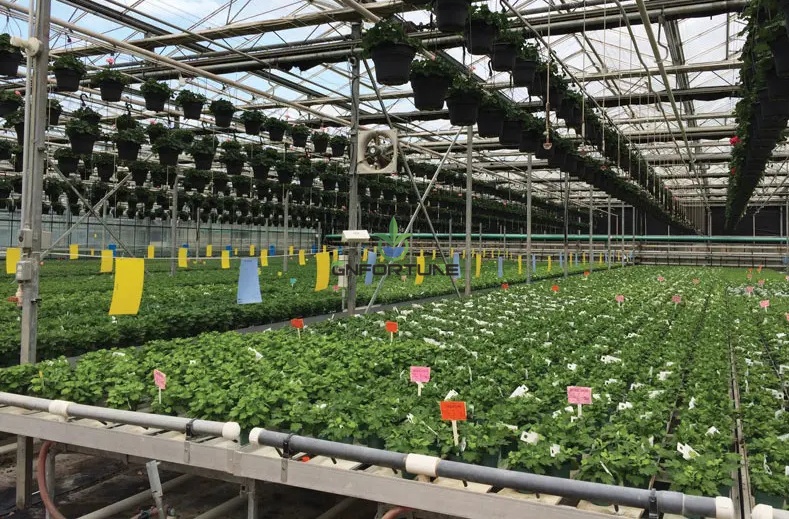
Hydroponic lettuce trays with yellow and blue sticky cards deployed for insect scouting and monitoringScouting is the data layer of an IPM program. Without it, the other three pillars run blind. The standard scouting SOP used on commercial hydroponic projects:
- Card density. One yellow sticky card per 100 m²; one blue card per 200 m² where thrips is the main concern. Place cards at canopy height, with a few raised to monitor incoming flights.
- Inspection cadence. Cards are changed weekly and counted under a hand lens. Counts are logged in a single spreadsheet or dashboard with a per-bay trend.
- Action thresholds. A card count above a defined level (commonly 5–10 thrips per card per week, or 20+ whitefly) triggers the next intervention — usually a biological release or a targeted spray.
- Plant-level scouting. Twice a week, walk each bay, inspect 20 random plants per bay, and note any larvae, mites, or damage.
The card and scouting data feeds directly into the rest of the program. A well-run scouting log lets the IPM coordinator skip a chemical application that would have happened by the calendar, and catch a thrips population three weeks before it shows at the canopy level.
Common Pests in Hydroponic Greenhouses
Five pest groups account for the majority of commercial hydroponic IPM work. Each has a recognizable signature and a typical threshold:
| Pest | Where it shows first | Threshold (typical) | First-line response |
|---|---|---|---|
| Western flower thrips | Blue sticky cards; silvering on leaves; black fecal specks | 5–10 thrips per card per week | Predatory mites (A. cucumeris), blue card intensification, then selective spray if exceeded |
| Greenhouse whitefly | Yellow cards; honeydew and sooty mold on leaves | 20+ adults per card per week | Encarsia formosa parasitic wasp, then selective insecticide rotation |
| Aphid (multiple species) | New growth distortion; honeydew | Localized colonies on scout | Aphidius colemani wasp, spot treatment, then selective spray |
| Fungus gnat | Adults flying at the substrate; larvae on root crowns | Sustained card counts + visible larvae | Steinernema nematodes, sticky traps, moisture reduction at the substrate surface |
| Two-spotted spider mite | Fine stippling on leaves; webbing under heavy pressure | Localized leaf damage on scout | Phytoseiulus persimilis predatory mite, humidity management, then selective miticide |
On strawberry and gutter-grown crops the same pests apply, with two-spotted spider mite usually the dominant concern. The pest mix shifts by crop, climate, and season; the scouting SOP does not.
Biocontrol Agents: Predatory Mites, Amblyseius, and Parasitic Wasps
Biological control is the workhorse of a modern IPM program on hydroponic greens, herbs, and strawberries. The most commonly deployed agents, with their typical release rates and price range:
| Agent | Target pest | Typical release rate | Realistic price band |
|---|---|---|---|
| Amblyseius cucumeris | Thrips larvae | 50–100 per m², weekly | Low — most economical thrips biocontrol |
| Phytoseiulus persimilis | Two-spotted spider mite | 10–20 per m² on first sign | Moderate |
| Encarsia formosa | Greenhouse whitefly | 5–10 per m², weekly | Low to moderate |
| Aphidius colemani | Aphid (multiple) | 1–2 per m², weekly during pressure | Low |
| Steinernema feltiae | Fungus gnat larvae | Soil-drench application, biweekly | Low |
Two practical rules from project experience. First, biocontrol agents must be introduced preventatively or at the first sign of pressure — they cannot recover an established outbreak. Second, broad-spectrum insecticides and biological agents are not compatible; every chemical decision must be checked against the agents currently in use.
Pesticide Rotation and the Residue Problem
When the scouting threshold is exceeded and biological control alone cannot catch up, a selective pesticide is the right tool. Two disciplines keep that tool effective:
- Mode-of-action rotation. Pesticides are classified by IRAC groups. Rotate between groups on each application to slow resistance; two consecutive sprays from the same IRAC group is a flag for review.
- Residue and MRL compliance. Every export market sets maximum residue limits for each active ingredient on each crop. The IPM coordinator maintains a market-specific MRL sheet and selects products that fit the strictest market the produce will enter.
The chemistry decision is rarely about efficacy alone. A pesticide that controls the pest but exceeds the strictest buyer’s MRL costs more than it saves. The IPM coordinator’s job is to know both the agronomy and the residue profile before any spray is approved. This is where the program pays for itself.
Building a 12-Month IPM Calendar for a Commercial Greenhouse
A working IPM calendar aligns the four pillars with crop cycles and seasonal pest pressure. The structure the team uses on multi-hectare projects:
| Quarter | Cultural focus | Scouting focus | Biological releases | Chemistry trigger |
|---|---|---|---|---|
| Q1 (cool, low pressure) | Sanitation between cycles, intake screen service | Weekly scouting; baseline card counts | Preventative A. cucumeris on long crops | Only if scout thresholds exceeded |
| Q2 (rising thrips, whitefly) | Humidity management; double-door discipline | Biweekly scouting, blue card focus | Weekly Encarsia, A. cucumeris boost | Selective spray if cards exceed threshold for two weeks |
| Q3 (peak pressure, hot) | Canopy airflow; remove border weeds outside | Twice-weekly scouting; pheromone check | Full beneficial mix including Phytoseiulus | Spot treatment preferred over blanket spray |
| Q4 (cooling, fungus gnat risk) | Substrate surface moisture control | Continue scouting; add fungus gnat cards | Steinernema where cards rise | Targeted drenches only when nematodes insufficient |
The calendar is a template, not a prescription. Each farm adapts it to its crop mix, climate, and export markets. What stays constant is the four-pillar structure and the discipline of running every decision through the scouting data.
FAQ
How often should sticky cards be changed?
A: Weekly on a commercial IPM program. Some growers change cards twice a week during peak pressure; never less than weekly because old cards lose their adhesive and undercount.
Are biological controls enough on their own?
A: For low-to-moderate pressure, yes. For recurring high-pressure situations, biological control needs to be paired with cultural and mechanical measures; chemistry is added only when thresholds are exceeded.
Do I need a different IPM program for export versus domestic markets?
A: The four-pillar structure is the same. What changes is the residue discipline: stricter MRL targets reduce the available chemistry and push the program further toward biological and cultural controls.
How do I start an IPM program on an existing farm that uses calendar sprays?
A: Stop the calendar first. Begin weekly scouting and threshold-based decision making. Introduce biological agents compatible with the most recent spray’s residual period. The first cycle is usually the hardest; by the second cycle the program is on a sustainable footing.
Request the IPM Calendar Template and Scouting SOP
Send your crop, climate zone, and export markets, and the team will return the IPM calendar template, scouting SOP, and a starter biocontrol release plan. The same scoping process used for turnkey greenhouse design applies — start with the design inputs we collect, then move to the quote form to begin.
— G&N Fortune Limited · hydroponic equipment manufacturer since 1996 · Reviewed by the engineering team