Two farms can run the same crop, the same recipe and the same sensor set, and one will fight drifting EC every afternoon while the other barely touches the dosing unit. The difference is usually hydroponic system water volume — the total litres held in channels, gutters, pipework and tanks at any moment. That volume absorbs every disturbance the day delivers: a pump trip, an acid correction, a heat spike at noon. Size it thin and the system reacts sharply to all three.
This is separate from tank design and pump selection, which have their own rules.
What Counts as Hydroponic System Water Volume
Hydroponic system water volume is every litre of solution in circulation at one instant: the film or depth in each channel or gutter, the standing volume in the reservoir, the contents of supply and return manifolds, and what is held in filters, dosing units and any chiller or heater loop. It is not the tank nameplate capacity, and it is not the sum of empty pipe cross-sections.
Three distinctions matter when the number is written down:
- Operating versus geometric volume: a 1,000 L tank running at a 400 mm working level does not contribute 1,000 L.
- Dynamic versus static volume: solution in transit counts as buffer only if it returns; a drain-to-waste run contributes almost nothing.
- Per-zone versus whole-farm volume: eight independent zones give eight buffers, each behaving as a small system even if the site total looks generous.
Zone boundaries decide which number is relevant. If a pump failure isolates one bay, the buffer protecting that crop is the volume inside the bay plus its share of the return line.
Why a Thin Buffer Swings Faster on EC, pH and Temperature
Because volume is the denominator. Every disturbance — crop uptake, a dosing shot, evaporation, a heat gain — is divided by the same litres. Halve the volume and the same disturbance moves the reading twice as far.
Three symptoms appear first:
- EC swing in a small system: transpiration removes water faster than nutrients, so the solution concentrates through the afternoon. A planning range for a properly sized recirculating leafy system is an EC rise of roughly 0.2–0.4 mS/cm across a hot day, assuming a 100×50 mm channel, a 1% slope and a full canopy.
- pH bounce after correction: a small volume accepts a concentrated acid dose quickly, then overshoots as the dose finishes mixing. Operators chase it with a second correction and end further from target.
- Nutrient temperature stability: a shallow film under afternoon sun has little thermal mass. A planning range of 2–4 °C rise between morning and mid-afternoon is common on low-volume channel systems in a warm greenhouse.
These are planning ranges, not guarantees. Channel geometry, slope, flow rate, canopy cover, ventilation and raw water temperature all move them, so measure on your own site before setting alarm thresholds.
Estimating Water Volume per Square Metre by System Type
The fastest sanity check on a design is litres per square metre of growing area. The figures below are for estimation only; confirm against actual channel section, working depth and tank levels.
| System type | Planning range, L per m² of growing area | What dominates the number |
|---|---|---|
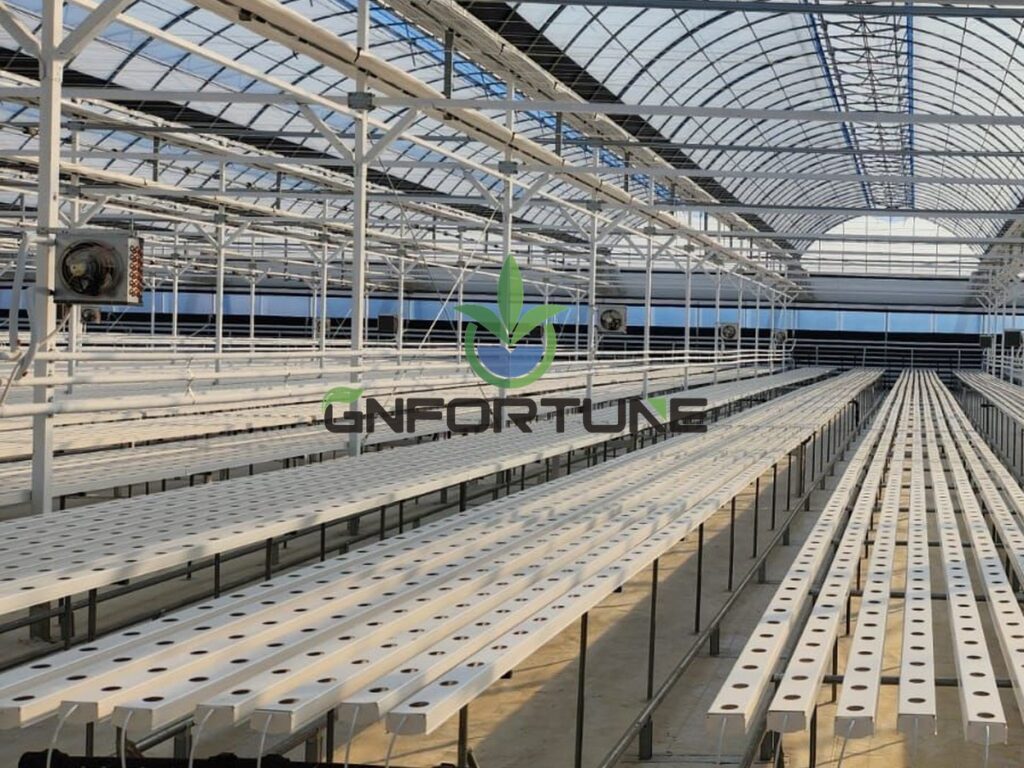
| NFT channel, 100×50 mm | 1.5–4 | Film depth and slope, plus the tank share |
| NFT channel, 73×62 mm MGS | 2.5–6 | Larger section and deeper film |
| DWC raft bed | 20–40 | Bed depth; the bed is the buffer |
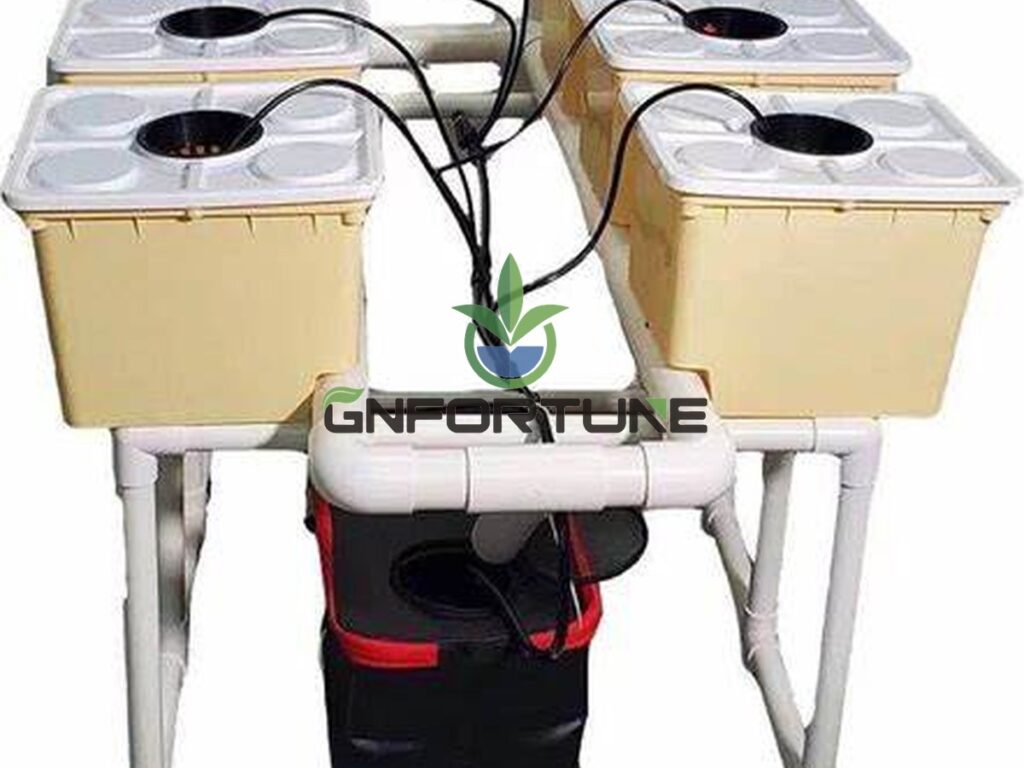
| Dutch bucket with slab | 4–10 | Bucket sump and slab saturation |
| Substrate gutter | 3–8 | Media pore volume and drain-down rate |
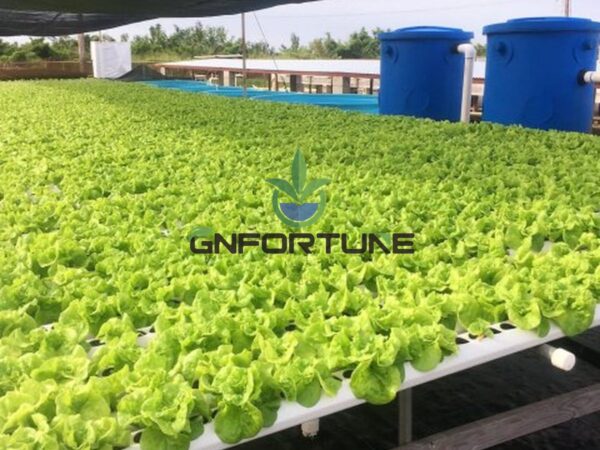
| Reservoir tank allowance | 10–30 | Tank working level, not nameplate capacity |
Rows contribute the lower numbers; the tank contributes most of the rest. On NFT the reservoir is usually the largest single component a designer can change, which is why an undersized tank is felt across the whole house.
Channel section detail is covered in the NFT channel size comparison, and tank geometry, working level and access requirements in the guide to reservoir sizing and water storage tank design.
Reservoir Plus Channel Volume: Reading the Sum
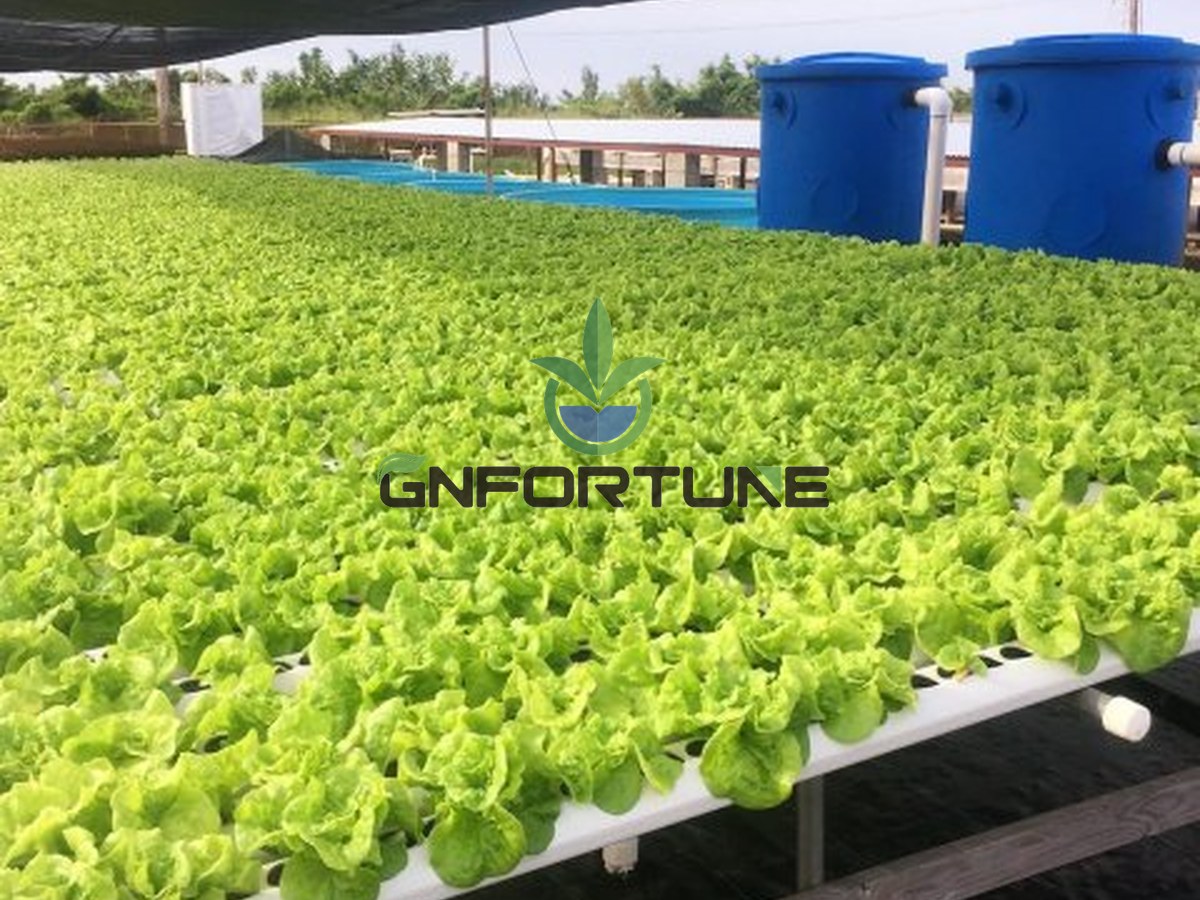
Add the two and check the ratio. A rule of thumb from project work: the tank working volume should be several times the volume held in channels and pipework, so a pump stop does not drain the rows dry and a heat gain is diluted into a larger mass. Where channel and pipework volume approaches tank volume, stability usually suffers.
A worked example, using assumed figures for illustration only:
- A bay carries 400 m of 100×50 mm NFT channel. At roughly 1.5–2.5 L per metre of channel in operation, the rows hold on the order of 600–1,000 L.
- Supply and return manifolds add an estimated 150–300 L, depending on pipe diameter and run length.
- The tank serving that bay runs at a working volume of 3,000 L.
- Total for the bay lands at roughly 3,750–4,300 L, with the tank supplying about 70–80% of the buffer.
The arithmetic exposes weak designs early: at 800 L instead of 3,000 L, the bay would run on a buffer the crop consumes in a hot afternoon.
Adding Buffer: Extra Tank, Surge Vessel or Deeper Channel
Three routes exist and they are not equivalent:
- Larger or additional reservoir: the most effective per litre. It costs floor space and structural load, and slows the response to a deliberate recipe change.
- Surge vessel on the return line: useful where floor space is tight. It must be plumbed so it genuinely mixes rather than short-circuits back to the pump.
- Deeper film or larger channel section: adds volume where the crop is, which helps root-zone temperature directly. It lowers velocity at a fixed flow rate, so slope and flow must be re-checked.
Two checks follow. Confirm the pump still sits inside its duty range with the extra static head, because a bigger tank can push a marginal pump out of its efficient band. Then re-check dosing: a larger volume needs larger correction doses and shows results more slowly, so the control dead-band should be retuned rather than left as commissioned.
What Extra Volume Costs You
Buffer is not free, and not all of the cost is financial:
- Space and structure: a 10,000 L tank occupies roughly 4–6 m² of floor plus its load; on a raised slab that becomes a structural question.
- Chemical lag: bigger systems respond slowly, and dosing by habit rather than calculation creates a slow oscillation that is harder to clear than the original drift.
- Sanitiser dilution: doses are calculated per litre, so a hidden increase in volume silently under-doses.
- Dump cost: dumping for EC drift or disease management means more fertiliser and more water to dispose of.
- Capital: tank, insulation and any chilling capacity all scale with litres.
Size to the disturbance you must survive — a two-hour pump stop and a midsummer afternoon — rather than to a theoretical maximum.
How to Verify the Volume on Site
Calculated numbers drift from reality. Three methods, in increasing accuracy:
- Drawdown test: with the tank isolated, note the level, run for a fixed period, then measure the make-up water needed to restore it.
- Salt-tracer method: on a crop-free system, add a known mass of a measurable salt, circulate until EC stabilises, and back-calculate from the dilution. Accurate, but it needs an empty system.
- Tank dip plus level logging: the cheapest ongoing check — log tank level at fixed times and correlate with EC drift.
Record the measured figure in the commissioning file. Every later dosing calculation and sanitiser dose depends on it, and it is routinely lost between handover and the first crop change.
A hydroponic system water volume written down at commissioning, with the method used, settles the next debate before it starts.
FAQs About Hydroponic System Water Volume
How much volume does a commercial hydroponic system need per square metre?
Plan on the ranges above — roughly 1.5–6 L/m² in NFT channels depending on section and film depth, 20–40 L/m² for DWC beds, plus a tank allowance of about 10–30 L/m². Confirm against measured channel depth and tank working level.
Why does EC climb every afternoon on our NFT house?
Transpiration removes water faster than nutrients, concentrating the solution, and a thin total volume amplifies the effect. Compare the observed rise against a planning range of about 0.2–0.4 mS/cm per hot day; a larger rise points to thin volume, weak make-up control, or both.
Does a bigger reservoir always improve stability?
It improves buffering but slows deliberate change, raises dump and sanitiser cost, and needs more floor space and structural capacity. The trade is worth it only where the disturbance is real.
Can we count the volume held in pipework as buffer?
Only the portion that stays full and returns to the tank. Long supply mains that drain back when the pump stops contribute little during a stoppage, which is precisely when buffer matters most.
How does water volume interact with nutrient temperature control?
Thermal mass scales with litres, so a larger total warms more slowly under the same heat load. Where solution temperature is the limiting factor, volume is one input and chiller capacity is the other; both should be sized together.
Related Reading
- Hydroponic Reservoir Sizing and Water Storage Tank Design — Tank geometry and working level, the parts that carry most of the buffer
- NFT Channel Sizes: 100×50mm vs 73×62mm Compared — How channel section changes film depth and litres per square metre
- Hydroponic Pump Sizing: Flow Rate, Head Pressure and Redundancy — Checking the pump still sits inside its duty band once volume grows
- Nutrient Solution Management: EC Drift and Dump Cycles — Where EC drift comes from and how dumps are decided
- EC, pH and PPM in Hydroponics: A Grower’s Guide — The measurement basis behind the swings above
Next Step: What to Send for a Quotation
Buffer is a design output, not a product line. When channels, tanks and pumps are quoted as separate items, nobody owns the resulting hydroponic system water volume, and the number that decides day-to-day stability gets set by accident.
Specifying or upgrading a system? For RFQ or project consultation, send: greenhouse dimensions and the number of independent zones; system type and channel section (100×50 mm, 73×62 mm MGS or substrate gutter); growing area in square metres per zone; target crop and expected canopy; available floor area and load capacity for tanks; peak ambient temperature range and raw water analysis; whether solution chilling is planned; pump and automation level; delivery schedule; and the budget band. G AND N FORTUNE LIMITED supplies NFT channels, DWC and Dutch bucket systems, tanks and matched pumping sets quoted to those parameters.