

The Tank Is Not Just a Box of Water
The reservoir is the cheapest component in a hydroponic system and the one that causes the most disproportionate trouble. Undersized, it lets EC and temperature swing every time the crop drinks. Oversized, it costs floor area, chemical and heating energy. Plumbed badly, it starves the pump or short-circuits fresh nutrient straight back to the return.
Getting hydroponic reservoir sizing right means deciding which of four jobs the tank has to do, then sizing for the largest of those requirements rather than guessing from a rule of thumb.
Four Jobs, Four Sizing Drivers
| Function | What it demands | How to size it | Typical outcome on a commercial site |
|---|---|---|---|
| Circulation buffer | Enough volume that the pump never runs dry and the system volume stays stable | A defined number of minutes of system flow rate held in the tank | Commonly the smallest of the four drivers on recirculating NFT |
| Crop uptake buffer | Enough volume that EC and pH stay within band between service visits | Peak daily water uptake per zone, multiplied by the buffer days you want | Often the controlling figure on Dutch bucket and slab systems with big plants |
| Thermal mass | Enough volume that root-zone temperature does not chase the air temperature | Judged against the chilling or heating capacity and the daily swing you can tolerate | Drives larger tanks on sites without chiller capacity |
| Emergency supply | Enough volume to ride out a supply interruption | Hours or days of peak demand, decided by how reliable the mains or borehole is | Usually a separate tank, not the working reservoir |
Calculate all four, take the largest, then round up to a standard tank size. Rounding down to save floor space is a decision you will revisit during the first heatwave.
Worked Example
A recirculating NFT house with a peak flow requirement, a daily crop uptake of several percent of system volume, and a chiller sized to hold the solution at target:
- Circulation buffer: a set number of minutes of flow, which on NFT is modest
- Uptake buffer: one day of peak uptake, because the dosing system tops up EC automatically but the operator only attends once daily
- Thermal mass: checked against the chiller’s ability to absorb a morning load spike
- Emergency: handled by a separate raw-water tank, not by the nutrient tank
The controlling figure is normally uptake or thermal mass. On a slab or bucket system with mature fruiting crops, uptake dominates and the tank grows sharply; on a leafy-green NFT house with a good chiller, circulation and mixing volume dominate and the tank stays comparatively small.
Material Choice
| Material | Advantages | Watch for | Where it fits |
|---|---|---|---|
| Rotomoulded polyethylene | Chemically inert, light, cheap, opaque options available | Deforms under point load; needs a level, fully supported base | Most commercial systems up to mid-size volumes |
| Fibreglass (FRP) | Can be built to size and shape, repairable on site | Quality varies widely by fabricator; resin must be food-safe | Custom footprints and larger volumes |
| Stainless steel | Durable, cleanable, good for sterile or heated applications | Cost; chloride pitting if the grade is wrong for the water | Processing-adjacent areas, high-value or heated systems |
| Concrete (lined or coated) | Thermal mass, low cost at large volume | Coating failure is catastrophic; cleaning is labour-intensive | Large central reservoirs and raw-water storage |
| Modular panel tank | Builds to very large volume in a tight plant room | Seals and fixings are the maintenance item | Retrofits where a one-piece tank will not fit through the door |
Whichever you choose, insist on opaque walls and a light-tight lid. Light plus nutrient solution equals algae, and algae equals blocked emitters and biofilms that protect root pathogens.
Siting and Plumbing
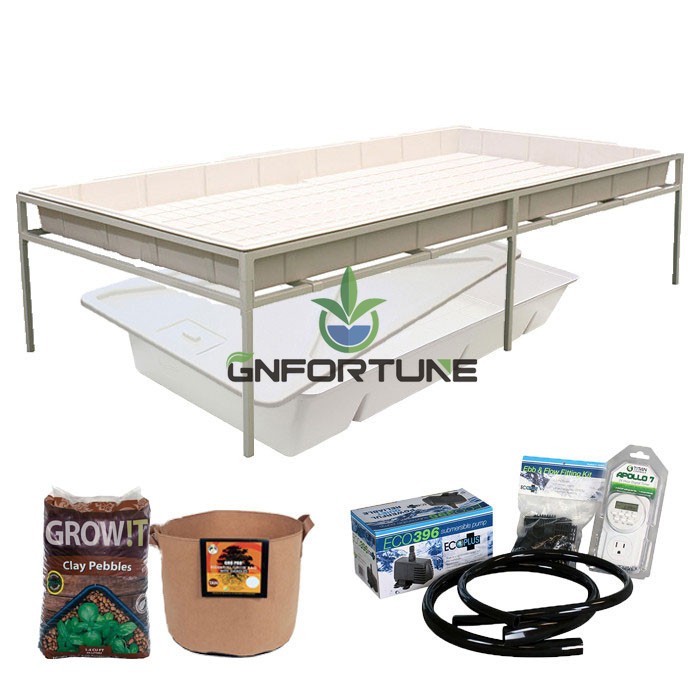
- Site the tank below the return wherever the layout allows, so gravity does the draining and the pump only has to lift
- Give it a level, fully supported base — a point load on the corner of a plastic tank is how tanks split
- Provide a bund sized to contain a credible release, with a drain that does not lead straight to the environment
- Separate the suction and return so freshly dosed solution cannot short-circuit to the pump inlet
- Fit an anti-vortex plate above the suction outlet; a vortex entrains air and cavitates the pump
- Include a full-bore drain at the lowest point, plus an overflow set above the working level
- Leave access for cleaning — a manway or a removable lid large enough for a person and a brush, not just a hatch for a hand
Instrumentation Worth Paying For
- Level sensing with low-level pump protection and a high-level alarm on the refill line
- Solution temperature at the tank, logged — the cheapest early warning you will ever buy
- EC and pH measured in a representative sample point, not in a stagnant corner
- Fill line on a solenoid with a backflow preventer and a mechanical fail-safe, because a stuck valve floods a plant room
- A visible, manual dipstick or gauge. Sensors fail; a mark on the tank wall does not
Mistakes We See Repeatedly
- Sizing from a litres-per-plant rule taken from a hobby guide, which ignores uptake and thermal mass entirely
- Putting the tank where it fits rather than where it drains, so every dump needs a pump and a hose
- No light-proof lid, because the plant room is dark — until someone leaves the door open for a week
- Sharing one tank across zones to save money, then losing the whole farm to one disease event
- No low-level pump protection, which is how pumps are destroyed in the first month
- Forgetting access for cleaning: a tank with a small hatch cannot be scrubbed, and an unscrubbable tank is a biofilm factory
If you are comparing system layouts at the same time, the tank decision interacts with how NFT circulation works and with the choice between Dutch bucket and NFT, because the two systems place very different demands on storage volume.
FAQ
How big should a hydroponic reservoir be?
Size it against the largest of four requirements — circulation buffer, crop uptake buffer, thermal mass and emergency supply — rather than a fixed litres-per-plant rule. On leafy-green NFT the circulation buffer usually governs; on large fruiting crops, uptake does.
Should the tank be inside or outside?
Inside wherever you can. An outdoor tank gains heat in summer, loses it in winter, grows algae unless fully light-proofed, and makes every plumbing joint harder to inspect. Where outdoor storage is unavoidable, bury it or insulate and shade it.
Do I need a separate raw water tank?
Yes on most commercial sites. Reverse osmosis and filtration produce water slowly; storing treated raw water means you can refill or remix a tank without waiting a day for the RO plant.
Can I use one big tank for the whole farm?
It simplifies dosing and reduces capital, but it also couples every zone together: one disease or dosing incident reaches the entire farm. Most commercial sites zone the water the same way they zone the crop.
How often should the tank be drained and cleaned?
At every crop turn at minimum, and immediately after any root disease incident. Sediment at the bottom of the tank is where problems start, and a tank you cannot drain completely cannot be cleaned properly.
Does tank size affect my chiller?
Directly. More volume means more thermal mass and a slower temperature swing, but also a larger mass to bring back to setpoint after a disturbance. Size the two together rather than independently.
Get the Water Side Specified With the System
Send your crop, system type, zone layout and peak water demand through the quote form. We will return a reservoir sizing calculation, a plumbing schematic and a tank specification that matches your pump duty.
Related reading: reservoir volume and pump duty are one calculation — see regional design considerations and confirm your starting point with a proper water treatment and analysis setup.