Film rarely fails at the middle of a panel. It fails where it is held — the base rail, a gable end, a corner that took one storm too many. Choosing a greenhouse film lock channel is therefore less about the profile drawing and more about how that profile carries load into the structure over a full film life. This article walks through the hardware types, what differentiates them in practice, the installation sequence that decides whether a sheet holds tension, and which parts are worth replacing rather than reusing at re-filming time.
It is written for project engineers and installation teams specifying or building polyethylene-covered structures for hydroponic production.
What a Greenhouse Film Lock Channel Actually Does
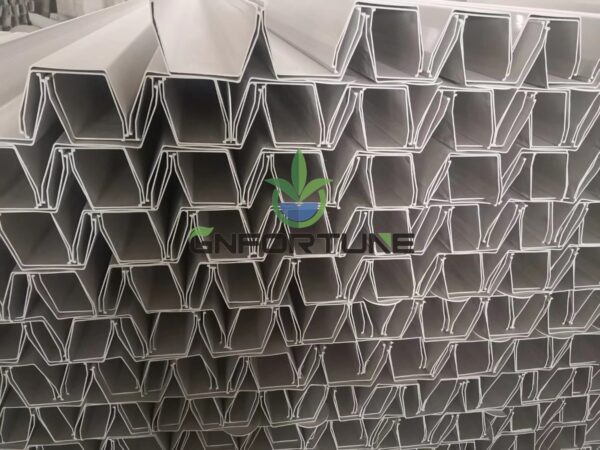
A lock channel is the receiving profile that film is laid over and locked into, usually with a sprung wire or a rigid poly locking strip. Its job is to spread wind load — which arrives trying to peel the film — into a line of fixings along a structural member.
Three things decide how well it does that job: metal thickness and alloy, how often it is fastened to the structure, and whether the geometry suits the material being held. Thin profiles that look adequate flat often deform at the slot lips under sustained uplift, and once a lip opens the wire can walk out.
The common forms:
- Base rail — the channel at the bottom of a side wall or gable where the film terminates.
- Side-wall or intermediate rail — used to anchor mid-height when a single film width cannot span the wall.
- Gable and ridge profiles — the curved or angled runs that take the highest local loads.
- Roll-up side profiles — paired with a tube and gear to allow venting.
- Multi-purpose channel — also used for insect netting and shade cloth, which is why compatibility across those materials is worth asking about.
Single vs Double Lock Channel: Where Each Belongs
Single channel carries one sheet in one slot. Double channel carries two independently — film in one slot, netting or a second film layer in the other — without removing either. Doubling up is a decision made once, during fabrication.
| Application | Single channel | Double channel |
|---|---|---|
| Side wall with insect screen | Two separate runs needed | One run takes both |
| Air-inflated double film roof | Works with independent profiles | Commonly used where two layers meet at one member |
| End walls and gables | Standard choice | Useful where a screen layer is also required |
| Bay height restriction | Slimmer | Taller profile; check clearances |
| Re-filming without removing netting | Not possible at the shared edge | Possible, since slots are independent |
On sites running insect exclusion or insect netting over vent openings, the double profile pays back during re-filming, because the net stays clamped while the film is replaced.
Wiggle Wire: Wire Diameter, Length and Material
Wiggle wire — also sold as zig-zag spring or poly lock wire — is the sprung steel that presses the film into the slot. Its job is line pressure, holding continuously along the run rather than at intervals, so wire quality and straightness matter more than the channel brand.
- Wire diameter must suit slot and film thickness together. Too thin and it rides out under load; too thick and it will not seat properly.
- Coating is the corrosion plan. Galvanised suits most covered runs; heavier coating or stainless is worth considering where the laceway stays wet or fertiliser splash reaches it.
- Length affects installation. Long continuous runs are awkward to handle and to remove; shorter sections can be re-tensioned selectively.
- Material pairing should avoid a corrosion couple between wire and channel — mixed metals stay damp here and fail early.
Worth ordering both items as one line. A channel specified carefully and then laced with whatever wire was cheapest on the day is a common source of callbacks.

Base Rail and Side Rails: Load Paths and Details
The load path is easy to state and easy to get wrong: wind pushes film, film pulls the wire, wire pushes into the slot, the channel transfers that into fasteners, and fasteners must land in something structural. Every weak link in that chain becomes permanent once the film is on.
Three details decide it:
- Fastener spacing tight enough that the profile cannot bow between fixings — tighter towards gables and corners where load concentrates.
- Fasteners suited to the host member, whether steel purlin, aluminium extrusion or concrete kerb.
- Drainage at the base. A laceway holding water becomes a corrosion site and a hygiene problem at once.
Two checks belong before work starts: corner and end-wall returns, where a run needs a terminating channel rather than a fold, and any junction feeding into a structural load path calculated elsewhere.
Installation Sequence: Getting Tension Without Damaging the Film
Tension comes from sequencing, not force. Film is pulled after it has warmed, worked from the centre outwards, and locked progressively rather than clamped at one end and stretched against the other.
- Start once the material has warmed. Cold polyethylene is stiff and tears rather than conforms.
- Avoid wind. Sheet behaviour changes above modest breeze, and a panel lost mid-install costs more than a day of waiting.
- Fix one leading edge, then pull from its centre outwards, rather than dragging from a corner.
- Seat the film fully into the slot before pushing wire, so the wire clamps film rather than air pockets.
- Lock in passes. First pass holds; later passes take up slack once the panel settles.
- Trim excess flush after the final pass, leaving enough material in the channel to stay gripped.
Over-tensioning has its own cost. A drum-tight panel has no slack left to give in a cold snap, and the openings — doorways, vents, corners — take the strain. Leaving some working slack is normal where seasonal temperature swings are wide.
Failure Points: Wind Uplift, Corrosion and Reuse
Films tear at hardware before they wear anywhere else. The repeat offenders are corroded base rails, laceways that hold water, wire reused across film lives, and ridge runs where flutter was never controlled.
- Flutter works both film and wire over time. Where it is visible, look for inadequate intermediate support rather than a film defect.
- Corrosion at the laceway reduces slot depth and can weld the wire in place, turning a re-film into a cutting job.
- Re-used wire loses spring. It may seat, but the line pressure is gone.
- Mixed hardware often means slightly different slot geometry, which shows as loose sections rather than obvious failures.
Judging whether existing channels can be reused takes one walk along the line: open a short length at the worst spot, check for lip deformation and slot corrosion, and see whether wire still comes out freely. Service life expectations by material are set out in the equipment lifespan comparison — rails outlast film, but not indefinitely.
Specifying the Attachment System for a Project
Write profile, wire and fastener as one assembly in the specification, and ask the supplier to confirm they were designed to work together. It is the cheapest way to avoid mismatched slot geometry arriving on site.
- Channel material and coating — aluminium alloy, galvanised steel or PVC-coated steel, matched to the greenhouse environment and the chemicals in use.
- Thickness expressed as a stated range with the supplier’s tolerance, since thickness governs how the slot lips behave.
- Fixing-hole pitch and any pre-punching requirement, tied to the structural member it lands in.
- Wire diameter, coating type and total length required, ordered as a single line item rather than an afterthought.
- Compatibility with the intended film build-up: single layer, inflated double layer, or film plus netting.
- Spare wire quantity and a small surplus of profile for damage and future repairs.
G AND N FORTUNE LIMITED supplies greenhouse structures with matching film, netting and hardware sets, quoted against project parameters.
The greenhouse film lock channel is a small line on a big quotation, and the one most likely to be substituted for a cheaper equivalent. Film choice sits upstream — see the covering materials comparison — and once the covering is settled, the hardware follows from its build-up.

FAQs About Film Attachment Hardware
Should every farm use double lock channel?
Only where two materials share one edge, such as film with insect netting or a second film layer. Everywhere else single channel does the same work for less material cost.
Can wiggle wire be reused at re-filming?
It can be refitted, but the spring does not fully recover. Against a small unit cost, replacing wire avoids the drop in line pressure that lets sections creep.
Aluminium or galvanised steel for the channel?
Aluminium suits most covered structures and avoids rust staining; galvanised steel is stronger per unit cost but depends on coating integrity at cut ends and drill holes. Match it to the structure and chemical environment.
Why does film loosen a few weeks after installation?
Usually because it was tensioned in one aggressive pass, or installed cold. Material relaxes after loading, so later tensioning passes are standard rather than a sign something went wrong.
How much extra channel and wire should we order?
Set the surplus against the number of terminations and the distance from your supplier rather than a flat percentage, so repairs and later modifications are covered.
Related Reading
- Greenhouse Structural Design for Hydroponics: Wind, Snow and Foundation Loads — The loads that the fixing spacing and fastener choice have to carry into the structure
- Greenhouse Storm, Heatwave and Cold Snap Preparation — Pre-storm checks that start at the rails, corners and terminations
- Greenhouse Covering Materials: Glass vs Polycarbonate vs Film — Choosing the covering itself before its hardware is specified
- Commercial Hydroponics in Southeast Asia: Humidity, Disease Pressure and Structure Choices — Why hot humid climates push towards different film and fixing choices
- What’s in a Complete Hydroponic System Package — Where structure and covering hardware sit inside a full project scope
Next Step: What to Send for a Quotation
Film hardware is quoted per metre of run, but only once the build-up is known — how many layers, whether netting shares an edge, and what sits underneath.
Specifying a structure or planning a re-film? For RFQ or project consultation, send: greenhouse dimensions, bay width and gutter height; structure type (multi-span, single-span, tunnel) and host member material; covering build-up — single film, inflated double layer, or film plus netting; total metres of each profile type; channel material and coating preference; wire diameter, coating and required length; local wind and snow parameters; whether this is new build or replacement of existing hardware; delivery schedule; and the budget band. G AND N FORTUNE LIMITED supplies greenhouse structures with matching film, netting, lock channel and wire sets quoted to those parameters.