Greenhouse Insect Netting: Mesh and Install
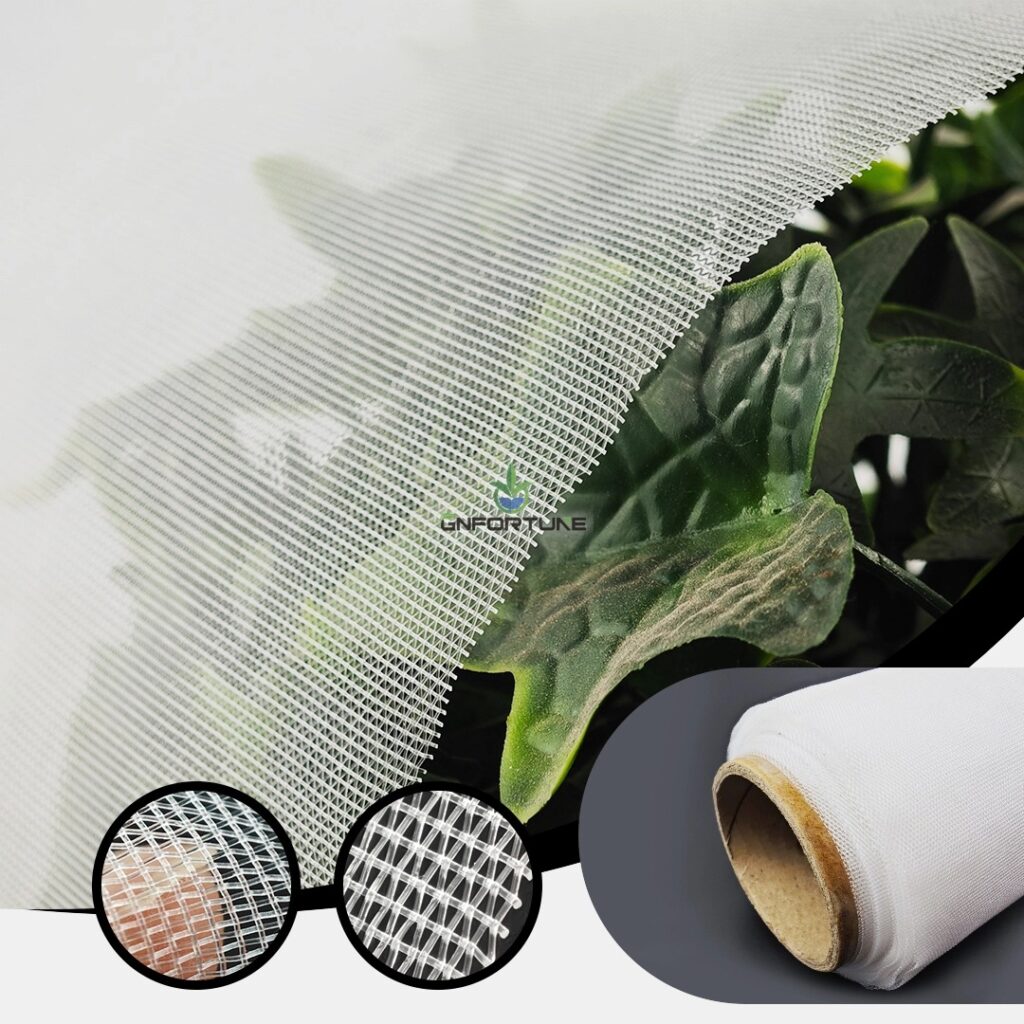
Greenhouse insect netting is an exclusion barrier, not a pesticide. The mesh is a sieve sized against the smallest pest that has to stay out, and every other specification decision follows from that one number. Mesh count is stated per linear inch; aperture in millimetres is what actually stops the insect, and aperture depends on thread thickness as well as count. Most commercial houses land between 16 and 50 mesh. Below 16 it stops moths and beetles but not whitefly; above 50, the airflow penalty costs more than the pests do.
Two things decide whether the order works: the mesh has to be finer than the target pest at every opening, including the forgotten ones (ridge vents, gable ends, door gaps, the frame-to-foundation joint), and vent area has to be recalculated afterwards, because a fine screen removes much of the open area the house was designed around.
Mesh Count vs Target Pest: Reading the Spec
Choose mesh against the pest, then check what it does to air. A quotation reading “40 mesh anti insect net” without aperture, thread diameter or open area gives nothing to design with.
| Target pest | Body width | Mesh that excludes it | Field note |
|---|---|---|---|
| Thrips | 0.15 to 0.25 mm | 50 mesh | Practical upper limit; reserved for propagation zones |
| Whitefly | 0.3 to 0.4 mm | 40 mesh | The common commercial spec on lettuce, tomato and herbs |
| Aphid | 0.4 to 0.6 mm | 32 to 40 mesh | Range where virus-vector pressure drops most visibly |
| Leafminer adult | 1.3 to 2.0 mm | 25 mesh | Keeps air moving; pair with monitoring |
| Looper, armyworm moth | 2 to 3 mm | 16 to 20 mesh | Net houses and open-sided tunnels in warm regions |
| Beetles, grasshoppers | Over 3 mm | 16 mesh or coarser | Often chosen where the real target is wind-borne debris |
Body width is the number to look up, not wingspan, because insects fold through openings narrower than their wings. Suppliers rarely publish aperture since it shifts with thread diameter at the same nominal count, so ask for it in writing.
Airflow Penalty: What the Mesh Takes Away
Finer mesh means fewer holes and slower air, and the curve is steep at the fine end. That is why a 50 mesh screen on a hot-climate house is usually the wrong trade.
| Mesh count | Typical open area | Vent upsizing factor | Where it belongs |
|---|---|---|---|
| 16 mesh | 60 to 70 percent | 1.2 to 1.3 times | Net houses, open-sided tunnels, warm dry regions |
| 25 mesh | 50 to 60 percent | 1.35 to 1.45 times | Fruiting vegetables under moth pressure |
| 32 mesh | 40 to 50 percent | 1.5 to 1.6 times | Aphid and virus control on pepper and cucumber |
| 40 mesh | 30 to 40 percent | 1.6 to 1.8 times | Whitefly exclusion on leafy greens and tomato |
| 50 mesh | 22 to 32 percent | 1.9 to 2.2 times | Propagation and seedling zones, usually fan-assisted |
Expect internal peak temperature to rise roughly 1 to 3 degrees Celsius once a 40 mesh screen goes onto a house designed for open vents, and more where the structure was marginal to start with. That is the real cost of exclusion, paid for in vent area rather than accepted as a crop problem.
Vent Area Recalculation
Effective vent area equals gross vent area multiplied by the net’s open area, then discounted for how the screen discharges air. Most houses are drawn around a vent area of roughly 15 to 25 percent of floor area. Fit 40 mesh and the opening has to grow by about 1.6 to 1.8 times to deliver the same air exchange.
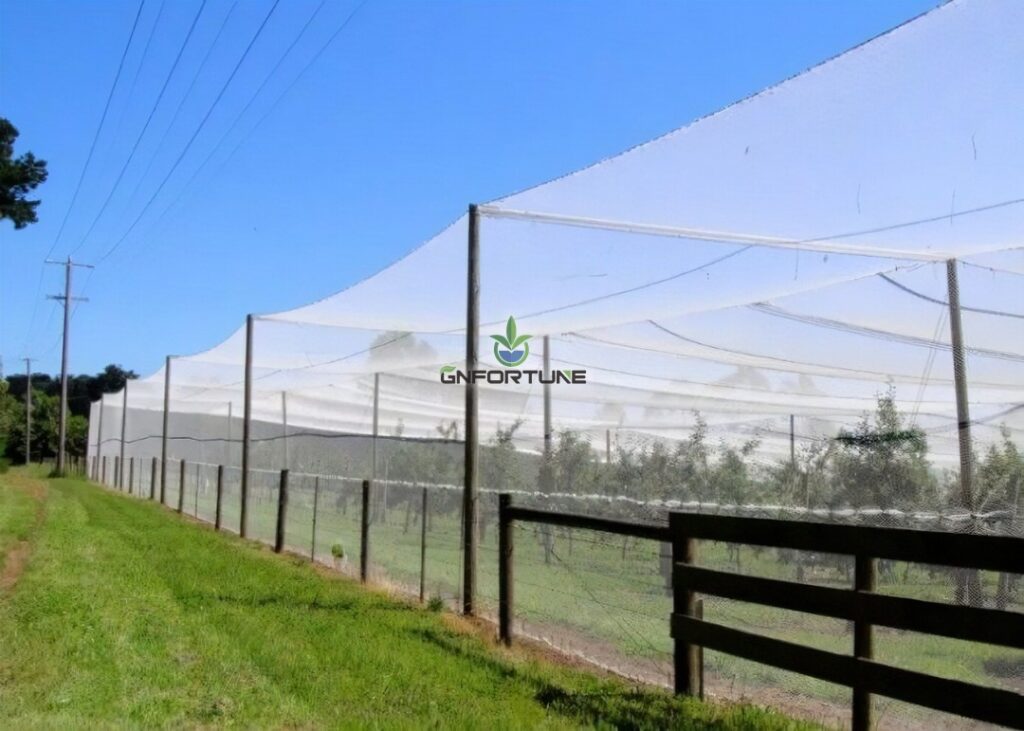
On site we often see the reverse order: the net is bought first, pulled over vents sized for open airflow, and the heat is then blamed on the fan supplier. Sizing runs the other way — fix the target air exchange rate, work out what the mesh allows, then order net to that larger opening.
Where the frame cannot accept bigger vents, the fallback is mechanical: more exhaust capacity, or coarser mesh paired with a biological program. The ventilation and HAF fan design guide covers the fan side; the biological control release-rate guide covers what a coarser mesh has to be paired with.
Greenhouse Insect Netting: UV Life and Thread Type
Most commercial insect netting is HDPE monofilament, knitted rather than woven, with UV stabiliser compounded into the resin rather than coated on. That choice decides service life more than mesh count does.
- Monofilament, knitted: single extruded threads, run-resistant, holds aperture under tension.
- Multifilament or tape yarn: cheaper per square metre, stretches, and aperture drifts after a season of thermal cycling.
- UV package: ask for stabiliser type and a warranty in months of exposed service; three to five years is typical for quality monofilament.
- Colour: white passes the most light, black lasts longest.
Failure rarely appears mid-panel. It starts as brittleness at the fixing line, where the net flexes against a clip, and as a chalky surface on horizontal runs. Net loads are small beside cladding but not zero; the structural design guide on wind and foundation loads explains why a large netted side wall still deserves a check.
Door Airlocks and Double Netting
The door is where exclusion fails. A 40 mesh envelope with one swinging door loses more pests in a week than the mesh keeps out in a season.
- Build an airlock: two netted doors with a vestibule between them, closing into positive pressure where fans allow.
- Fit self-closing hardware and a brush or magnetic threshold seal. A door propped open for a pallet truck undoes the specification.
- Use coarser mesh outside and the specified mesh inside, so the fine layer takes less mechanical abuse.
- Net the vestibule walls and ceiling as well, or pests simply enter around the frame.
Exclusion sits inside a wider program, and the IPM playbook for hydroponic greenhouses sets out where barriers stop and monitoring begins.
Fixing Detail: Clips, Rope, Profiles
Net tensioned unevenly flutters, and fluttering net abrades itself at every contact point.
- Clip profiles on vent frames give the cleanest edge and the fastest re-netting, at the highest material cost.
- Rope-threaded hems with tension hooks suit long side walls; keep the rope inside a hem, not through the mesh.
- Batten and staple is cheapest and shortest-lived; staples pull through once UV hardens the net.
- Space fixings at 300 to 500 mm, closer on windward corners where lift loads concentrate.
- Keep net off sharp metal. A burr on a cut purlin will cut a seam within one season.
Leave 20 to 40 mm of sag on long spans so thermal movement has somewhere to go. Net pulled tight in summer splits at the fixing line the first time it contracts.
Inspection and Repair Rhythm
A net with a 20 mm tear has no exclusion value along that edge. Repairs are cheap; finding the failure through pest counts is not.
- Weekly: walk the perimeter for daylight at the base, door frames and pipe penetrations.
- Monthly: check fixing lines for lifted clips and abrasion after wind events.
- Per crop turn: patch tears with matching mesh and UV-stable thread. Tape does not survive washing.
- Annually: bend-test a coupon from the most exposed panel. Once threads snap, the panel is finished.
The failure mode that shows up on almost every retrofit: the mesh is specified against the pest, the vents stay at their original size, and the house runs 2 to 4 degrees hotter than the crop plan assumed. Exclusion was solved and climate was broken by the same purchase — size the opening from the net’s open area, not from the frame it happens to fit.
Put mesh count, aperture, thread type, open area, roll width and UV warranty on one purchase order line, and order roll widths to match vent dimensions plus hem allowance.
FAQ
What mesh count do I need for whitefly?
A: 40 mesh is the commercial default, with aperture finer than roughly 0.4 mm. Get the aperture in writing, since thread diameter changes it at the same nominal count.
Does insect netting cut greenhouse airflow enough to matter?
A: Yes. A 40 mesh screen typically removes 60 to 70 percent of the open area, so gross vent area has to grow by 1.6 to 1.8 times.
Can one net handle insects and shade together?
A: Rarely well. Shade nets are graded by shading percentage and insect nets by aperture, and a product claiming both usually compromises one.
How long does greenhouse insect netting last?
A: Quality UV-stabilised HDPE monofilament commonly runs three to five years in high-insolation regions; figures vary by region and season.
Is biological control still needed once the house is netted?
A: Yes. Netting cuts immigration but does not clear an established population, and one door gap or tear reintroduces pressure every week.
Get Netting Specified for Your Vents
Send vent dimensions, target pest, climate and fan capacity through the netting specification quote form and the engineering team will return a mesh count, aperture target, open area figure and vent upsizing factor for your greenhouse insect netting.