
Shade Net vs Insect Net vs Bird Net: Changes
Agricultural netting comes in three families that look alike on a roll and behave very differently once they are on a structure. A shade net for plants is graded by the percentage of light it removes, an insect net by its aperture in millimetres, and a bird net by its tensile strength and mesh size. Buying the wrong one is rarely obvious on day one. It shows up as a house that runs hotter than the design assumed, a vent that no longer delivers its air exchange, or a fixing line that pulls out in the first storm of the season.
The three numbers behind the specification are shade percentage, aperture, and breaking strength. Everything else on the data sheet follows from those, which is why comparing quotations by price per square metre alone produces bad decisions.
Weave Types: Knitted vs Woven
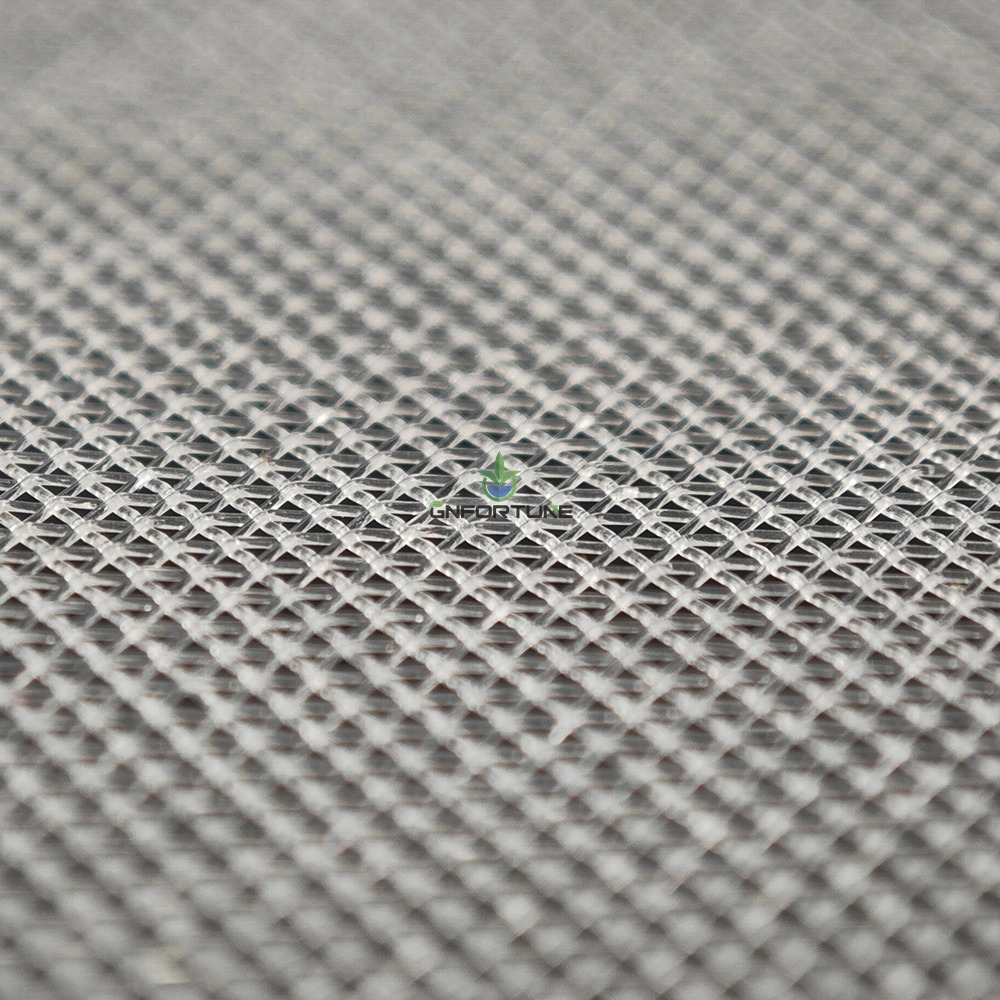
Weave decides how the net behaves under load and how it fails. Knitted netting is the default for shade and insect work; woven netting is used where tension and tear resistance matter more than price.
| Construction | How it is made | Typical weight | Behaviour on site | Best used for |
|---|---|---|---|---|
| Warp-knitted | Interlooped yarn, run-resistant | 30 to 120 g/m² | Drapes well, stretches slightly, lowest cost per square metre | Shade and insect netting on vents, walls and tunnels |
| Woven monofilament | Over-under weave, heat-set | 60 to 200 g/m² | Dimensionally stable, high tensile, holds aperture | Bird net, windbreak, tensioned spans |
| Knotted extruded | Knotted PE strands | 8 to 25 g/m² | Very light, snags on frame edges, needs support wires | Bird netting over orchards, tunnels and open beds |
Knitted net fails by tearing at the fixing, while woven net tends to pull the fixing out instead. That distinction belongs in the installation drawing rather than in the netting order, because it changes the clip spacing and the profile you buy.
Shade Percentage and Crop Effect
Shade percentage is the share of incoming light the net removes. Commercial shade nets run from roughly 30 to 70 percent, and every step up is a decision to accept less photosynthesis in exchange for lower heat and lower leaf temperature.
| Shade rating | Typical use | What it costs you |
|---|---|---|
| 30 percent | Leafy greens and cucumber through hot months | Little; safe to leave on for most of the season |
| 40 to 50 percent | Tomato and pepper in high-insolation regions | Fruit colour and sugars can slip if left on too late |
| 50 to 60 percent | Propagation and transplant recovery | Stretching and soft growth beyond the recovery window |
| 60 to 70 percent | Nursery, ornamentals, shade houses | Not a production rating for fruiting crops |
Shade is a climate tool, not a permanent fitting. Retractable or removable shading lets one house run 40 percent through summer and nothing at all in winter, which is usually where the money is. In hot regions the payback case is the cooling load rather than the crop: less solar gain means lower pad-and-fan duty and a lower peak leaf temperature. The cooling comparison for hot climates puts shade against pads and fogging on the same budget.
Agricultural Netting Against Insect Pressure
Insect netting is specified by aperture, not by shade, though it always removes some light as a side effect. A fine whitefly mesh typically takes out a further 10 to 25 percent of light and removes a large share of the open vent area, so an insect net on a vent is also a partial shade net and a permanent airflow restriction.
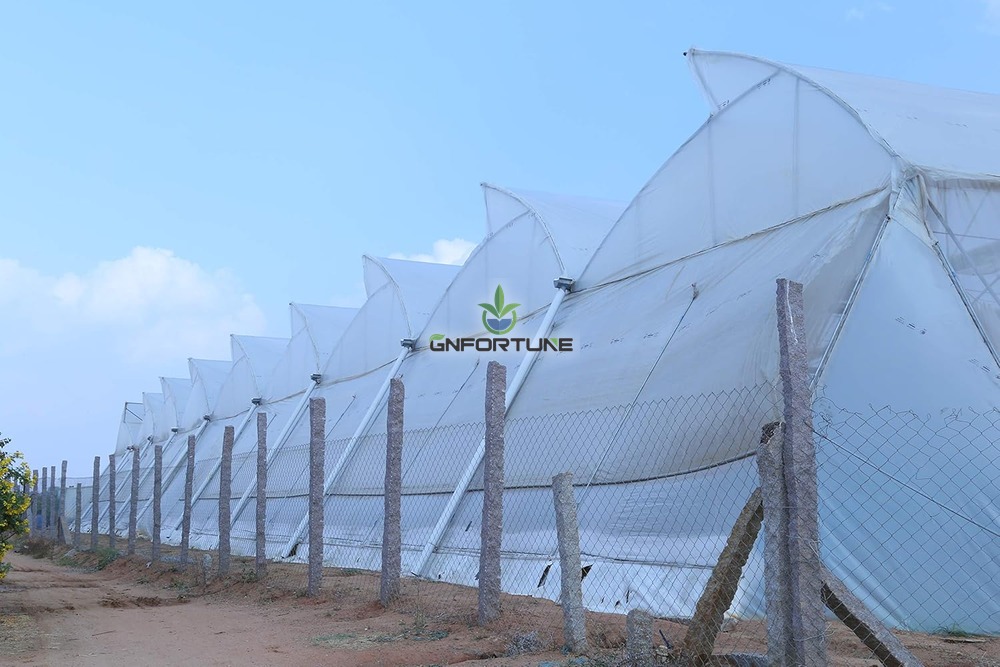
Where the pest list is short and the climate is hot, the honest comparison is between a coarse insect mesh plus biological control and a fine mesh plus more fan capacity. Both cost money; they cost it in different columns. The insect netting mesh and installation guide sets out aperture against target pest and the vent upsizing factor that follows from it.
Bird Net: Load and Fixing
Bird net is a structural item sold as a consumable. The net itself is light, but a large span presents a real sail area to the wind, and the load lands on the posts, wires and perimeter fixings rather than on the mesh.
- Mesh size of 15 to 30 mm covers most bird pressure without turning the structure into a wind wall.
- Support wires at 3 to 5 m spacing with a deliberate catenary sag, so the net does not drum in wind.
- Perimeter fixings sized for the wind load, not for the net weight. This is the line item that fails first.
- Allow for leaf and snow accumulation on near-horizontal spans; a sagging net collects both.
On exposed sites the netting decision becomes a structure decision. The structural design guide for wind, snow and foundation loads covers the check that should happen before a large netted span is signed off.
Combined-Purpose Products and Trade-offs
Multi-function products exist because they are genuinely useful in some houses: insect net with a declared shade rating, shade cloth with a thermal coating, and aluminised screens that cut both light and heat loss. Each one gives up something, and the trade is worth naming before the order goes in.
- Insect and shade combined: fewer layers, one installation, but shade and aperture are locked together for the life of the net.
- Thermal or energy screens: real heating savings in cold climates, at the cost of light transmission and a mechanism that needs maintenance.
- Two separate layers: highest material and labour cost, but each layer can be changed, retracted or replaced independently.
For a house that runs year-round with a changing crop plan, separate layers usually win on operating flexibility. For a single-crop seasonal tunnel, a combined product is often the better buy.
Cost per Square Metre and Service Life
Cost per square metre spans a wide band with weight, mesh fineness and UV package, and figures vary by region and season. What matters more for a budget is the replacement cycle, because labour to re-net a house is often comparable to the material cost.
| Net type | Typical service life | Cost driver | Replacement trigger |
|---|---|---|---|
| Shade net | 4 to 8 years | Weight per square metre and UV package | Fading, loss of shade rating, tearing at fixings |
| Insect net | 3 to 5 years | Mesh fineness and aperture tolerance | Brittleness along fixing lines, tears at corners |
| Bird net | 5 to 10 years | Tensile strength and knot type | UV embrittlement, permanent sag, wire wear |
Freight is the variable that surprises buyers. Netting is light and bulky, so a container is usually full by volume long before it reaches weight limits, and the effective cost per square metre is set as much by roll width and packing density as by the material price.
The advisory point worth repeating before any netting order: buy against the worst week of the year, not the average week. A shade rating chosen for July costs yield in December, and an insect mesh chosen for the worst pest costs airflow every day of the season. Write down the week the net has to survive and specify to that.
Replacement planning belongs in the capital budget rather than in the maintenance line. A house that re-nets on a cycle avoids the pattern where a torn vent is patched for two seasons before the whole envelope is finally replaced during a crop gap, which is always the most expensive moment to do it.
FAQ
Can insect netting replace shade netting?
A: Partly. A fine insect mesh removes roughly 10 to 25 percent of light and a large share of vent airflow, but it cannot be adjusted, so it is a poor substitute for a removable shade layer.
What shade percentage suits leafy greens in a hot climate?
A: Around 30 percent is the usual starting point, rising to 40 to 50 percent at peak insolation. Above that, growth slows enough to show in the harvest plan.
Does bird net need support wires?
A: Yes on spans beyond a few metres. The wind load on a large netted area is carried by wires and perimeter fixings, not by the mesh.
How much airflow does insect netting remove?
A: A 40 mesh screen typically removes 60 to 70 percent of open vent area, which is why gross vent area has to grow when a house is netted.
When should agricultural netting be replaced?
A: On symptom rather than on age. Fading, brittleness at fixing lines, and tears that keep returning mean the UV package is spent; figures vary by region and season.
Request a Netting Package Quote
Send structure dimensions, crop plan, pest list and climate through the netting package quote form and the team will return a shade rating, aperture, weave and fixing schedule for your agricultural netting, with the service life and replacement cycle stated alongside the price.


