
Stackable Pot Systems: Where They Pay Off
Stackable pot systems sell on plants per square metre and pay back on crop fit, labour and freight, in roughly that order. A tower of moulded pots fed from the top and drained at the base turns floor area into growing surface without the frame cost of a multi-layer rack. The question for an operator is not whether towers produce more per square metre, since they usually do, but whether the extra plants arrive at a labour and capital cost the crop price covers.
How Stackable Planters Work
Each tower is a stack of moulded pots, commonly three to seven high, carried on a central spine or an interlocking rim and standing on a base that collects run-off. Nutrient is applied at the top through one or two drippers and cascades down through drain holes into each pot below. Pot volumes run 3 to 8 L, footprints 0.25 to 0.5 m², and finished heights 1.5 to 2.2 m.
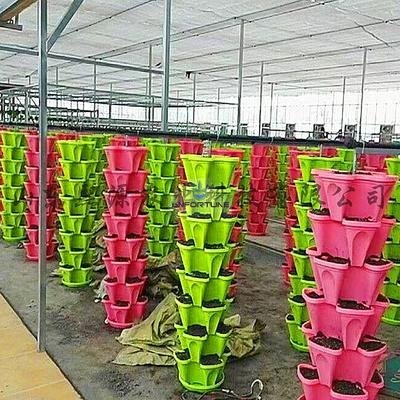
The simplicity is the commercial argument. There are no channels, no gutter supports and no return main per row; a tower is assembled on the floor, stood up, connected to a drip line and planted. For a site with limited capital, a short lease or a seasonal tunnel, that start-up shape is worth more than the headline density figure.
Count the plants rather than the pots. A five-pot tower carrying three or four plants per pot holds 15 to 20 plants, and the number that matters for the crop plan is plants per tower divided by the footprint, because aisles consume the same floor in a tower layout as they do in a bed layout. A layout drawn on that basis is usually a fifth to a third less dense than the tower specification suggests.
Crops That Fit Vertical Stacking Pots
The format rewards short cycles and high value per plant. Crops that turn in weeks and can be picked from a standing position suit towers; long vine crops that need a high wire and weekly lowering do not.
| Crop | Fit | Why |
|---|---|---|
| Strawberries | Strong | Fruit hangs clear of the pot; picking height is workable |
| Leafy greens and herbs | Strong | Short cycles, uniform canopies, fast turns |
| Seedlings and young plants | Strong | Short dwell and high value per square metre |
| Cut flowers and ornamentals | Conditional | Depends on stem length and whether support is needed |
| Fruiting vegetables | Weak | Pruning, load and access do not suit the format |
| Root and bulb crops | Weak | Media depth and harvest access |
Where the crop is a fruiting vine, the comparison is better made against buckets, and the choice between Bato buckets and Dutch buckets is the more useful decision to spend time on.
Watering Uniformity Top to Bottom
Watering is the engineering weak point of the format. The top pot receives fresh feed, and every pot below receives what has already passed through the pots above, so salinity climbs down the column. The standard correction is to run a higher leaching fraction, commonly 20 to 30 percent, and to measure run-off EC at the base rather than at the dripper.
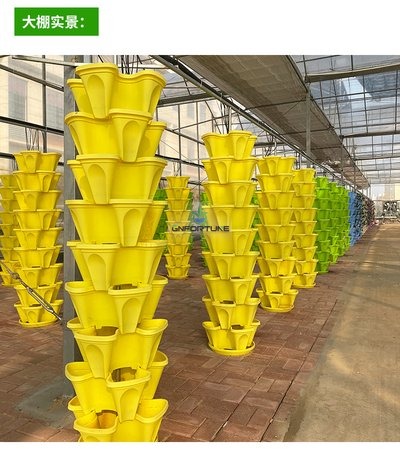
Irrigation scheduling follows the same logic as any container crop, with one difference: the column has to be flushed through, not merely wetted. Short pulses that wet the top pot and stop leave the lower tiers running on leachate, so events are sized to produce run-off at the base at least once a day in warm weather, and the run-off is what gets measured.
Two details decide whether the column wets evenly. Dripper number: one or two drippers at 1 to 2 L/h per tower is typical, and a single dripper down the centre leaves the outer root zone dry on a wide pot. And drain path: the base tray needs a positive drain to a collection line, or the floor becomes the drain and the aisle turns into a hygiene problem. Filtration should be matched to the dripper, as it is in any pressurised system, and the same logic is explained in the vertical tower irrigation notes.
Labour Compared with Beds and Buckets
Density is easy to advertise and labour is what decides the margin. Compare formats on plants per hour of crew time rather than plants per square metre of floor.
| Format | Plants per m² of floor | Labour character | Capital shape |
|---|---|---|---|
| Raft beds or channels | 20 to 30 | Fastest picking, best access | Low capital per plant |
| Dutch buckets | 2 to 4 | Weekly training, high labour | Medium capital per plant |
| Stacked pot towers | 25 to 60 | Planting and picking at height | Low structure cost, more media per plant |
Towers buy density and give back access. Above roughly 1.8 m, a step or a platform is needed for planting and picking, and that slows a crew more than the extra plants justify on a low-value crop. The other labour item is rotation: lower tiers are shaded by the tiers above, so towers are turned periodically to even out light, and that handling has to be in the work standard. The commercial vertical growing systems comparison puts towers against racks and walls on the same basis.
Freight: The Nested Shipping Advantage
Moulded pots nest, and nesting is the quiet economic argument for the format. Pots typically nest at roughly a third to a fifth of their assembled height, so a container carries several times as many pots nested as assembled, and freight cost per plant falls accordingly. For an imported order that difference is material on the first invoice.
A caution on the arithmetic: the freight saving is real and it arrives once. The recurring numbers are media per plant, labour at height and pot replacement, and a tower program that only works because the shipping was cheap does not work in year three.
Spares belong in the first order rather than the second. Towers are damaged in handling at crop change more than in service, and a broken pot mid-column means stripping the stack to replace it, so holding 5 to 10 percent of the pot count on site is cheaper than an air freight order and a crew standing idle.
Media per plant is the other side of the ledger. A tower pot holds 3 to 8 L, so media volume per plant is higher than in a channel, and the media bill scales with plant count at every crop change. Set that against a pot life of roughly three to seven years for UV-stabilised mouldings, and the comparison with channels becomes a cash flow question rather than a technology choice.
Limits: Wind, Height and Drainage
Three limits show up in practice. Wind: a wet 2 m column standing outdoors presents a real overturning load, so outdoor and tunnel installations use shorter stacks, a stabilising frame or a base that can be weighted. Height: check the gutter height and the clearance for spray equipment before committing to a seven-tier stack, since the top tier is the one that hits the structure. Drainage: a diseased pot at the top of a column drips into every pot below it, which is a different disease dynamic from isolated buckets and should shape how closely the crop is monitored.
Cleaning between cycles takes longer than it does in a channel system, because each pot has to be emptied and washed rather than a run being flushed. Where crop turns are short, that turnaround time is the hidden cost of the format, and it should be in the crop calendar as a number of days rather than assumed to be a weekend.
For most sites the sensible next step is a measured trial. Run 50 to 100 towers for one full crop cycle, log plants per labour hour, run-off EC at the base, and plant losses by tier, then compare against the existing beds on the same crop. Stackable planters reward that measurement, because the answer depends on the crop and the local labour rate more than on the moulding, and figures vary by region and season.
Frequently Asked Questions
Which crops suit stackable pots best?
A: Short-cycle, high-value crops: strawberries, leafy greens, herbs and young plant production.
How many plants per square metre do towers give?
A: Commonly 25 to 60 plants per square metre of floor depending on tier count, pot size and spacing.
Does water reach the bottom tier?
A: Yes, provided the leaching fraction is high enough, commonly 20 to 30 percent, and run-off EC at the base is checked rather than assumed.
Can towers be used outdoors?
A: Yes, with shorter stacks or a stabilising frame, because wind load on a tall wet column is the limiting factor.
How long do the pots last?
A: Roughly three to seven years for UV-stabilised mouldings, depending on radiation exposure and how they are handled at crop change.
Stackable planters are not a replacement for beds and buckets, they are a third option that wins on specific crops and specific labour rates. The trial block is what tells you which of the three your site falls into.
Price a Trial Block Before a Full House
Send the crop, floor area, working height under the gutters, crew labour rate and target plants per square metre, and ask for pot volume, tier count, dripper rate and nesting ratio in writing. Request a stackable pot trial quote sized to a trial block rather than a full house, so the first order answers the labour question instead of committing the whole floor.


