

Cooling is rarely the problem in the tropics; standing water, saturated air and the disease that follows are. Commercial hydroponics in Southeast Asia succeeds or fails on airflow, drainage and the discipline of operating a wet house — not on how much equipment is imported.
This guide sets out which structure level actually pays back in tropical conditions, how humidity drives the disease calendar, what to grow, and how to plan around storms and the monsoon.
What Is Different About Growing in the Tropics?
Temperature sits in a workable band year-round, so neither heating nor heavy cooling is usually required. In exchange, humidity stays high, rainfall is intense and seasonal, and pathogen pressure — particularly downy mildew, Pythium and bacterial rots — runs all year with no winter reset.
The design implication is that airflow and water management carry the load that heating and cooling carry elsewhere. Well-run mid-tech houses consistently outperform poorly run high-tech ones in the region, because the limiting factor is operational rather than mechanical.
Net House, Polytunnel or Sealed Greenhouse — Which Pays Back?
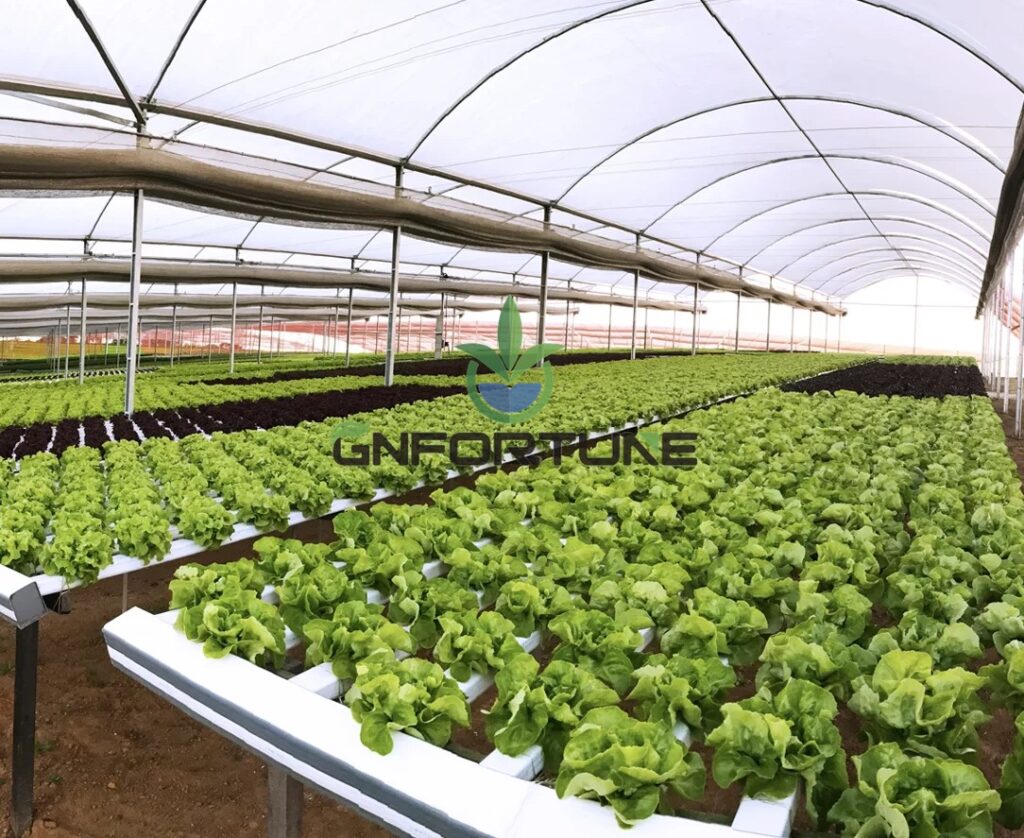
Match the structure to the crop value and to how much control the crop actually needs. Over-specifying is the regional default error: a fully sealed, actively cooled house in a tropical lowland often costs more to run than the crop margin supports.
| Structure | Control level | Suits | Trade-off |
|---|---|---|---|
| Net house / rain shelter | Rain exclusion, insect barrier, natural ventilation | Leafy greens, herbs, seedlings | Limited climate control; disease pressure in prolonged wet weather |
| Polytunnel with roll-up sides | Partial rain and wind control, better airflow management | Mid-value leafy and fruiting crops | Film life under high UV; condensation control needed |
| Sealed greenhouse with active cooling | Full climate control | High-value vine crops, propagation, seedling production | High energy cost; requires reliable power and skilled operation |
Choose honestly against the crop, not against the brochure. A well-sited net house with good airflow and disciplined sanitation will out-earn an under-funded sealed house in most tropical locations.
How Does Humidity Drive Disease Pressure?
Persistently high humidity slows transpiration, keeps leaf surfaces wet for longer, and gives foliar pathogens the window they need. Three interventions do most of the work:
- Keep air moving: horizontal airflow fans run continuously, including at night when condensation forms.
- Manage the roof: anti-drip film and adequate slope stop condensation falling back onto the canopy.
- Control the floor: drainage, graded surfaces and hygiene zoning remove the standing water that spreads root pathogens.
Then align the spray programme to the calendar rather than the symptom. Preventive action taken before a forecast wet week is worth more than any curative treatment available afterwards.
Which Crops Fit Tropical Reality?
Leafy greens that tolerate warmth — including many Asian brassicas and amaranths alongside lettuce varieties selected for heat — plus herbs, cucumbers and, at higher elevations, tomatoes and peppers. Elevation is the region’s quiet advantage: a site at 800–1,500 m often behaves like a temperate one, and the same country can contain both realities.
Select genetics for the conditions you have. Heat-tolerant and disease-resistant varieties cost more per seed and return far more per square metre than a standard European variety pushed into the wrong altitude.
How Should Monsoon and Storm Risk Be Planned?
Design drainage first, then structure. Intense rainfall overwhelms undersized gutters and site drainage long before it threatens the frame, and standing water around a house is a disease problem rather than a nuisance.
Power resilience comes next. Airflow depends on it: a tropical house that stops moving air degrades within a single afternoon. Specify surge protection, proper earthing, automatic restart logic and — critically — backup capacity sized for fans before lighting. Keep a written restart procedure for night-time outages, since that is when they happen.
FAQs About Hydroponics in Southeast Asia
Is a net house enough for commercial production?
For leafy greens and herbs in most tropical lowland sites, yes — and often the most profitable choice. Net houses exclude rain and insect pressure while keeping airflow high and capital low. Fruiting crops and propagation generally need more control, and elevation changes the answer significantly.
How do you control humidity in a tropical greenhouse?
Through continuous air movement, roof condensation management and floor drainage rather than dehumidification. Mechanical dehumidification is usually too energy-intensive for production houses; sealed propagation rooms are the exception where it pays.
What is the biggest operational risk?
Disease following prolonged wet weather, and power interruption during it. Farms that treat airflow, drainage and sanitation as daily disciplines rather than periodic tasks lose far less crop than farms that rely on sprays alone.
Which crops suit tropical hydroponics best?
Heat-tolerant leafy greens and Asian brassicas, culinary herbs, cucumbers, and tomatoes or peppers at elevation. Choose varieties bred or selected for heat and disease resistance rather than temperate types, and trial them at small scale before committing a full house.
Does monsoon season mean production has to stop?
No, but the plan has to change. Expect lower yields, higher disease pressure and intermittent logistics disruption; schedule maintenance, deep cleaning and staff training into the wet months, and keep critical spares and chemical stocks topped up before the season starts.
What to Send When You Request a Quotation
Site elevation, annual rainfall pattern and design wind load, available power and outage frequency, target crop and weekly volume, and whether the site is lowland or highland. With those five, a supplier can recommend structure level, ventilation layout and drainage capacity that match reality.
Related reading: structure trade-offs in high tunnel vs greenhouse vs polytunnel, humidity control in VPD and humidity management, airflow design in ventilation and HAF fans, and regional context in hydroponics in Vietnam, Thailand and Indonesia.
Send your site elevation, rainfall pattern, crop plan and power situation, and we will recommend a structure and ventilation layout that suits your conditions: contact our team.