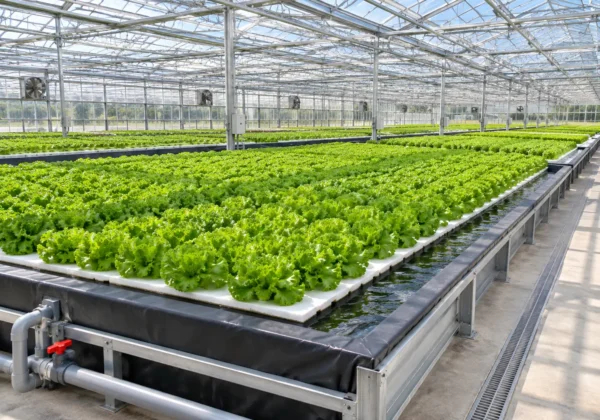
A commercial deep water culture raft system grows lettuce and other leafy greens on floating boards above a shared pond of aerated nutrient solution. Its performance depends on more than the raft board itself. Pond depth, structural support, liner protection, insulation, circulation, aeration and harvesting access must work together as one production system.
For commercial growers, the main design objective is to maintain consistent root-zone conditions while making planting, transplanting, harvesting and cleaning efficient. A larger water volume can buffer short interruptions better than a thin nutrient film, but it does not eliminate the need for reliable circulation, aeration and backup planning.
What a Deep Water Culture Raft System Actually Includes
A commercial DWC raft system typically consists of six interconnected components:
- Production pond: Holds the nutrient solution and supports the required water volume.
- Pond liner: Creates a waterproof barrier between the growing solution and the supporting structure.
- Insulation: Helps limit heat transfer and protects the liner from abrasive surfaces.
- Floating raft boards: Support seedlings and maintain the planned planting positions.
- Circulation and aeration: Distribute nutrients throughout the pond and supply oxygen to the root zone.
- Monitoring and drainage: Allow operators to check solution conditions, clean the growing area and manage water replacement.
Unlike NFT channels, where nutrient solution flows as a thin film through individual channels, DWC keeps plant roots immersed in a shared nutrient solution throughout production.
The system is particularly suitable for lettuce, basil, pak choi and other leafy greens. Fruiting crops require separate evaluation because their root structures, plant support and production cycles can demand different growing configurations.
Crop selection should therefore come before equipment sizing. See our crop and hydroponic system matching guide for a broader comparison.
Designing a Commercial Floating Raft Hydroponics Layout
The pond dimensions determine the working water volume, raft coverage, structural load and access requirements. These parameters should be considered together rather than specified independently.
The following ranges provide preliminary planning references for commercial lettuce production. Final dimensions should be confirmed against crop requirements, greenhouse conditions and engineering calculations.
| Parameter | Preliminary design reference | Main consideration |
|---|---|---|
| Solution depth | 150–200 mm | Water volume, root access and temperature stability |
| Bed length | 10–30 m per run | Circulation distribution and maintenance access |
| Bed width | 1.2–1.5 m | Raft dimensions and operator reach |
| Board size | 1.2 × 0.6 m, approximately 30–50 mm thick | Rigidity, handling and reuse |
| Plant spacing | 150–200 mm | Crop head size and planting density |
| Working height | 0.6–0.9 m for raised beds | Transplanting and harvesting ergonomics |
These are project planning values, not universal DWC standards. Published extension guidance also describes pond depths of approximately 4–12 inches, depending on the system configuration and required water volume.
Calculate the Working Water Volume
Water volume is one of the most important inputs when sizing a commercial DWC installation.
For a rectangular pond:
Working water volume = Bed length × Bed width × Solution depth
For example, a bed measuring 20 m long, 1.2 m wide and 180 mm deep holds approximately 4.32 m³ of nutrient solution.
This volume influences circulation requirements, nutrient management, cooling demand and the structural load placed on the supporting floor.
For larger installations, calculate each production zone separately. Include connected reservoirs and pipework only when they form part of the operating solution volume being assessed.
Structural loading should also be checked before construction. Water alone weighs approximately 1,000 kg per cubic metre, excluding the pond structure, equipment, rafts and workers.
Plan Plant Spacing and Board Coverage
Plant spacing affects both marketable head size and the number of plants produced per square metre.
A preliminary spacing range of 150–200 mm is commonly considered for leafy-green raft layouts. Depending on crop variety, head size, edge clearance and usable board area, practical planting density may fall around 20–30 plants per square metre.
For example, a 1.2 × 0.6 m board with approximately 180 mm spacing can accommodate around 20 planting positions.
The final layout should consider:
- Seedling plug and net pot dimensions.
- Crop variety and expected mature head size.
- Hole diameter and centre-to-centre spacing.
- Board edge clearance.
- Whether boards are moved manually or through a production workflow.
A planting layout should be approved before the boards are manufactured. Changing hole positions after production can create unnecessary procurement costs.
Choosing DWC Floating Raft Boards
Raft boards are handled repeatedly throughout the growing cycle, so material, thickness, buoyancy and hole configuration all affect operating efficiency.
Extruded polystyrene (XPS) is commonly used for floating raft boards because its closed-cell structure offers low water absorption and lightweight handling.
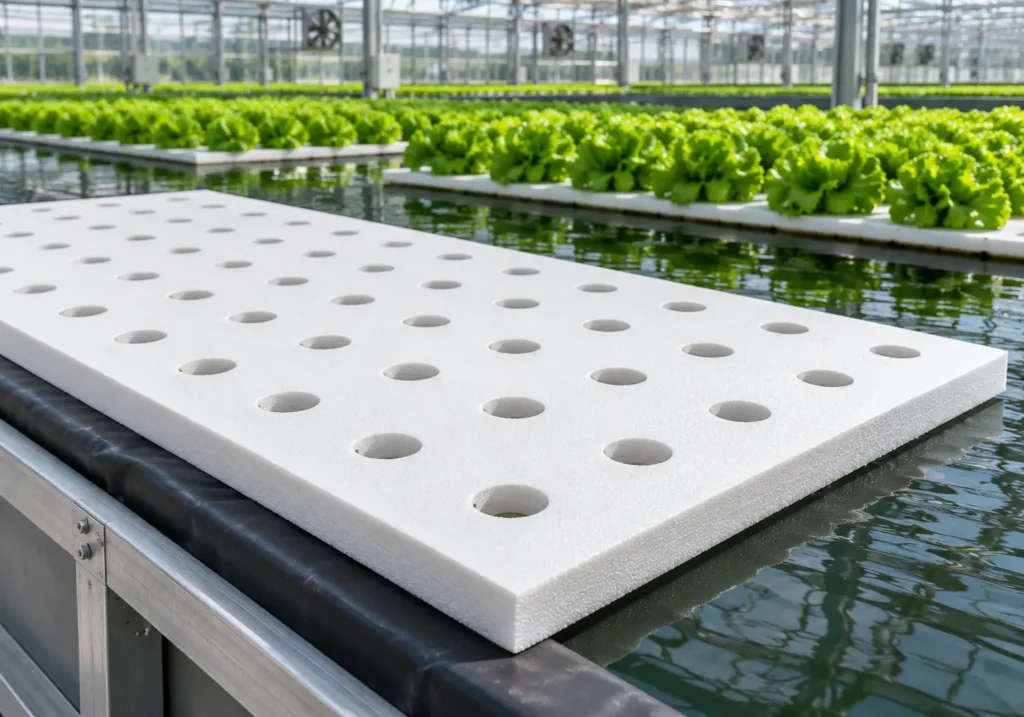
For commercial purchasing, evaluate the following:
| Specification | What buyers should confirm |
|---|---|
| Material | XPS, EPP or another specified foam material |
| Board dimensions | Must match pond width and production layout |
| Thickness | Must provide sufficient rigidity and buoyancy |
| Hole diameter | Must fit the actual plug, collar or net pot |
| Hole spacing | Must match crop density and mature plant size |
| Surface condition | Should be suitable for repeated handling and cleaning |
| Reuse requirements | Confirm expected service conditions and replacement policy |
G&N’s current DWC product collection lists XPS floating raft options including 100 × 60 × 3 cm and 120 × 60 × 3 cm boards, with different planting-hole configurations.
Buyers can review the available DWC floating raft boards and pond liner options.
The correct board should be selected against the pond dimensions and planting plan, not simply by choosing the largest available size.
Insulation, Pond Walls and Liner Selection
The pond structure must withstand the pressure of the nutrient solution while protecting the liner and maintaining suitable root-zone conditions.
The liner and insulation should be specified as part of the same assembly.
| Component | Common options | Main selection considerations |
|---|---|---|
| Wall structure | Concrete block, insulated panel or timber frame | Structural capacity, construction time and maintenance |
| Pond liner | PE membrane, PVC or EPDM | Material compatibility, thickness, installation and service conditions |
| Insulation | XPS or EPS boards | Thermal performance, moisture resistance and compressive strength |
| Surface protection | Smooth protective underlay | Prevents punctures from rough or sharp surfaces |
| Raft coverage | Floating boards across the pond | Light exclusion, access and planting layout |
For DWC projects, PE pond liners are an important procurement option. G&N’s product collection includes PE membrane listings with thickness options described from 0.3 to 2.0 mm.
However, the exact thickness and material specification must be confirmed against pond dimensions, water pressure, installation conditions and the supplier’s documentation.
Buyers should also verify any food-contact requirements and supporting material documentation rather than assuming that every liner grade is suitable for every application.
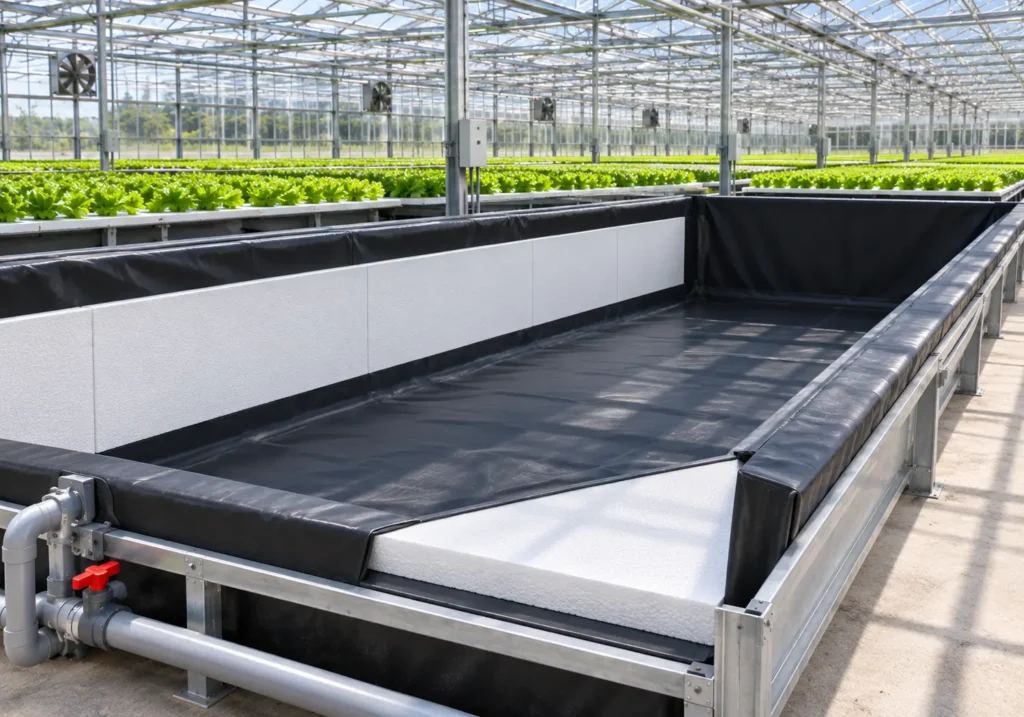
Why Insulation Matters
Insulation reduces heat transfer through the pond floor and surrounding structure. It can also protect the liner from abrasive surfaces underneath.
A preliminary insulation thickness of 30–50 mm can be used for early project discussions, but the final specification should account for:
- Local summer temperatures.
- Greenhouse ventilation and shading.
- Pond construction materials.
- Whether the pond is installed above ground or on a concrete slab.
- Expected nutrient solution temperature.
- Available cooling capacity.
Two installation details deserve particular attention.
First, the liner should be installed over a smooth, clean substrate. Screws, sharp corners and construction debris can puncture the membrane and cause leaks after the pond is filled.
Second, the liner edge should be secured above the maximum operating water level. This reduces the risk of water escaping around the pond perimeter during filling, cleaning and maintenance.
Water Circulation, Aeration and Dissolved Oxygen
Circulation and aeration have different functions in a deep water culture raft system.
Circulation distributes nutrient solution. It helps maintain more uniform nutrient concentrations and temperature throughout the growing pond.
Aeration supplies oxygen. It supports root respiration and helps maintain suitable dissolved oxygen conditions.
A circulation pump should therefore not be treated as a substitute for a properly designed aeration system.
Plan the Flow Path
A long raft bed with only one inlet can develop differences between the inlet and outlet.
For commercial installations, consider:
- Inlet positions and the number of distribution points.
- Return pipe location.
- Pipe diameter and pressure losses.
- Pump operating head and actual performance.
- Water movement at the far end of the pond.
- Access for inspection and maintenance.
A practical calculation example is a 20 m × 1.2 m × 180 mm bed holding approximately 4.32 m³.
The required circulation flow should then be calculated from the selected design turnover target and checked against the actual pump operating curve. There is no single turnover interval that should be applied to every DWC installation.
Monitor Dissolved Oxygen and Temperature
Dissolved oxygen (DO) should be measured at more than one location, particularly near the inlet, in the middle of the bed and at the far end.
For preliminary lettuce production planning, 5–8 mg/L can be used as a reference operating band, subject to crop-specific and site-specific validation.
Published extension guidance varies: UF/IFAS uses 5 mg/L in its small hydroponic lettuce guidance, while Virginia Tech discusses 7–10 ppm as an optimal range in its system comparison guidance, with 4 ppm as a minimum reference.
Water temperature also affects oxygen availability. Warmer nutrient solution holds less dissolved oxygen, which can increase the aeration demand.
An 18–22°C range can be used as an initial temperature planning reference where appropriate for the crop and climate, but it should not be treated as a universal operating requirement. Cooling decisions should be based on measured conditions, local heat loads and the production target.
DWC vs NFT for Commercial Lettuce Production
Both DWC and NFT are established methods for commercial lettuce production. The choice depends on the building, production workflow, available floor area, water management and investment priorities.
| Factor | DWC raft beds | NFT channels |
|---|---|---|
| Water volume | Larger pond volume and greater stored solution | Smaller circulating solution volume |
| Pump interruption | Larger water volume can provide a short buffer, but aeration and circulation remain essential | Thin nutrient film makes reliable flow especially important |
| Temperature stability | Greater thermal mass can slow temperature changes | Thin solution film responds more quickly to surrounding conditions |
| Disease management | Shared pond requires careful water hygiene and zoning | Shared reservoirs also require effective sanitation and isolation |
| Structural requirements | Heavy water load requires suitable floor and support design | Lighter channel structures can suit multi-tier layouts |
| Labour pattern | Board-based planting, movement and harvesting | Channel-based planting and harvesting workflows |
DWC is worth evaluating when batch handling, raft movement and a larger water buffer fit the operating model.
NFT may be more appropriate when space efficiency, channel configuration and multi-tier production are priorities.
For a more detailed comparison of system costs and operating requirements, read our NFT vs DWC hydroponics comparison.
For growers specifically evaluating lettuce production in channels, see our commercial lettuce production guide.
Common DWC Design Problems and How to Prevent Them
Poorly specified raft beds often create operating problems that are expensive to correct after installation.
Insufficient water depth and inadequate insulation
A shallow pond on an exposed concrete slab can experience greater temperature fluctuations. Review working depth, insulation and local heat gain before finalising the cooling equipment.
Incorrect liner installation
Sharp substrate edges, exposed screws and poorly secured liner edges can create leaks. Inspect the pond structure before filling it.
Uneven nutrient circulation
Measurements taken only at the inlet may hide problems at the far end. Record DO, temperature and solution conditions at multiple points.
Incorrect raft hole spacing
Boards manufactured without confirming the actual plug or net pot dimensions may create unstable planting positions or inconsistent crop spacing.
Inadequate cleaning access
A commercial raft pond needs practical drainage, inspection and cleaning arrangements. Plan these before the structure is built, not after the first crop cycle.
Between-cycle cleaning should also be included in the operating procedure. See our hydroponic system cleaning and sanitizing guide.
What to Include in a DWC System RFQ
A useful quotation request should provide enough information for the supplier to understand the actual production requirements.
Before requesting a DWC raft board or pond liner quotation, prepare:
- Project location: Country, local climate and greenhouse environment.
- Crop requirements: Lettuce variety, other leafy greens and target plant count.
- Growing area: Greenhouse dimensions and usable production area.
- Pond layout: Required bed length, width, depth and number of growing zones.
- Raft specifications: Board dimensions, material, hole diameter and planting spacing.
- Liner requirements: Preferred material, thickness and installation conditions.
- Water information: Source water analysis and any existing treatment equipment.
- Operating requirements: Target solution temperature, DO, circulation arrangement and cleaning access.
- Project quantity: Estimated number of boards, liner area and delivery schedule.
Providing a greenhouse drawing or preliminary pond layout can make the quotation process more accurate.
FAQs About Commercial DWC Raft Beds
What information is needed to size a commercial DWC raft bed?
Start with greenhouse dimensions, crop type, target plant count, pond dimensions and the intended raft board layout. Water quality and local climate data are also important for evaluating circulation, aeration and cooling requirements.
Is a 150–200 mm water depth suitable for every DWC project?
No. It is a preliminary reference range for the design discussed here. The final depth depends on root development, water volume, crop requirements, pond structure and operating conditions.
Does a floating raft system need both circulation and aeration?
Yes, they perform different functions. Circulation distributes nutrient solution throughout the pond, while aeration supplies oxygen to the roots. Both should be considered during system design.
How should buyers choose XPS floating raft board dimensions?
Match board dimensions to pond width, handling requirements and planting density. Confirm hole diameter and spacing against the actual seedling plugs or net pots before manufacturing.
Can DWC raft boards and pond liners be purchased separately?
Yes, raft boards and pond liners can be evaluated as individual equipment components. Confirm the selected material, dimensions, specifications, minimum order quantity and project compatibility before placing an order.
Plan a DWC Raft Bed for Your Lettuce Project
A successful deep water culture raft system starts with the right pond dimensions, raft board configuration, liner specification and water management plan.
G&N Hydroponic supplies floating raft boards and pond liner options for commercial hydroponic growing projects.
To discuss your requirements, send your greenhouse dimensions, crop type, target plant count, pond layout, preferred raft board size and project location through our contact and quotation page.
The team can review the relevant equipment options and prepare a quotation based on your project requirements.