The mixing room is where a fertigation programme either holds together or quietly drifts. Most of the trouble traced back to a hydroponic nutrient tank is not a chemistry error; it is hardware — a lid that lets light in, an outlet placed where sediment collects, an agitator that leaves one corner of the tank unmoved. This article covers what the tank set has to do, how material and lid choices behave against concentrated fertiliser, how agitation and suction should be arranged, and what belongs in a specification.
It is written for engineering teams and farm managers building or re-fitting a mixing room on a commercial site, where the tank set sits upstream of every crop decision.
What the Tank Set Has to Do
A nutrient tank set holds concentrated A and B stock separately, keeps both out of the light, keeps them moving, and delivers each to the injector without drawing in settled solids or air. Everything else follows from those jobs.
The A/B split exists because calcium and phosphate or sulphate concentrates cannot share a tank at working strength without precipitating. In practice that means:
- Two tanks minimum, plus a third if acid or a separate micro stock is dosed independently.
- No shared pipework between A and B upstream of the injection point.
- Clear labelling and physical separation so a top-up cannot go into the wrong tank.
Preparation sequence and concentrate handling are covered in the A and B mixing guide; this article stays with the vessel and its fittings.
Material: PE, PP and FRP
Material choice turns on what the concentrate does to the wall over years and how the tank behaves under its own load when full. Polyethylene, polypropylene and glass-reinforced plastic are the three in common use.
| Material | Where it works | What to check |
|---|---|---|
| PE (rotational or extrusion moulded) | General A and B stock, most standard programmes | Wall thickness uniformity, lid stiffness, UV stability if outdoors |
| PP | Warmer mixing rooms, higher temperature tolerance | Weld quality at fittings, brittleness at low temperature |
| FRP / GRP | Large volume, rigid installation, custom shapes | Resin compatibility with the concentrate, gelcoat condition, delamination at cut-outs |
Three points decide most arguments on site: confirm the resin or polymer is rated for the concentrate and its pH range rather than for water alone; prefer opaque walls, since light reaching the solution supports algae; and treat wall stiffness as a specification item, because a tank that flexes when full strains every bulkhead fitting.
Lids, Light Exclusion and Access
An open tank is a contaminated tank. The lid keeps light out, keeps debris out, and slows evaporation that would otherwise change concentration between top-ups.
Specify a lid as part of the tank, not as an accessory ordered later:
- Opaque and seated: a lid that rocks or leaves a gap on one side lets light in at the rim.
- Hinged or split access: a small hatch for checking and dosing beats removing a full lid several times a day.
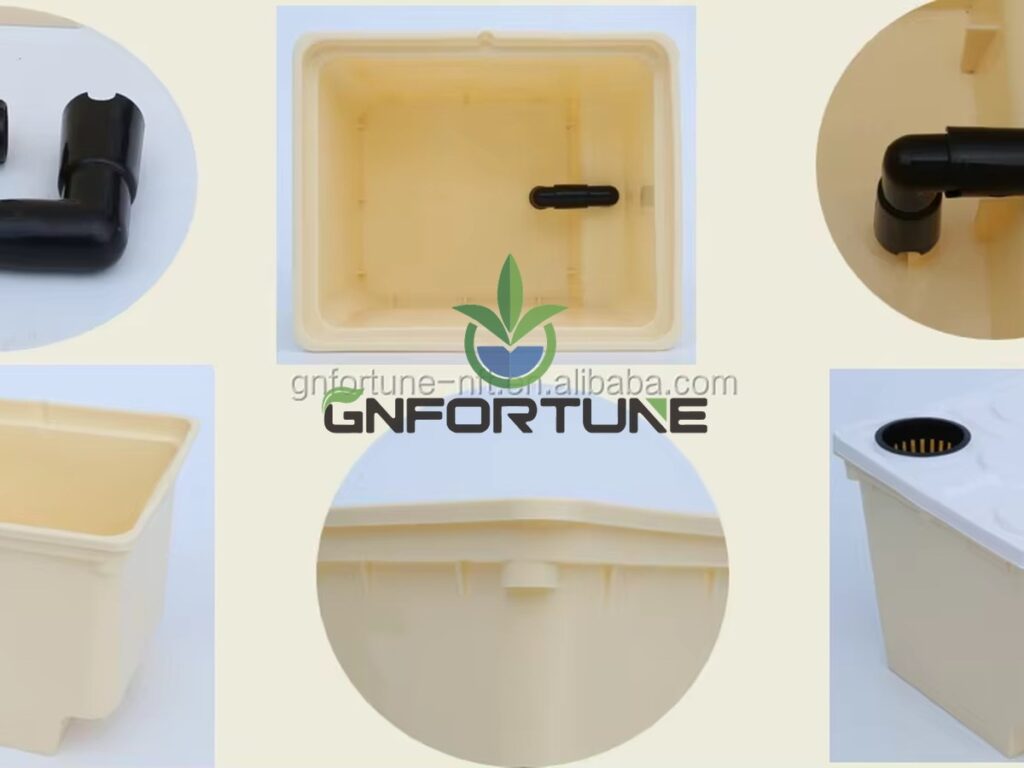
- Sealed penetrations: agitator shafts, suction lines and level sensors all need grommets or bulkhead fittings rather than a hole cut with a knife.
- Condensation management: the underside of a lid in a humid room will drip; a lip or fall back into the tank avoids puddles on the floor.

Where the mixing room sits inside the greenhouse, lid hardware and hinges need the same corrosion consideration as the rest of the house.
Agitation: Pump Loop, Air or Mechanical
Agitation exists to keep the concentrate homogeneous, not to aerate it. The right method moves the whole volume, including the corners and the layer at the base, without drawing air into the suction.
- Recirculation loop: a pump drawing from the tank and returning through a sparge or eductor. Simple, uses the pump you already have, but the return has to be directed to create circulation rather than a short circuit back to the suction.
- Air agitation: a blower and diffuser line. No moving parts in the tank, but it adds air to a solution where dissolved gas is not wanted, and the blower becomes another maintenance item.
- Mechanical mixer: a shaft-mounted impeller through the lid. Positive and controllable, at the cost of a shaft seal and a drive to service.
Farms usually plan agitation against a turnover band rather than a fixed number — enough to keep the tank uniform through a dosing cycle without pulling air into the outlet. The figure depends on tank volume, the concentrate, ambient temperature and how long solution sits between batches, so confirm it on site.
The failure looks the same whichever method is used: a settled layer at the base and a weaker dose than the recipe assumed. Direct the return or diffuser to sweep the tank floor, and verify by sampling top and bottom after a cycle.
Outlet, Suction and Settled Solids
The outlet should draw from above the sediment zone, not from the very bottom of the tank. A suction point sitting directly on the floor pulls settled fines into the injector and the filtration downstream.
The arrangement that works in practice:
- Take suction a short distance off the base, through a fitting that is accessible from outside the tank.
- Fit a valve at the tank so the line can be isolated without draining the vessel.
- Provide a separate drain or flush point at the genuine lowest point for clean-out and for flushing settled material.
- Keep a strainer or filter on the suction side that can be removed and cleaned without tools.
- Avoid long horizontal runs and high points where air collects, since an air lock at the injector shows up as erratic dosing rather than as an obvious failure.
Strainers belong in the maintenance plan: they are the first thing to block, and a blocked one presents as a dosing fault rather than a plumbing fault.
Level, Fill and Bunding
Level indication on a stock tank is there to prevent two things: running the injector dry mid-cycle, and overflowing during a top-up. Both are avoidable with modest hardware.
- Visible level: a gauge tube or a graduated sight strip on an opaque tank, readable without opening the lid.
- Low-level cut-out or alarm: wired to stop the injector or raise an alarm before the tank empties.
- Fill line with an air break: the top-up water connection should not be a permanent submerged connection back to the supply.
- Bunding or a drip tray: a secondary containment sized to hold a tank failure, with a floor that drains to a point where a spill is noticed.
Backflow protection on the fill line is a separate specification with its own code requirements; keep it separate in the drawing set.
Specifying a Hydroponic Nutrient Tank in the RFQ
Position tanks so a full drum or bag reaches the lid, the level can be read without climbing, and the outlet valve is reachable with the room busy. Rooms that fail those tests get worked around, and workarounds are how concentrate ends up in the wrong tank.
Volume is driven by refill interval and dosing rate rather than by farm area alone; that calculation is set out in the reservoir and storage tank sizing guide. Automation level changes the requirement as well, since a dosing controller with its own suction management will specify what it needs at the tank connection — see the auto dosing systems guide.
Ask for the tank set as a specified item with:
- Material and wall thickness, confirmed compatible with the concentrate and its pH range.
- Number of tanks, working volume and whether a third stock is needed.
- Lid type, hatch size and every penetration with its fitting.
- Agitation method and where the return or diffuser discharges.
- Outlet height above the base, valve arrangement, strainer and separate drain point.
G AND N FORTUNE LIMITED supplies tank sets with matched lids, penetration fittings and outlet assemblies alongside its dosing packages, quoted against the tank count and concentrate programme you specify.
FAQs About the Hydroponic Nutrient Tank Set
Why are A and B kept in separate tanks?
Because calcium concentrates and phosphate or sulphate concentrates precipitate when combined at stock strength. Keeping them apart until dilution is what keeps the programme in solution.
Which tank material suits concentrated fertiliser best?
PE and PP cover most programmes and FRP suits large custom vessels, but the deciding factor is confirmed compatibility with the actual concentrate and pH range.
Should stock tanks be agitated continuously?
They need enough movement to stay homogeneous through a dosing cycle, which most farms plan as a turnover band rather than a fixed figure. Aggressive aeration adds air the solution does not want.
Where should the suction outlet sit?
Slightly above the base, with a separate drain at the true lowest point. Drawing from the floor pulls settled fines into the injector and the downstream filtration.
Do stock tanks need secondary containment?
Bunding or a drip tray sized to a tank failure is standard practice on commercial sites, and local environmental rules may set the requirement.
Related Reading
- Mixing Hydroponic Nutrient Solution: A and B Tanks — Concentrate preparation sequence and how stock tanks are actually worked day to day
- Hydroponic Reservoir Sizing and Water Storage Tank Design — How working volume follows refill interval and dosing rate
- Auto Dosing Systems for Hydroponics: When and What to Buy — What a dosing controller requires at the tank connection
- Fertilizer Injectors for Hydroponic Farms: A Guide — Injector types and how suction conditions at the tank affect dosing
- Food-Safe Materials in Hydroponics: uPVC and RoHS Certification — Material compliance questions that apply to vessels and fittings alike
Next Step: What to Send for a Quotation
A hydroponic nutrient tank set is quoted from the concentrate programme and the room, not from a litre figure alone.
Building or re-fitting a mixing room? For RFQ or project consultation, send: greenhouse dimensions and available mixing room area; crop and target weekly or annual output; concentrate programme including A, B and any separate acid or micro stock; working volume and desired refill interval; preferred tank material and lid type; agitation method; automation level requested; local water analysis and climate range; delivery schedule; and the budget band. G AND N FORTUNE LIMITED supplies tank sets, dosing and irrigation packages quoted to those parameters.