

Every surface that touches nutrient solution is a food-contact surface, because anything that leaches out of the plastic can end up in the crop. Food-safe materials in hydroponics are therefore a purchasing requirement: retailers audit grower inputs, and importers must prove that the parts they ship meet the rules of the destination market. The conversation comes down to a few terms — UPVC, PVC, RoHS, REACH — and suppliers use all of them loosely. This guide explains what each acronym means and how to verify a claim before you pay.
Food-Safe Materials in Hydroponics: Why Material Grade Matters
Nutrient solution is not tap water. It recirculates for weeks at pH 5.5–6.5, warm at 18–25°C and full of dissolved salts — exactly the conditions that pull additives out of a polymer. That is why two parts that look identical can behave very differently in a migration test.
Material grade matters on a commercial farm for four reasons:
- Crop safety and brand risk. A leafy green with a short harvest window can accumulate a migrating substance fast enough to fail a retailer’s residue screen.
- Food-safety audits. Retail schemes increasingly ask where equipment and consumables come from; documentation closes that question.
- Import compliance. Several markets control hazardous substances in imported plastic articles, and a failing container costs far more than good resin would have.
- Life and consistency. A food-contact-grade compound with UV stabilizers also survives a decade in a greenhouse. Cutting the compound usually cuts both safety and service life.
| Component | Contact profile | Risk if compound is not food-contact grade |
|---|---|---|
| NFT gutter and channel covers | Continuous warm, UV-exposed solution contact over hundreds of meters | Additive migration into the nutrient film; early brittleness |
| Pipework, fittings, and manifolds | Pressurized recirculating solution | Leaching from flexible hose compounds; pinholes in thin-wall pipe |
| Flood trays and benches | Periodic deep contact with solution and media | Migration into standing water during flood cycles |
| Net pots, baskets, and media cups | Direct root-zone contact for the whole crop cycle | Contaminants taken up by roots; cracking when UV stabilizers are missing |
UPVC versus PVC: What the Acronyms Really Mean
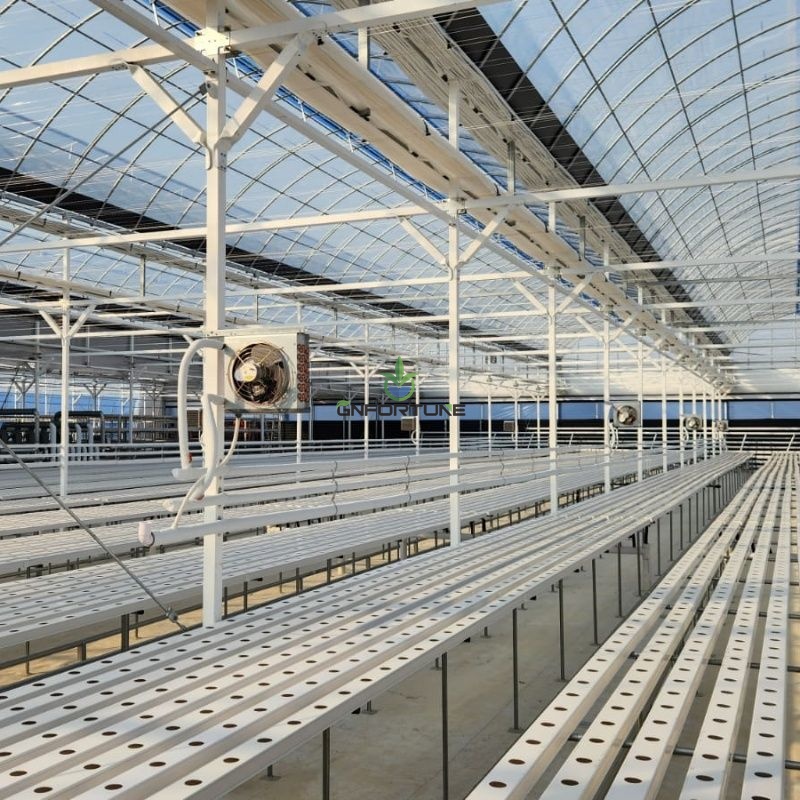
White UPVC square hydroponic pipes with planting holes in a greenhousePVC is polyvinyl chloride, one polymer with two commercial personalities. Plasticized PVC is the flexible version used for hoses and seals; it stays flexible because the compound carries roughly 20–40% plasticizer by weight, and phthalate plasticizers are exactly what regulators worry about in food contact because they migrate readily into water. UPVC, or unplasticized PVC, is the rigid version used for extruded profiles and pipes — and the “U” removes the biggest migration question from the material.
Rigid PVC still needs heat stabilizers, and this is where the second legacy issue sits. Older pipe compounds used lead-based stabilizers; modern food-contact compounds use calcium-zinc systems. So “food-grade PVC” has no single definition — ask which stabilizer family the compound uses and whether the finished article passed a migration test. If you buy under your own brand, this is the specification you lock down at the OEM stage, where the compound is written into the manufacturing agreement rather than left to chance.
| Material | Rigid or flexible | Key additive question | Typical hydroponic parts | What to request |
|---|---|---|---|---|
| UPVC (uPVC) | Rigid | Stabilizer family (lead-free calcium-zinc preferred) | NFT gutters, drain pipes, rigid profiles | Migration test report + no-lead statement |
| Flexible PVC | Flexible | Plasticizer type and migration level | Soft hoses, gaskets, seals | Plasticizer declaration; avoid phthalates where possible |
| Polypropylene (PP) | Rigid | Additive package and UV stabilizer | Net pots, flood trays, fittings | Food-grade PP certificate for the resin batch |
| ABS | Rigid | Impact modifiers; surface quality | Flood trays, benches, valve bodies | Food-contact test where the article is load-bearing wet |
One common confusion: BPA is not a PVC issue. Bisphenol A belongs to polycarbonate resins — if a supplier raises it while selling PVC pipe, ask for the stabilizer and plasticizer story instead.
Certifications That Matter: RoHS, REACH, and Food-Contact Test Reports
Importers routinely ask Chinese suppliers for “RoHS certification,” and suppliers routinely produce one. RoHS (EU Directive 2011/65/EU) restricts hazardous substances in electrical and electronic equipment: lead, mercury, hexavalent chromium, PBB, and PBDE are capped at 1,000 mg/kg, cadmium at 100 mg/kg. It is genuinely useful for pumps, controllers, and cables — but a channel or net pot is not electrical equipment, and RoHS is not a food-safety declaration.
The documents that actually speak to food contact are different:
- REACH compliance. EU suppliers of articles must declare substances of very high concern above 0.1% by weight. A REACH statement is supply-chain disclosure, again not a migration test.
- Food-contact migration test reports. For plastics touching food crops, relevant frameworks include the EU plastics regulation ((EU) No 10/2011) and US FDA 21 CFR; accredited labs such as SGS, Intertek, and TUV issue the reports.
- Raw-material certificates. The resin supplier’s food-grade certificate for the polymer grade, plus the converter’s statement that no non-food additives were introduced at extrusion or molding.
A useful habit: ask which standard the report is issued to, which product it covers, and which lab issued it. A one-page “RoHS certificate” with no lab, no product, and no date is worth the paper it is printed on.
How to Verify a Supplier’s Claims
Verification is a document chain with four links. Ask for all four before you place a production order:
- Material declaration. A signed statement of polymer family, rigidity type, and additive system for each SKU.
- Third-party test report. Issued within the last two years and naming your exact product and the standard it was tested against. A raw-material certificate is a supplement, not a substitute.
- Batch traceability. The certificate must reference a batch number that also appears on the packing list and cartons. Without that link, a report proves what the lab tested, not what is in your container.
- Sample or inspection. For a first order, reserve the right to inspect or to receive a pre-shipment sample from the actual production batch.
A certificate is only as good as the batch it covers: A supplier who cannot trace a test report to the exact resin batch in your container is selling you a document, not a guarantee. We attach batch numbers to material certificates on every export order from our factory — treat hesitation on this point as a red flag rather than a delay. If you are building a China supplier list from scratch, the guide to importing hydroponic equipment from China covers the screening steps that come before certificates are discussed.
Who you buy from also matters. A manufacturer that extrudes and moulds in-house can answer material questions from its own records; a trading company must relay whatever its factory tells it. Our production history since 1996 is outlined on the company profile page — any supplier you take seriously should show you something equivalent.
Questions to Put in Your Next RFQ
Put these questions in writing so the answers come back in writing — verbal assurances disappear when a container leaves the port.
- Is the part extruded or moulded from UPVC, PP, or ABS, and is the compound lead-free?
- Which stabilizer family does the compound use? Calcium-zinc is the modern food-contact answer for rigid PVC.
- Is the resin UV-stabilized, and to what intended service life?
- Can you supply a third-party migration test report for the exact product, issued in the last two years?
- Does the certificate reference a batch number that will appear on our packing list and cartons?
- Is the “food grade” claim based on the resin certificate, the finished-article test, or both?
- Can we hold a pre-production sample from the actual run?
- What documentation ships with the goods — certificates, batch numbers, inspection records?
FAQ
Is UPVC the same as food-grade PVC?
A: Not automatically. UPVC removes the plasticizer question, but the heat stabilizer still matters; food-grade status comes from the additive package and a migration test.
Does a RoHS certificate mean a product is food-safe?
A: No. RoHS caps hazardous substances in electrical and electronic equipment. For plastic parts touching nutrient solution, ask for a food-contact migration test report in addition.
How do I check whether a supplier’s certificate is genuine?
A: Confirm the laboratory name and report number, that the report covers your product, is less than two years old, and references a batch matching your cartons. Verify the number with the lab on large orders.
Are PP net pots and ABS trays covered by the same rules?
A: The principle is the same for every polymer: food-contact status comes from the additive package and migration testing, not the material name. Ask for the finished-article report per product family.
Do you supply material certificates with export orders?
A: Yes. Every G&N export order ships with material declarations and test reports referenced to batch numbers. List required certificates in your RFQ and we confirm them before ordering.
Request Material Documentation with Your Next Quotation
Because food-safe materials in hydroponics are only as good as the paperwork behind them, make the documents part of the quotation instead of an afterthought. Send your channel, tray, net pot, and fitting quantities through the quote form, note which certificates you require, and we will confirm material grade, test report coverage, and batch traceability in writing — request material specs and test reports with your next quotation.