

A Blocked Emitter Is a Silent Yield Loss
Tomatoes in Dutch buckets do not wilt politely when an emitter blocks. They keep standing for most of a day, then the slab dries unevenly, EC climbs at the root surface, and by the time the plant shows stress you have lost a measurable part of that day’s growth — plus the fruit sizing that was being set during it. Multiply that by a few hundred positions and the cost dwarfs the price of a filter cartridge.
Drip emitter clogging is rarely bad luck. It is the result of three decisions made long before planting: how you filter, which emitter you buy, and whether the pipework can be flushed at all. This guide covers each one, the chemistry that keeps lines clean, and the checks that turn a hidden problem into a logged one.
What Actually Blocks an Emitter
| Cause | Where it comes from | How it shows up | Practical control |
|---|---|---|---|
| Sand and silt | Bore water, surface water, disturbed mains, an empty tank being refilled | Random single emitters blocked, worst after any supply interruption | Media or disc filter sized to the flow, plus a settling tank where supply is dirty |
| Organic debris | Algae in the tank, biofilm sloughing off pipe walls, root fragments | Blocking concentrated at the far end of runs and in low-flow sections | Tank shading, sanitiser programme, routine line disinfection |
| Precipitated salts | Calcium carbonate and phosphates dropping out at high pH | Emitters and the inside of laterals feel gritty; blockage climbs after acid is stopped | Keep pH in band, acid injection sized correctly, periodic acid flush |
| Iron and manganese | Groundwater with dissolved metals oxidising on contact with air | Rust-brown slime; filters stained orange | Pre-treatment — aeration, settling, filtration — before the dosing room |
| Biofilm | Bacterial growth in warm recirculating solution | Slimy internal surfaces; gradual flow decline across whole blocks | Sanitiser programme and temperature control, not just filtration |
| Mechanical debris | Cutting swarf, thread tape, jointing compound left during installation | Blockage concentrated right after commissioning, usually near new joints | Commissioning discipline — lines flushed before emitters are fitted |
Nearly every chronic case we are called to has two of these running together, typically silt plus biofilm. Fixing only the filter fixes half the problem.
Filtration: Screen, Disc or Media
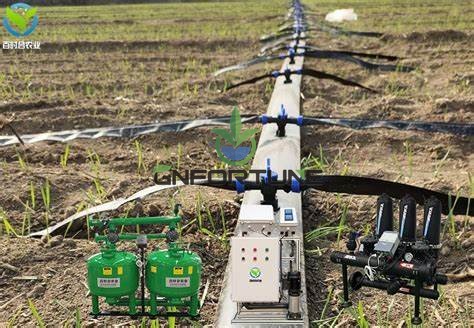
| Filter type | Typical rating | Best for | Limitations |
|---|---|---|---|
| Screen filter (mesh) | Commonly 100–150 mesh for drip lines | Clean mains or rainwater; cheap to inspect | Clogs fast on silt load; the mesh tears if cleaned with anything stiff |
| Disc filter | Comparable ratings, deeper capture | Bore and surface water with variable silt | Cartridges must be opened and rinsed; easy to reassemble wrongly |
| Sand / media separator | Removes the coarse fraction by settling | High silt loads before fine filtration | Needs backwash volume and somewhere to put the dirty water |
| Cartridge filter | Fine polishing, 5–25 micron | After main filtration where emitters are very fine | Short service intervals; treat as consumable with scheduled spares |
Select the filter from the emitter’s published requirement, not from what was on the shelf. If the emitter needs 120 mesh, the filter must be 120 mesh or finer — and the flow must still be sufficient at the end of a run with the filter part-loaded. Undersizing the filter is the most common specification error we see in RFQs.
Sizing and Placement Rules
- Size on flow, not pipe diameter. A filter that is right for the pipe size but too small for the actual flow clogs within days
- Put filtration upstream of injection so any dosed chemical cannot precipitate into the filter element
- Fit pressure gauges before and after the filter. The differential across the element is your cleaning trigger — without them, flushing happens on somebody’s memory
- Install a second filter on a bypass where production cannot stop for cleaning; farms lose more crop to unplanned downtime than to filter cost
- Access matters. A filter body you cannot open without dismantling pipework will not be cleaned as often as it should be
Emitter Selection
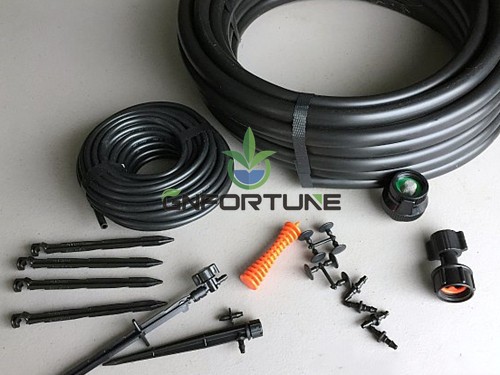
| Emitter type | Behaviour | When to choose it | Risk |
|---|---|---|---|
| Turbulent flow | Fixed flow rate for a given pressure, wider internal path | Low-cost, short runs, clean water | Flow varies with pressure; poor uniformity on slopes and long rows |
| Pressure compensating (PC) | Holds near-constant flow across a stated pressure range | Long rows, sloped ground, multi-tier layouts | More expensive; sensitive to debris in the compensating mechanism |
| Anti-drain / CNL | Closes below a set pressure, opens above it | Staggered dosing and multi-zone systems | Opening pressure must suit your pump curve |
| Adjustable / multi-outlet | Several take-offs from one point | Dense planting where one emitter feeds several plants | Unequal distribution if the manifold is not level |
The emitter’s minimum filtration requirement and flow rate at your working pressure belong in the specification you send suppliers. Ask for both numbers in writing and compare them across bids — two quotes with the same headline price can carry very different emitters.
Line Design That Can Actually Be Flushed
- Fit flush valves at the end of every manifold and every row, discharging somewhere you can see the water — if you cannot watch a flush, you cannot judge it
- Size laterals for flushing velocity. A line designed only to deliver trickle flow is too slow to scour itself
- Keep outlets below you. End-of-line flush points should be lower than the row so debris leaves instead of settling back
- Avoid dead legs. Any capped branch is a future biofilm reservoir
- Commission before crop. Flush the mains and laterals with emitters not yet fitted, then install outlets — this removes the swarf and jointing debris that blocks new systems in week one
- Schedule flushes. Weekly for low-risk supply, more often with surface water; put it on the checklist with the person responsible named
Chemical Maintenance
Filtration removes particles; chemistry handles what dissolves or grows.
- Acid treatment lowers pH enough to redissolve carbonate scale and is the standard control for hard water. Dose to a measured value, hold it, then flush
- Oxidising treatments — hydrogen peroxide or peracetic acid — knock back biofilm and organic slime. Check compatibility with your sanitiser programme and with emitter elastomers before dosing
- Never mix treatments blindly. Combining acids and oxidisers in the wrong order produces unsafe conditions and, in some combinations, accelerated corrosion
- Treat, then flush, then verify. A chemical programme with no verification step is an expense, not a control
Spotting Blockage Before Yield Moves
- Flow meters per zone. Compare actual flow to the design value weekly; a small drop is your earliest signal
- Pressure readings at both ends of a zone expose gradient problems long before plants react
- Emission uniformity checks. Catch-cup sampling across a few positions twice a season gives a number you can trend
- Run-off or slab-weight checks against the irrigation schedule — plants receiving less than scheduled show it here first
- Log everything. The value is in the trend line, not the single reading
What Poor Uniformity Costs
Non-uniform delivery means part of the crop is always over-irrigated and part is under-irrigated. The plant receiving too little sets smaller fruit and loses yield; the plant receiving too much runs higher discharge volumes and wastes fertiliser. The crops most sensitive to this are exactly the ones with the highest value per square metre — vine tomatoes, peppers, cucumber, berry gutters. If your discharge volumes look high but plant performance is uneven, distribution uniformity is one of the first things to measure.
FAQ
How often should drip line filters be cleaned?
Clean on differential pressure, not on a calendar — when the pressure drop across the filter rises above its clean value by the manufacturer’s stated margin. In practice that may be daily with dirty surface water and monthly with clean mains.
What mesh size do I need for Dutch bucket drippers?
Use the figure in the emitter datasheet rather than a rule of thumb. Many common drip emitters specify in the order of 120 mesh; a finer filter costs little more and buys margin, provided flow capacity is still adequate.
Can I stop clogging by flushing more often?
Flushing removes what has already arrived, but it does not remove the source. If sediment keeps appearing, the answer is finer or additional filtration upstream, or settling capacity before the filter.
Is pressure-compensating worth the extra cost?
On long rows, slopes, or any layout where individual plants sit at different elevations, yes. Where the layout is level and short, standard turbulent emitters with good filtration are fine — but confirm the uniformity your rows actually achieve before deciding.
Why do new systems block in the first weeks?
Usually installation debris: swarf from cutting pipe, thread tape, jointing compound and grit pulled in during connection. Commissioning discipline — flushing mains and laterals before outlets are fitted — prevents almost all of it.
Do I need filtration if I use rainwater?
Yes. Roof-collected water carries dust, leaf debris and bird contamination, and the biofilm problem exists regardless of source. Rainwater is cleaner, not clean.
Spec It Once, Then Maintain It
Filtration, emitters and flush points are cheap at design stage and expensive to retrofit once rows are planted. Send us your water analysis, layout drawing and emitter preference and we will return a filtration schedule with differential targets and a commissioning checklist you can hand to the installer. Start from the quote form.
Related reading: filtration sits upstream of dosing — see designing a drip system for Dutch bucket rows, water treatment options and reading your water analysis; for chemical control see cleaning and sanitizing between cycles and controlling algae, and check pump duty against pump sizing for commercial systems.