

Most Export Delays Are Paperwork, Not Freight
A container of hydroponic equipment can sit in port for a week because a certificate was issued in the wrong name, a packing declaration was signed by someone without authority, or live plant material arrived without the import permit that the destination requires. The freight was arranged months earlier; the paperwork was left to the last week.
This guide covers what exporting hydroponic equipment involves in practice — the documents that apply, the ones that only apply when live plants or seeds are involved, and where the delays usually originate.
The Core Document Set
| Document | Issued by | What it does | Typical mistake |
|---|---|---|---|
| Commercial invoice | Seller | Declares value, terms and parties | Incorrect Incoterms, causing a customs dispute about who pays duty |
| Packing list | Seller | Itemises contents, weights and dimensions | Not matching the invoice; triggers inspection |
| Bill of lading / airway bill | Carrier | Contract of carriage and title document | Consignee name differing from the import permit |
| Certificate of origin | Chamber of commerce or authority | Establishes origin for duty and trade agreements | Missing a preferential origin claim where one is available |
| HS classification | Seller, verified | Determines duty and controls | Mis-classifying equipment, which changes duty and possible licensing |
| Insurance certificate | Insurer | Covers transit risk | Cover not matching the Incoterm agreed |
| Fumigation or heat treatment certificate | Approved provider | Meets wood packaging requirements | Non-compliant pallets holding the whole container |
| Packing declaration | Seller | Declares packaging materials | Signed without authority or not matching actual packing used |
Every one of those items is routine. The failures are almost always consistency failures — one document disagreeing with another — rather than missing documents.
When Live Plants, Seeds or Cuttings Are Involved
Shipping plant material crosses into a different regulatory world. Most countries restrict the import of live plants, seeds and tissue-culture material to protect agriculture, and the requirements are set by the destination, not the origin.
- Import permit (destination country). Usually required in advance and often specific to species and quantity. Without it, the consignment has no legal route in
- Phytosanitary certificate (origin country). Issued by the national plant protection authority after inspection, confirming the material meets the destination’s requirements
- Laboratory testing. Some destinations require specific tests for viruses, bacteria or pests before a phytosanitary certificate will be issued
- Post-entry quarantine. Certain material may have to enter a quarantine facility on arrival, which has to be arranged and paid for before shipping
- Grower registration. Many countries require the exporting nursery to be registered and inspected
- Labelling and traceability. Variety name, batch, and often the production site must be identifiable on the packaging
The practical rule is simple: for live material, arrange the destination’s import permit first, then design packing, timing and variety selection around it. Consignments shipped before the permit exists are the single most reliable way to lose a shipment.
Packing and Transit for Equipment
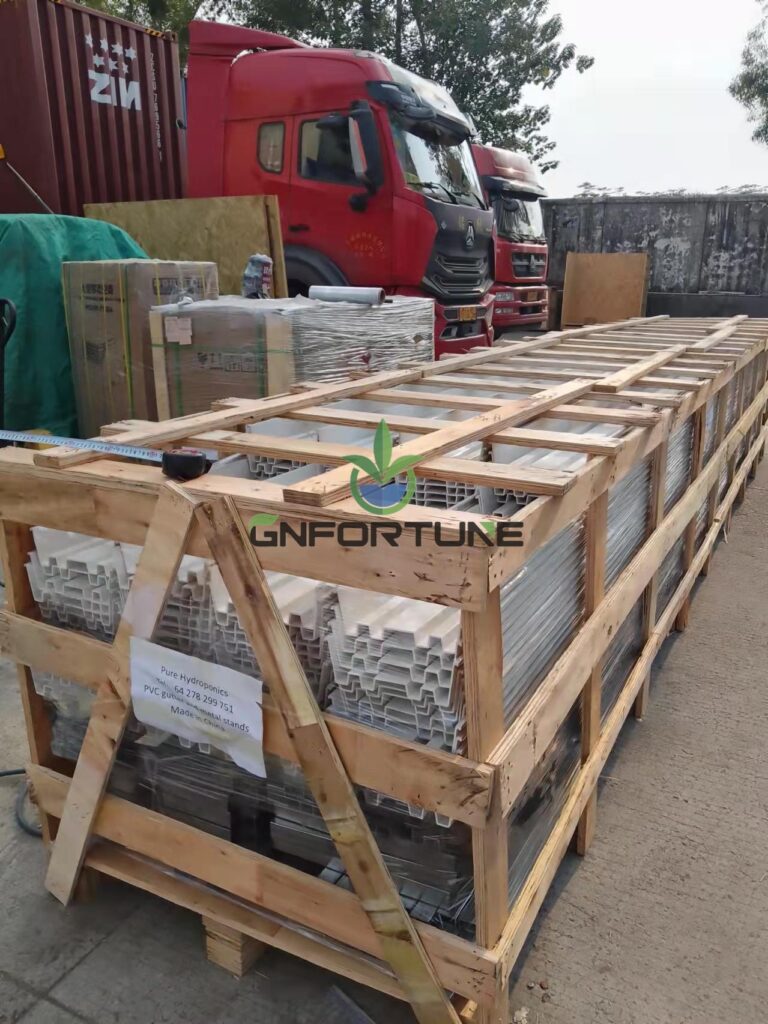
- Match the packing to the handling it will receive. A container loaded and unloaded by forklift needs different protection from an LCL consignment that will be handled repeatedly
- Keep moisture out. Growing equipment often travels through humid and cold conditions; condensation inside a container is a real risk for electronics and steel
- Pack electronics separately and declare them. Control gear, sensors and drives need moisture protection and often separate customs treatment
- Use compliant wood packaging. Treated and marked, or use non-wood alternatives
- Number the packages to match the packing list. Installation on site is faster and disputes are fewer
- Include the drawings and manuals. Physically in the crate, and digitally in advance — a system cannot be commissioned from a drawing that arrives after the technicians
Common Causes of Delay
| Cause | How to prevent it |
|---|---|
| Documents inconsistent with each other | One master list; check name, quantity, value and weights line by line before submission |
| Wrong HS classification | Confirm with the destination customs broker before shipping, not after |
| Consignee does not match the import permit | Align the legal entity across all documents |
| Incoterms disagreement | State the term and the named place explicitly on the invoice |
| Missing import permit for plant material | Never ship live material before the permit is in hand |
| Non-compliant wood packaging | Specify treated and marked pallets with your freight forwarder |
| Inspection at destination | Accurate documentation and clean packing reduce selection rate; budget time for it anyway |
| Payment documentation mismatch | Letter of credit terms require exact wording — review against the draft before shipment |
A Practical Export Checklist
- Two weeks out: confirm HS codes, Incoterms and consignee legal name with the broker; confirm any import permits are in hand
- One week out: prepare invoice and packing list; arrange treatment certificates and any phytosanitary inspection
- At loading: photograph the packing, record container and seal numbers, verify package count against the list
- On departure: send the document set to the consignee and broker before the vessel or flight leaves, not after
- On arrival: have a named contact on the ground who can respond to a customs query within hours
FAQ
What HS code applies to hydroponic equipment?
It depends on the item — pumps, pipes, steel structures, controllers and LEDs fall into different headings. Have the destination broker confirm classification, because it affects duty and sometimes licensing or electrical approval.
Do I need a phytosanitary certificate for equipment?
Not for the equipment itself, but plant material, seeds and untreated plant residues do require one. Wood packaging requires its own treatment and marking under international standards.
Can I ship cuttings or young plants internationally?
Only with the destination’s import permit and an origin phytosanitary certificate, and frequently with testing and post-entry quarantine. This is a specialist trade with long lead times — plan it months in advance.
Who arranges the import permit?
Normally the importer, since the permit is issued in the destination country in their name. The exporter should not ship until a copy is in hand.
What Incoterm should we use?
Whatever both parties understand and can execute. Be explicit about the named place — “CIF Port of X” and “CIF destination warehouse” are materially different obligations.
How do I avoid disputes about damage in transit?
Photograph packing before loading, insure for the full replacement value, note any visible damage at receipt in writing, and keep the packing list aligned with package markings so condition can be tied to specific items.
Get the Documentation Right the First Time
Send us your destination, project scope and delivery schedule and we will prepare the export documentation pack, advise on HS classification and plant health requirements, and coordinate with your broker. Start through the quote form.
Related reading: documentation is one part of a landed cost — see the importing buyer’s checklist and container loading and MOQ maths, and plan the receiving end with commissioning and site acceptance.