

A commercial hydroponic farm does not measure each of the thirteen mineral nutrients individually. It mixes two concentrates — A and B — at a measured ratio into a stock tank, then dilutes that into the working reservoir at a target electrical conductivity (EC) and pH. The two-tank system exists for one reason: some nutrients, when concentrated together, react with each other and fall out of solution as solids the plant cannot absorb. Splitting them removes the chemistry, and a few simple rules about ordering keep the working tank stable. This guide walks a buyer or new operator through the same A/B mixing protocol that our turnkey greenhouse projects use on day one.
Why Hydroponic Nutrients Are Sold as Two Tanks
Most A/B concentrates are designed around a single conflict: calcium phosphate and calcium sulfate are highly insoluble, and calcium ions in the same concentrate as sulfate or phosphate will form a fine white precipitate at room temperature within hours — sometimes within minutes in a warm stock tank. The plant loses the calcium, the operator sees a cloudy tank, and the injectors eventually clog.
The industry convention is therefore simple: everything that contains calcium or that reacts with calcium goes into Tank A, everything containing sulfate, phosphate, or chelating agents that bind iron goes into Tank B. Both tanks reach the same target concentration when diluted 1:100 or 1:200 in the working reservoir, where the dilution water overwhelms the small ion-by-ion availability and the conflict chemically dissolves. If you have ever wondered why you cannot buy a single-tank nutrient at 1:200 EC 2.0 mS/cm, that white precipitate is the answer.
The rule we hand to every new farm: if your A tank is clear and your B tank is clear and your working solution looks milky, the order of dosing or the dilution ratio is wrong — not the fertilizer.
What Goes in Tank A and What Goes in Tank B
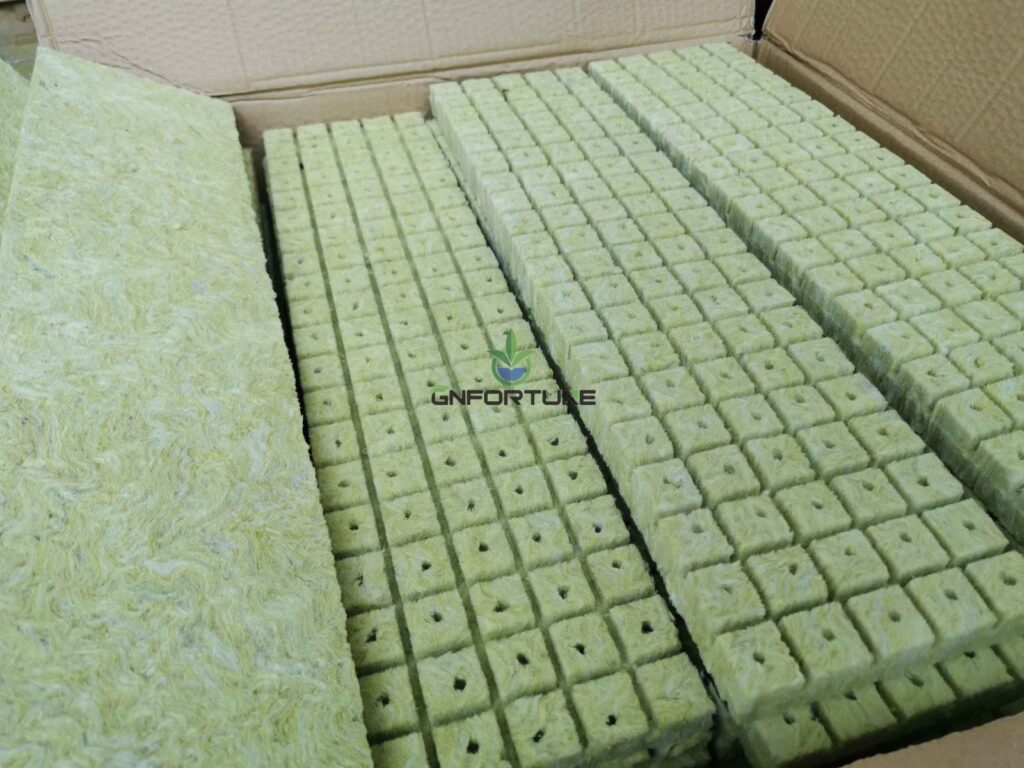
Rockwool seedling cubes lined up under drip irrigation for nutrient solution deliveryMost commercial A/B pairs follow one of two templates (vegetable or fruiting) with slight variations between manufacturers. The mineral split is consistent across the industry:
| Tank | Common salts / chelates | Holds these ions at concentrate |
|---|---|---|
| A | Calcium nitrate, potassium nitrate, iron chelate (Fe-EDTA or Fe-EDDHA in many newer recipes), kelp or fulvic additive | Ca²⁺, K⁺, NO₃⁻, Fe (chelated) |
| B | Monopotassium phosphate (KH₂PO₄), magnesium sulfate (MgSO₄·7H₂O), potassium sulfate, manganese sulfate, zinc sulfate, copper sulfate, boric acid, sodium molybdate | Mg²⁺, SO₄²⁻, PO₄³⁻, Mn, Zn, Cu, B, Mo |
Two ordering rules always apply, in this order: add Tank A first to the working reservoir, stir, then add Tank B. Never pour them together as concentrates. Never pre-mix the two concentrates. And when you top up a working tank that already contains both, dose each into a different point or alternate them with a full circulation cycle between doses. The chelated iron in A is the most fragile ion in the mix; UV light, high pH above 7.0, and high temperature all weaken chelates over hours.
The Mixing Math: Dilution Ratio to Target EC
Every A and B concentrate ships with a printed label like “1:100 for EC 1.8 mS/cm” or “1:200 for EC 2.4 mS/cm”. Those two numbers are the dilution ratio and the target EC, and they must be read together: a 1:100 concentrate needs a smaller working reservoir to hit a given EC than a 1:200 concentrate at the same label strength. If a farm switches concentrate brands, the operator must reset the dilution rate — that is the single most common cause of “the new fertilizer is too strong” complaints after a product change.
The quick calculation an operator can do on the back of a work order:
- Target EC for the crop (lettuce 1.2–1.6 mS/cm; tomato 2.0–2.6; strawberry 1.4–1.8; basil 1.0–1.4).
- Stock dilution = working volume × label dilution ratio (e.g. 1,000 L × 1:200 = 5 L of each concentrate).
- Stirring time: 90–180 seconds of vigorous circulation. A standing stock tank without agitation will read low EC at the top and high EC at the bottom for hours.
- Sequencing: A first, stir 60 seconds, then B, stir another 60 seconds. Measure pH after both are in. Adjust pH with phosphoric acid or potassium hydroxide only — never with hydrochloric acid on a stainless fitting, never with citric acid on a long-term basis (it biodegrades in 48–72 hours).
Run through a worked example with the commercial hydroponic build guide approach: a 4,000 L working reservoir on a one-hectare NFT lettuce line, target EC 1.4 mS/cm, concentrate labeled 1:200. The operator adds 20 L of A, runs the circulation pump for 90 seconds, adds 20 L of B, runs another 90 seconds, then waits five minutes before probing. If the probe reads 1.35–1.45 mS/cm, the mix is correct; if it reads 1.2, the concentrate is older than its expiry and should be replaced, not re-dosed.
Storage: What Concentrates Need After the Tank Is Filled
Concentrate tanks fail in three predictable ways: UV degradation of chelated iron, biological growth in nitrate-rich A tanks, and salt crystallization in B tanks that evaporates below the liquid line. All three are avoidable with disciplined storage:
| Risk | Cause | Storage rule |
|---|---|---|
| Iron precipitates to a brown sludge | UV light or pH above 7.0 | Use opaque HDPE tanks, never clear PET; cover any translucent container with black film; keep A tank pH 5.0–6.0 |
| Algae or biofilm clogs injector pumps | Nitrate-rich A tank in sunlight at 18–28 °C | Indoor storage below 25 °C; lid tight; UV sterilizer on the return line for tanks > 200 L |
| White crust at the B tank air-space line | Sulfate salts crystallizing from evaporation | Fill B tank to ≥ 80% of capacity; do not leave half-empty for more than 2 weeks |
Every OEM commercial farm we configure receives two opaque HDPE tanks (typically 100 L A and 100 L B for a one-hectare facility) with a color-coded cap (red A, blue B or whatever the operator decides) and a printed mixing card taped to the stockroom wall. The card lists the dilution ratio, the addition order, the stir time, and the target EC for the current crop stage. Operators mix faster, the EC drifts less, and the chelated iron survives the season.
Troubleshooting: When the Mix Goes Wrong
When a working tank behaves strangely, the diagnosis is usually faster if the operator checks in order: probe calibration, dilution ratio, addition order, concentrate age. The common symptoms and the underlying cause are predictable:
- Cloudy working tank: A and B concentrates pre-mixed, or concentrate was poured into standing water without circulation. Drain, rinse, and re-dose with A first, stir, then B.
- EC reads high but plants show burn: pH is too low (below 5.5) and the probe is reading total dissolved solids, not available ions. Adjust pH first, then re-measure EC.
- EC reads low but Ca deficiency is visible: Calcium is precipitating out — pH is above 7.0, or the A concentrate is more than six months old. Replace the concentrate, lower pH, and verify iron chelate is still in suspension.
- Reservoir goes green in 48 hours: Concentrate tanks are in sunlight or have algae-contaminated lids. Move tanks indoors, replace lids, and add a UV sterilizer on the return line.
What to Ask a Supplier Before You Buy Concentrate
Two questions separate a commercial-grade concentrate from a hobby-grade product that will quietly run a farm off-budget for a year:
- What is the chelated iron form, and at what concentration? Fe-EDDHA is more stable at the warm pH most warm-climate farms run; Fe-EDTA is cheaper and fine at pH below 6.5. The label should state both the percentage and the form (Fe-EDDHA 6% vs Fe-EDTA 13%, for example).
- What is the expiry and how is the lot numbered? Commercial concentrates have an 18–24 month shelf life when stored correctly. The lot number should appear on the drum and on the Certificate of Analysis.
For a farm that is integrating dosing into a recirculating system, the next decision is whether to upgrade to a controller — that is the focus of the automatic dosing system buying guide, which covers when manual mixing stops making economic sense and how the A/B tanks interface with the pumps.
FAQ
Q: Can I mix A and B in the same stock tank if I dilute immediately?
A: No. Even a short contact at concentrate strength allows calcium and sulfate to form calcium sulfate dihydrate, which is insoluble. Always keep A and B in separate tanks and add them to the working reservoir in sequence, with circulation.
Q: What is the shelf life of A and B concentrates?
A: 18–24 months in opaque HDPE tanks stored below 25 °C and out of direct sunlight. Fe-EDDHA degrades faster than Fe-EDTA at high pH; if the A tank reads above pH 6.5 in storage, discard after six months.
Q: Why does my EC read different at the top and bottom of the working reservoir?
A: Inadequate stirring or stratification from cold inlet water mixing with warm tank water. Run a circulation pump for at least 90 seconds after each dose, and probe at mid-depth, not at the surface or at the drain.
Q: Can I use well water directly as the dilution source?
A: Only after a water analysis. Hard water above 150 ppm CaCO₃ shifts the final mix and interferes with the A concentrate; high bicarbonate above 100 ppm pushes pH up faster than the acid dose can correct. Many farms feed RO water through a permeate pump and re-mineralize with calcium nitrate to hit a known starting profile.
Q: Is there an organic-certified A/B concentrate?
A: Several brands exist (OMRI-listed kelp and fish-based products), but they rarely come as a true two-tank A/B. Most organic systems use single-tank organic nutrient plus a mineral top-up; this is a different operating model and is covered separately under aquaponics greenhouse operations.
Sources
- Resh, H.M. Hydroponic Food Production, 8th ed. — A/B tank chemistry rationale and precipitation tables.
- USDA NRCS water quality notes — dilution water hardness effect on concentrate stability.
Request a Custom Mixing Protocol
If you are configuring a one-hectare NFT line, a 2-hectare greenhouse, or a multi-stack vertical farm, G&N Fortune can ship the stock tank, color-coded HDPE A and B drums, a printed mixing card for your crop mix, and a pre-tuned auto-dosing controller wired to your reservoir. Request a quote with reservoir size, crop, and water analysis at /quote/, and our engineering team will return a BOM and a mixing protocol within one working day.
- EC, pH, and ppm measurement guide — pair this mixing protocol with a reliable probe routine.
- Automatic dosing system buying guide — when manual A/B mixing should be retired.
- NFT and ebb flow algae control — keep the working tank clear after the mix.
- Dosing injectors and stock tanks in the irrigation systems product line.