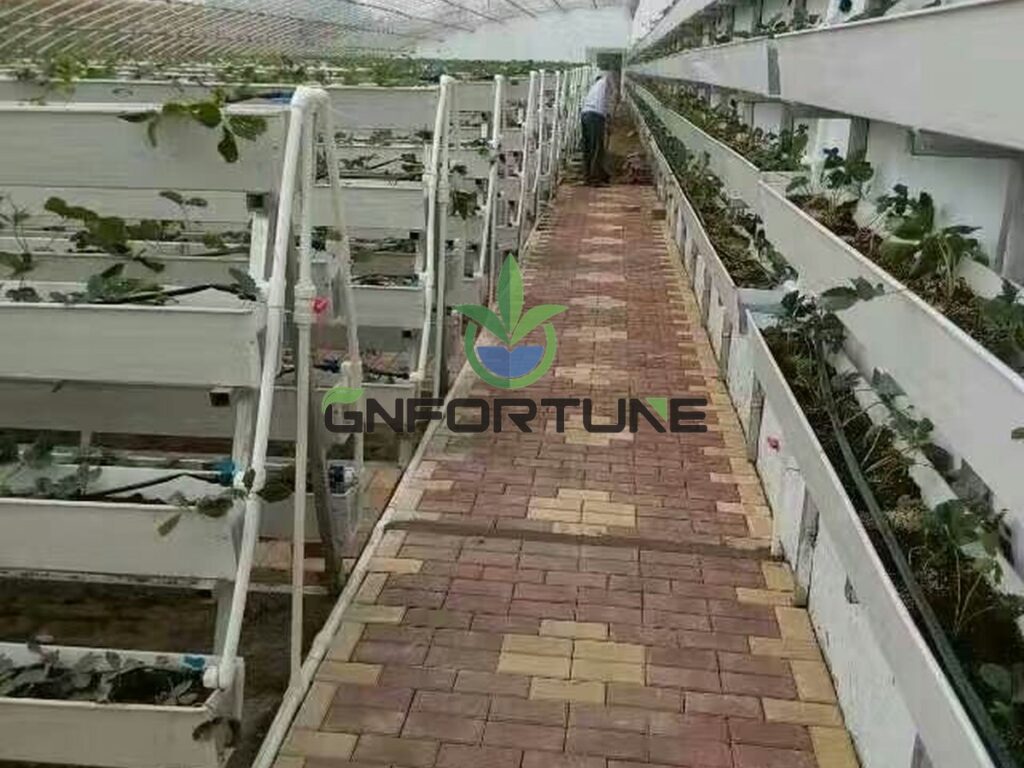
The symptom arrives in the afternoon: three zones open instead of two, and the drip line at the far end of the house stops weeping. Nothing is broken. The supply simply cannot deliver design flow at design pressure under the worst combination the day will ask of it — and that is the moment pressure boosting stops being an upgrade and becomes part of the system.
This article covers when boosting is genuinely required, the three ways to hold pressure, pressure tank sizing in numbers you can check, and how to measure end-of-line pressure honestly. Pump selection for duty point and redundancy is a separate topic covered in the guide to hydroponic pump sizing; here we deal with the pressure before the system inlet.
When Mains or Tank Pressure Cannot Hold a Zone
Boosting is required when the available static pressure minus every loss along the path leaves less than the most demanding zone needs at its worst simultaneous flow. Five conditions eat the margin:
- Elevation. Every metre of lift costs about 0.1 bar. A tank on the ground feeding gutters 6 m up has spent most of a typical mains pressure before a single emitter opens.
- Distance and friction. Long small-bore mains lose pressure continuously; a 100 m run of 32 mm PE carrying 10 m³/h can shed a planning range of 0.5–1.5 bar depending on fittings and bends.
- Filtration. A loaded filter is a deliberate restriction. A planning range of 0.2–0.5 bar of loss across a disc filter at 40 m³/h with a 120-mesh element is normal; when it doubles, the element needs service.
- Simultaneous demand. Pressure that looks adequate with one zone open collapses when the controller runs three at once. Always size against the worst-case zone combination, not the average.
- End-of-line requirements. Misting, fogging and some injector setups need a floor pressure to function at all; a drip line will “work” at pressures where a misting section simply stops producing droplets.
Pressure Booster Pump Options: Tank, VFD or Packaged Set
Fixed-speed pump with a pressure tank and pressure switch is the traditional arrangement: the pump charges the tank to the cut-out pressure, shuts off, and restarts at cut-in. It is simple, cheap and unpowered at rest, and every part is generic. The cost is cycling: every litre drawn between fill cycles comes from the tank’s stored air cushion, and small tanks on continuous draws start the motor dozens of times an hour.
A variable-speed drive pump holds a constant discharge pressure by modulating motor speed — the mechanism is explained in the article on variable speed drive on hydroponic pumps. It eliminates cycling, soft-starts, and needs little or no tank volume. The trade is higher capital, an electronics dependency in a wet plant room, and a minimum-flow requirement — a VFD pump with every valve shut needs a bypass or sleep mode or it will hunt.
A packaged constant pressure pump set — two pumps, alternation control, small buffer tank — is what mid-to-large farms end up with. Redundancy is built in: one unit runs, the second takes over on fault, and service happens without shutting the farm. It costs the most and needs the cleanest installation, but it removes the single-point-of-failure problem that haunts both other options.

| Arrangement | Pressure stability | Tank and cycling | Watch-outs | Fits best |
|---|---|---|---|---|
| Fixed-speed pump + pressure tank + switch | Steps between cut-in and cut-out | Needs real drawdown volume; cycling limits life | Tank precharge, switch contacts, waterlogged bladder | Small farms, single or two zones, budget builds |
| Variable-speed constant pressure pump | Holds a flat setpoint | Little or no tank; no cycling | Minimum flow, electronics in humid rooms, surge on trip | Mid-size farms wanting flat pressure at lower cost than a set |
| Packaged constant pressure set (duty/standby) | Flat, with automatic changeover | Small buffer tank for anti-cycling | Cost, controller settings, commissioning complexity | Commercial farms, multi-zone, unattended operation |
Pressure Tank Sizing: Effective Volume, Not Nameplate
The number that matters on a tank-fed irrigation setup is usable drawdown — the water the tank releases between cut-out and cut-in. It is always far less than the label. As a planning rule with the precharge set to the cut-in pressure, a 100 L tank on a 2.0 to 3.0 bar band yields roughly 25–35 L of usable drawdown; the rest of the volume stays in the water side.
Drawdown converts to start frequency directly. With a continuous draw much smaller than the pump flow, starts per hour approximately equal the hourly draw divided by the drawdown. Keep small single-phase motors under about 6–10 starts per hour and the arithmetic becomes a sizing tool: a continuous night-time drip draw of 0.5 m³/h needs roughly 50–80 L of usable drawdown, which means a 150–250 L tank at those settings. That is why undersized tanks destroy switches and capacitors.
Two settings complete the picture. Set the cut-out above the worst zone requirement plus every loss in between, then give the switch a hysteresis band — a planning range of 0.8–1.5 bar between cut-in and cut-out is common. Narrow bands flatten pressure variation slightly and multiply cycling sharply; resist the temptation.
Dry-Run and Low-Water Protection
A booster fed from storage — the classic tank-fed arrangement where the pump lifts from a cistern or raw-water tank — must assume the supply can disappear. Three layers are standard and cheap: a float switch in the supply tank that locks the pump out on low water, a pressure-side loss-of-prime cut-out on the pump itself, and current or power monitoring in the controller for anything larger. On farms with harvested or blended supply, the low-water interlock is not optional; running a mechanical seal dry for five minutes buys a pump overhaul.
Measuring End-of-Line Pressure Honestly
Most “we have enough pressure” arguments collapse because someone measured with the wrong zones open. The honest protocol:
- Fit a gauge at the zone manifold — placement rules are covered in the guide to pressure regulator and gauge placement — and a second gauge at the farthest emitter or the end of the longest drip run.
- Open the worst realistic combination: typically the two or three largest zones together, which is what the controller will actually run at midday.
- Read both gauges under that load. The difference is your true distribution loss, and the far reading is the number that matters.
- Record the date, the combination and the readings. Next season’s “it worked when we commissioned it” depends on this note.
A pressure booster pump for hydroponics should be sized so that the far-gauge reading, not the pump-discharge reading, meets the emitter requirement with margin.
Noise, Cycling and the Maintenance Nobody Books
Cycling has a sound: a pump that starts every few minutes at night with no irrigation running usually means a waterlogged bladder tank, a leaking check valve, or a weeping zone valve. The yearly routine is short — check tank precharge with the system depressurised, inspect switch contacts for pitting, and confirm the check valve holds. On VFD sets, add a look at the fault log; most chronic trips trace to a minimum-flow bypass nobody fitted at commissioning.
Choose by how the farm runs, not price alone: where pressure matters at 3 a.m. with nobody present, the set with changeover earns its cost. Where pressure boosting feeds two zones on a budget build, a properly sized tank and a well-set switch remain defensible.
FAQs About Pressure Boosting and Tank-Fed Supply
How big should the pressure tank be for a drip system?
Start from the smallest continuous draw, not the peak. Divide the hourly draw by your allowable starts per hour — a planning ceiling of 6–10 for small single-phase pumps — to get required drawdown, then allow that usable volume is only about 25–35% of nominal tank size at typical settings. A 0.5 m³/h continuous draw generally needs a 150–250 L tank.
Why does our pump start and stop every few minutes at night?
Either a continuous draw is passing through a small tank — a leaky emitter line or check valve — or the tank has lost its air precharge and its drawdown with it. Check precharge first with the system depressurised; it should sit near the cut-in pressure. A nightly start count in the dozens will kill a switch and capacitor within a season.
Can we boost pressure without a pressure tank at all?
Yes, with a variable-speed pump holding a setpoint, or a packaged set with a small buffer vessel. You lose the cycling protection a tank provides and add a minimum-flow requirement, so every-valves-closed operation needs a bypass or sleep mode. It suits farms that want flat pressure more than they want simplicity.
What pressure should we hold for a Dutch bucket drip line?
Plan for roughly 1.0–1.5 bar at the zone manifold after regulation, assuming pressure-compensating emitters and normal slab setups — but confirm against the emitter manufacturer’s minimum, and measure at the far bucket with the worst zone combination open. Regulator selection and gauge position matter as much as the number itself.
Where do we measure to prove the far zone is served?
At the farthest emitter, with the realistic worst-case zones open simultaneously — usually the two or three largest together. A reading at the pump or manifold proves nothing about the end of the line; the difference between the two gauges is the true distribution loss you are trying to justify.
Related Reading
- Hydroponic Pump Sizing: Flow Rate, Head Pressure and Redundancy — The duty point the booster must deliver
- Hydroponic Pressure Regulator and Gauge Placement — Where the gauges go so the readings mean something
- Variable Speed Drive on Hydroponic Pumps — The constant-pressure route in detail
- Water Hammer in Hydroponics: Pressure Spikes and How to Stop Them — What fast valve closures and switch trips do downstream
- Irrigation Filtration: Screen vs Disc vs Sand Filter — The standing pressure loss your margin must cover
Next Step: What to Send for a Quotation
Boosting decisions live or die on the demand data: a pump specified from one zone’s flow will not survive a three-zone afternoon.
Specifying a pressure booster pump for hydroponics or a tank-fed supply? For RFQ or project consultation, send: daily water demand and the worst-case simultaneous zone combination; zone count and flow per zone; static lift and mainline length with diameter and material; filter type and mesh; supply pressure at the source, or supply tank volume and level range if tank-fed; end-device pressure requirements (drip, misting, injectors); power supply and phase; delivery schedule; and the budget band. G AND N FORTUNE LIMITED supplies pump sets, pressure tanks and matched fertigation rooms quoted to those parameters.