

Here is the short answer: the vegetables grown in water commercially are lettuce, spinach, kale, herbs (basil, mint, cilantro), cucumbers, peppers, tomatoes, and strawberries. These are the crops that pay back the cost of a soilless system at scale. Below, each crop is expanded with system notes and yield expectations.
The Fastest List Answer
- Lettuce — NFT channels, 3–5 week cycle, ~30–50 heads/m² per cycle.
- Spinach and kale — NFT or DWC, 4–6 week cycle, similar density to lettuce.
- Basil, mint, cilantro — NFT or Dutch buckets, 4–8 week cycle depending on cut-and-regrow.
- Cucumbers — Dutch bucket system, 10–14 week cycle, ~25–40 fruit/m².
- Peppers — Dutch buckets, 14–18 week cycle, high price per kg.
- Tomatoes — Dutch buckets or bato buckets, indeterminate varieties, 16–20 week cycle.
- Strawberries — NFT channels or vertical gutters, perpetual cropping, ~15–25 fruit/plant/season.
Leafy Greens You Can Grow in Water
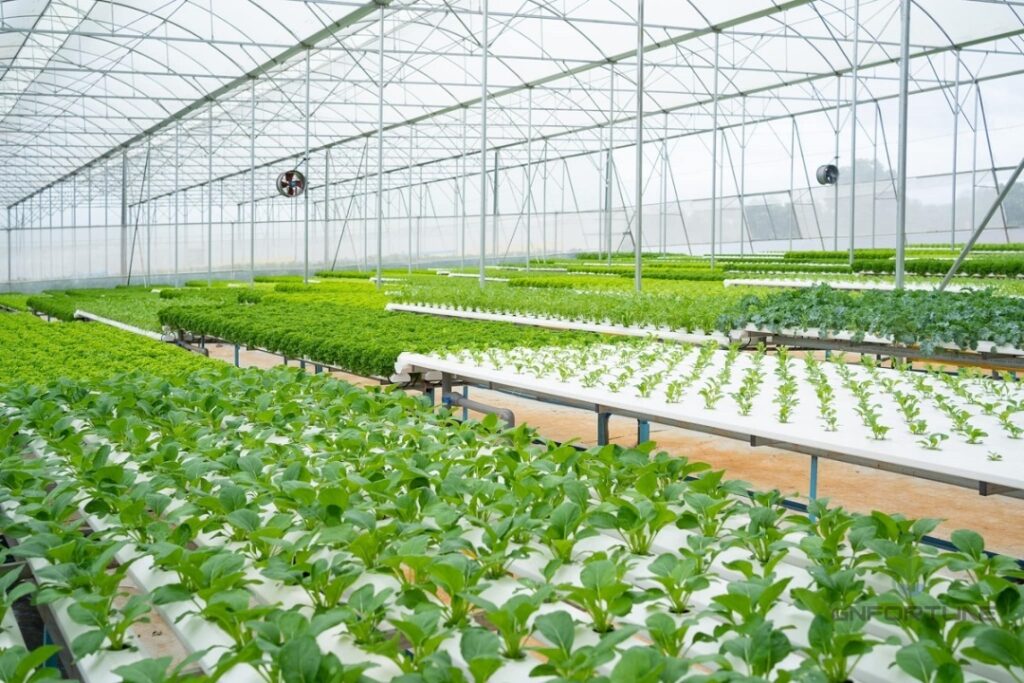
Commercial scale lettuce growing in greenhouse NFT pipesLeafy greens are the backbone of commercial water-based farming. They grow fast, command stable prices, and fit the highest-density systems.
- Lettuce (butterhead, romaine, loose-leaf): the default NFT crop. Cycle 3–5 weeks, 30–50 heads/m² per cycle. Full guide at commercial lettuce in NFT.
- Spinach: slightly slower than lettuce, prefers cooler water (16–20°C). Grows in NFT and DWC.
- Kale and chard: longer cycle (5–7 weeks), higher price per head. Cut-and-regrow extends harvest.
- Microgreens: fastest turnover (7–14 days), high price per kg, low volume per m².
Fruiting Crops That Work in Water at Scale
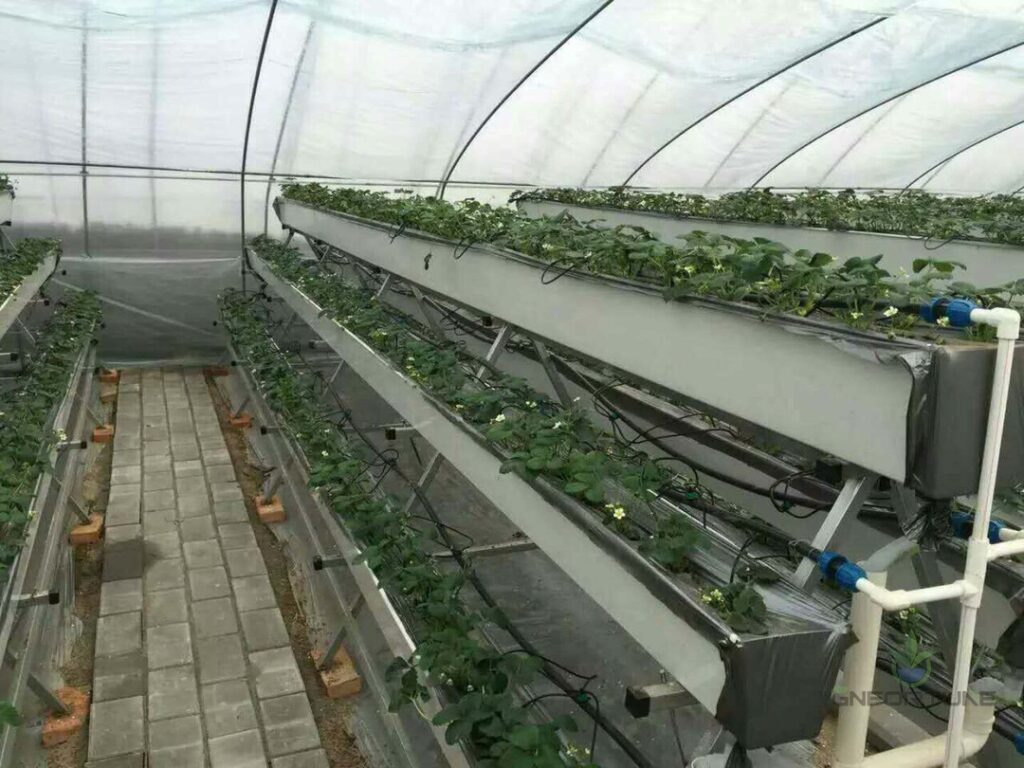
Three-tier strawberry gutters inside a greenhouseFruiting crops need more space, longer cycles, and stronger support structures, but sell at higher prices per kilogram.
- Cucumbers: Dutch bucket system with coco coir. Indeterminate varieties produce for 4–6 months. EC 2.0–2.5 mS/cm.
- Tomatoes: the standard Dutch bucket crop. Indeterminate varieties trained to a single stem, producing 6–9 months. Guide at Dutch bucket tomatoes.
- Peppers (bell and chili): Dutch buckets, 14–18 weeks to first harvest. Premium pricing for colored bells.
- Strawberries: NFT channels or vertical gutters. Perpetual varieties fruit 6–10 months. Guide at strawberry gutter guide.
Herbs and Roots: Where the Edge Cases Are
Herbs are strong water-grown crops. Root vegetables are not.
- Basil: one of the most profitable water-grown herbs. 4–6 weeks to first cut, regrows for 3–4 successive harvests. High restaurant demand.
- Mint and cilantro: grow well in NFT and DWC. Mint is aggressive — contain it in its own channel to prevent root spread into other crops.
- Oregano, thyme, rosemary: slower-growing woody herbs. Profitable only as specialty crops.
- Root crops (carrots, radishes, beets): technically possible in deep substrate beds, but not commercially viable. The cost per kilogram is far higher than field production. Skip them.
The one-line rule: if the crop sells for less than the system cost per kilogram to produce it, do not grow it in water. Root crops and grains fail this test. Leafy greens, herbs, and fruiting vegetables pass it.
Which System for Which Crop
| Crop | Best system | Cycle time | Yield range |
|---|---|---|---|
| Lettuce, leafy greens | NFT channels | 3–5 weeks | 30–50 heads/m² |
| Spinach, kale | NFT or DWC | 4–7 weeks | 25–40 heads/m² |
| Herbs (basil, mint) | NFT or Dutch buckets | 4–8 weeks | Varies by cut schedule |
| Cucumbers | Dutch buckets | 10–14 weeks | 25–40 fruit/m² |
| Tomatoes | Dutch buckets | 16–20 weeks | 20–35 kg/m² |
| Peppers | Dutch buckets | 14–18 weeks | 15–25 kg/m² |
| Strawberries | NFT or vertical gutters | 6–10 months (perpetual) | 15–25 fruit/plant |
For the technical foundation of the most common water-growing method, the NFT hydroponics explainer covers how channels, flow, and slope work. For a system-level comparison that includes aeroponic towers, the aeroponic vs hydroponic guide breaks down the trade-offs.
FAQ
What vegetables can you grow in water without soil?
A: Lettuce, spinach, kale, basil, mint, cilantro, cucumbers, tomatoes, peppers, and strawberries are the main commercial crops grown in water without soil.
Can you grow root vegetables in water?
A: Not commercially. Carrots, radishes, and beets can be grown in deep substrate beds, but the cost per kilogram is far higher than field production.
What is the easiest vegetable to grow in water?
A: Lettuce. It has a short cycle (3–5 weeks), grows at high density in NFT channels, and has stable wholesale demand.
Can you grow tomatoes in water?
A: Yes. Indeterminate varieties in Dutch bucket systems produce for 6–9 months with yields of 20–35 kg/m².
Turn This List Into a Crop Plan
Turn this list into a crop plan — request a system layout. Send your target crops, greenhouse area, and market through the quote form, and we will return a system layout with channel or bucket count, spacing, and yield projections for your specific crop mix.