

Density Is Not Free Yield
Packing more plants into the same square metre is the most tempting lever in any cropping plan, and it is also the one most often pulled one step too far. Add plants and you add seed, plugs, handling labour and transpiration load — but plant canopies begin competing for light and air, individual fruit size falls, disease pressure rises, and labour per plant climbs because the same tasks take longer in a denser crop.
The right hydroponic plant spacing is the point where additional plants stop paying for themselves. This guide shows how that point differs by system and crop, what changes when you push density, and how to test it cheaply before committing a whole house.
What Spacing Actually Controls
| Factor | Effect of tighter spacing | Effect of wider spacing |
|---|---|---|
| Yield per square metre | Usually rises to a plateau, then falls | Lower total, higher individual plant yield |
| Individual fruit or head size | Falls | Rises |
| Air movement through canopy | Restricted, humidity pockets form | Better; lower disease pressure |
| Labour per unit produced | Rises — more plants to handle for the same output | Falls for tasks done per plant |
| Transpiration and cooling load | Higher | Lower |
| Propagation requirement | More plugs or seedlings per cycle | Fewer |
| Cycle length | Often extends slightly, especially in fruiting crops | Tends to shorten |
The optimum depends on what you sell. A salad processor buying weight per box wants a different answer from a retailer paying a premium for large fruit.
Spacing by System Type
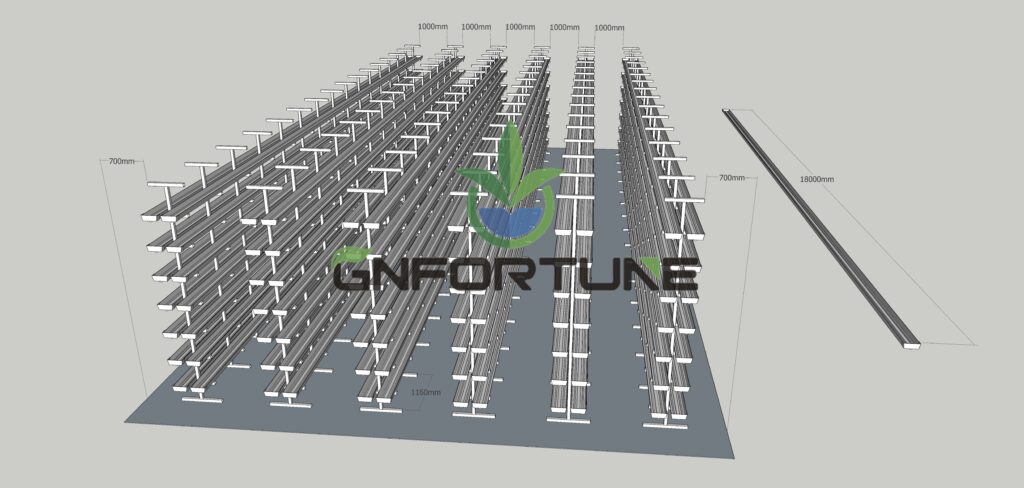
| System | What sets spacing | Practical notes |
|---|---|---|
| NFT channels (leafy) | Head diameter at harvest; plants must not merge before cutting | Small and baby leaf styles use much tighter spacing than full-head lettuce |
| Deep water culture rafts | Raft layout and float board holes | Raft spacing is effectively fixed by the board design, so choose the board to the crop |
| Gutter rows (strawberry, herbs) | Single or double rows per gutter, plus run position | Double-row layouts raise plants per metre of gutter but complicate picking access |
| Dutch bucket (vine crops) | Single plant per bucket; the real variable is bucket spacing along the row | Row spacing drives canopy depth and the number of passes per crop |
| Slab culture | Plants per slab and number of stems carried | Stem density is often adjusted across the season with light levels |
| Vertical tiers | Tier height and lateral spacing within a tier | Lower tiers are light-limited; spacing should acknowledge the light gradient |
Row spacing versus plant spacing
Two numbers, often conflated. Plant spacing along the row decides competition between neighbours; row spacing decides whether a worker can pass, whether air moves, and how many rows fit in the house. Tightening plant spacing while keeping row spacing generous usually costs less than doing the reverse.
Reading the Crop: Signs You Went Too Tight
- Canopy closing before harvest — leaves overlapping so that lower leaves never dry
- Botrytis and other fungal issues clustering in the densest blocks first
- Head or fruit size dropping while total count rises, with no net gain in saleable weight
- Humidity staying high beneath the canopy even when ventilation is running
- Picking and grading times per unit rising because workers fight the foliage
Any of those appearing together means density has passed its optimum. Individually they can have other causes; together they nearly always mean the crop is too crowded.
Design the Trial Properly
Most “trials” on working farms are informal — a row here, a row there, and an argument at the end of it. A usable comparison needs:
- A defined variable: change spacing, hold everything else constant
- Replication: at least three blocks per treatment, not one row each
- Randomised or alternating placement so that house position is not confused with treatment
- Identical management: same irrigation, nutrition, pruning and picking schedule
- The right measurements: saleable weight per square metre, plus size distribution and labour minutes — not just plant count
- A decision rule agreed in advance: what result would make you change, and by how much
A trial that only measures yield per plant will always favour wider spacing; one that only measures yield per square metre will always favour tighter. Measure both and you get the useful answer.
Build Density Into the Schedule
Density choices echo forward into the whole plan:
- Propagation: plants per cycle scales directly, and so does plug and seed ordering
- Labour: handling minutes per square metre change, which shifts headcount and the picking window
- Cooling: denser canopies transpire more, so the dehumidification and ventilation duty rises
- Packaging: size distribution determines which formats you can supply — a shift to smaller heads may not suit a contracted product spec
- Economics: the correct comparison is contribution per square metre per year, not yield alone
Seasonal Adjustment
The optimum is not fixed by calendar — it moves with light. In high-light seasons plants tolerate tighter spacing; in low-light winter production, wider spacing avoids stretched, weak plants and poor colour. Many farms run two densities across the year for the same crop, adjusting number of plants per gutter or per channel rather than rebuilding the layout.
FAQ
How many plants per square metre should I use for lettuce?
It depends on the product. Baby leaf and small heads are grown far denser than full-head lettuce, and channel width and mature head diameter set the limit. Start from the diameter your buyer expects at harvest and work backwards.
Does higher density always give higher yield?
Up to a point. Beyond that plateau, additional plants raise cost and disease pressure faster than they raise saleable output, so contribution falls.
Should I keep row spacing wider in humid climates?
Yes. Air movement through the canopy is a disease control measure, and in humid climates it is worth more than the plants-per-metre you give up.
Can I change spacing without rebuilding the system?
Often partially. Multi-hole lids, alternative spacing inserts and different slab layouts allow adjustment; changing row spacing is harder because it usually means moving the rows themselves.
How long should a spacing trial run?
At least one full crop cycle, ideally two, since seasonal light changes the result. A single short trial in high light will mislead a winter decision.
Does spacing affect tipburn?
It can. Restricted airflow around dense canopies raises local humidity and reduces calcium transport in fast-growing leaves, which is one of the routes into tipburn.
Plan the Layout Around the Answer
Spacing decisions are cheap in the drawing stage and expensive once rows are built. Send us your crop list, target pack size and house dimensions and we will return a layout with plant counts, row widths and labour estimates for comparison. Use the quote form.
Related reading: density interacts with air and nutrition — see humidity control and VPD and lighting, PPFD and DLI; for system specifics see NFT channel layout, strawberry gutter growing and crop profitability by yield, price and demand.