
Melons in Grow Bags and Dutch Buckets: Setup
Melon hydroponics is a water-volume and load problem before it is a nutrient problem. A fruiting vine carries several kilograms of fruit on a canopy that transpires far harder than a tomato, and the container has to hold enough media to buffer that demand between irrigation events. Growers who move straight from cucumber to melon on the same buckets find the limit in week eight, when fruit fill starts and the media volume stops being enough. This guide sets out the container, trellis, pollination and irrigation decisions that decide whether a melon crop finishes.
Media Volume for a Fruiting Vine
Size the container against peak daily water demand, not against the transplant. A melon vine at full fruit fill can use 4 to 8 L per plant per day in a hot house, and the media has to hold enough solution to cover the interval between irrigation events plus the leaching fraction. Under-sized media means more irrigation events per day, and more events mean a wetter root zone and a higher disease load.
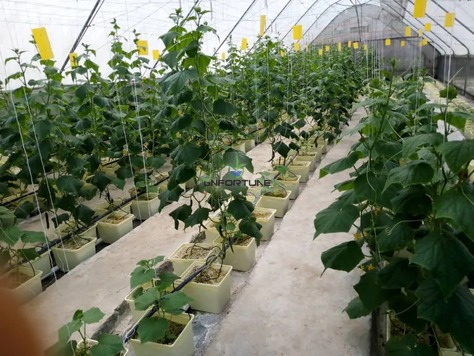
| Container | Media volume | Crop fit | Limit |
|---|---|---|---|
| Dutch bucket | 10 to 20 L | Mini watermelon, compact netted melon, one plant | Dry-down risk at fruit fill |
| Grow bag, small | 20 to 30 L | Mini watermelon, one to two plants | Heavier handling at change-out |
| Grow bag, large | 40 to 70 L | Full-size melon, one plant | Floor load and disposal volume |
| Coir or rockwool slab | 15 to 25 L per slab | Mini watermelon, two plants per slab | Needs a drainage table or gutter |
| Deep trough or bed | 30 to 50 L per metre | Ground-creeping melon, no trellis | Uses the most floor area per plant |
Media choice follows the irrigation strategy. Coir blends buffer water and forgive a missed event; perlite blends drain faster and suit short, frequent shots. A coarse coir and perlite blend near 70:30 is the common compromise.
On site we often see a melon crop planted on a bucket that was specified for cucumber: it looks fine until fruit fill, when demand passes what 10 to 15 L of media can buffer and the plant drops its lower leaves on the hottest afternoon of the week. The fix is not a bigger pump; it is more media volume per plant or shorter irrigation intervals with real drainage. Decide the volume before the layout is drawn, because bucket spacing cannot be changed once the rows are set.
Bag vs Bucket vs Slab
All three work, and the choice is lifecycle cost and labour rather than yield. Buckets are capital equipment that lasts seasons and can be washed; bags are a consumable bought and disposed of per cycle.
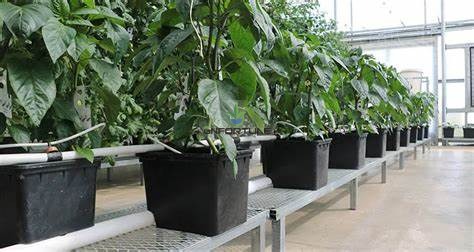
- Dutch buckets. Reusable, predictable footprint, easy emitter mapping. Suits a site already running bucket rows for tomato or pepper.
- Grow bags. Cheapest to start, flexible layout, folded and binned at crop change. Suited to seasonal melon blocks and to sites without wash-down capacity.
- Slabs. Highest plants per square metre and the cleanest drainage path with a gutter system. Needs a level, supported drainage run and consistent slab wetting.
Spacing is where melon differs from other vine crops on the same hardware. Tomato bucket rows sit at 1.2 to 1.5 m along the row; melon vines need 1.5 to 2.0 m per plant and 1.8 to 2.5 m between rows, because the canopy is wider and fruit needs light on all sides.
Layout and emitter mapping for bucket rows is covered in the Dutch bucket layout basics, and the cucumber bucket guide gives a direct comparison of vine-crop demand on the same hardware.
Trellis Load and Netting for Fruit
Melon trellis has to carry two loads: the vine, and the fruit hanging off it. A cucumber trellis sized only for vine weight will fail under a row of filled melons, and the failure usually happens in the last three weeks of the crop.
- Fruit weight. Mini watermelon runs 1.5 to 4 kg, netted melon 1 to 3 kg, full-size watermelon 8 kg and up.
- Design load. Size the wire for two to four fruit per plant plus vine and leaf, commonly 10 to 20 kg per linear metre of row.
- Support height. 1.8 to 2.2 m of clear wire height for a single string system, more where two fruit tiers are carried.
- Netting. Trellis net at 100 to 150 mm mesh lets the vine and tendrils grip without tying every node.
Anchoring deserves more attention than it gets. The top wire transfers load into the greenhouse structure, so purlins and posts must be rated for the fruiting case, not the bare vine. The vine crop support guide covers wire, twine and fixing loads.
Pollination Requirements
No pollination, no crop. Melons carry separate male and female flowers on the same plant, and the female flower needs several insect visits on the day it opens to set a fruit of marketable shape. Misshapen fruit and fruit drop are almost always pollination failures rather than nutrient failures.
Commercial houses stock bumblebee hives at a rate set by flower density rather than floor area; a common planning figure is one hive per 1,000 to 2,000 m² for a vine crop, adjusted by season and by what else is flowering. Hand pollination is used as a backup on small blocks and on varieties that set poorly, working in the morning while pollen is viable. Seedless watermelon needs a polleniser variety planted in the block, typically at a ratio of one polleniser to three or four seedless plants.
Pollination interacts with vent screening and sprays. Insect netting keeps pollinators in but holds heat, and any application must be scheduled outside pollinator activity. The pollination reference for commercial greenhouses covers hive rates.
Water and EC Through Fruit Fill
Irrigation and feed split into three phases, and running one recipe across all three is the most common cause of split fruit and low sugar.
| Phase | Target EC | Events per day | Runoff |
|---|---|---|---|
| Establishment, transplant to flowering | 1.8 to 2.2 mS/cm | 3 to 5 | 10 to 20 percent |
| Fruit set to early fill | 2.2 to 2.8 mS/cm | 5 to 8 | 20 to 30 percent |
| Fill to ripening | 2.5 to 3.0 mS/cm | 5 to 8, shorter shots | 20 to 30 percent |
| Ripening and harvest | 2.0 to 2.5 mS/cm | 3 to 5 | 10 to 20 percent |
Two failure modes repeat. Dry-down at midday during fill shows as wilting, then as blossom-end disorders and split fruit when water returns. Over-irrigation late in ripening dilutes sugar and softens flesh. Root-zone temperature matters alongside volume: 20 to 24 °C suits a fruiting melon, and above 28 °C oxygen uptake drops as demand peaks.
Drainage has to be measured, not assumed. Check runoff at the low end of the row, where salt accumulates, and keep drainage at 20 to 30 percent during fill so the media does not salt up. Yield expectations vary widely: two to four fruit per plant is a common planning figure for mini watermelon, and figures vary by region and season.
Fruit Nets, Slings and Hooks
Fruit support is cheap hardware that saves the most expensive loss on the crop: a 2 kg melon on a short stem tears out of the vine, and a sling moves that weight to the wire.
- Mesh slings or nets. Slipped under the fruit and tied to the wire once the fruit reaches about 300 to 500 g.
- Rated load. Select slings rated above the heaviest fruit expected, commonly 5 to 10 kg for mini and netted melon.
- Hooks and clips. Fixed to the top wire, not the trellis net, so the load path goes to structure.
- Inspection rhythm. Check slings weekly during fill; fruit grows faster than the slack in a net.
FAQ
Can melons be grown in standard Dutch buckets?
A: Mini watermelon and compact netted melon, yes, at 10 to 20 L per plant. Full-size melon needs 40 L or more and is better in large bags or beds.
How much media does a melon plant need?
A: 20 to 40 L for mini types and 40 to 70 L for full-size fruit. Under 20 L raises dry-down risk during fruit fill in a hot house.
Do melons need pollinators in a greenhouse?
A: Yes. Female flowers need several visits on the day they open; stock bumblebees or hand pollinate in the morning, and plant a polleniser for seedless types.
What EC suits melon through fruit fill?
A: EC 2.2 to 3.0 mS/cm during set and fill, eased to 2.0 to 2.5 mS/cm at ripening to protect sugar content.
How many fruit per plant should a crop carry?
A: Two to four for mini watermelon is a common target, selected for uniform size. Figures vary by region and season.
Melon hydroponics works on any of the three containers when the media volume, the trellis load and the pollination plan are set together. Growers who size those three before planting get uniform fruit instead of a split grade at harvest.
Request a Melon System Layout Quote
Send your growing area, melon type and target fruit size, and we will return a container layout with media volume, spacing, emitter count and trellis load set for a fruiting vine. Use the request a melon system layout quote form, and see Dutch bucket system components for the hardware options.


