
Asian Greens in NFT: Bok Choy, Tatsoi, Kale
Bok choy hydroponics runs on the same film of nutrient that lettuce does, and that is exactly where growers get into trouble. Brassica greens put down a denser, faster root mat, tolerate a higher feed strength, and bolt or tipburn on different triggers than a butterhead does. Put them on a channel engineered for lettuce and the crop still grows for three weeks, then the channels start ponding behind root mass. This guide covers the setup changes that make Asian greens work on an NFT line: width, spacing, EC, cycle and harvest handling.
Which Asian Greens Fit NFT
Fit is decided by root architecture and harvest format, not by cuisine. Everything that is cut young and sold as a bunch or a leaf works on a film of running solution. Anything grown for a dense head, a swollen stem or a storage organ does not.
| Crop | NFT fit | Notes for a commercial line |
|---|---|---|
| Bok choy, baby and full size | Strong | Fast, uniform, the volume crop for most mixed lines |
| Tatsoi | Strong | Low rosette, dense root mat, watch channel blockage |
| Komatsuna, mizuna | Strong | Cut-and-come-again, suits multi-harvest scheduling |
| Mustard greens, mibuna | Strong | Handles higher EC; strong flavour sells in small volume |
| Kale, baby leaf | Moderate | Wider spacing and longer cycle; heavier canopy |
| Gai lan, Chinese kale | Moderate | Stem crop; needs more support at the base |
| Napa cabbage, full head | Weak | Head formation is unreliable on a film; use substrate |
Multi-cut crops change the economics. Komatsuna and mizuna regrow from the cut and give two or three harvests per transplant, halving propagation cost and doubling labour touch points. Bok choy is taken whole and priced against one harvest.
Channel Width and Spacing
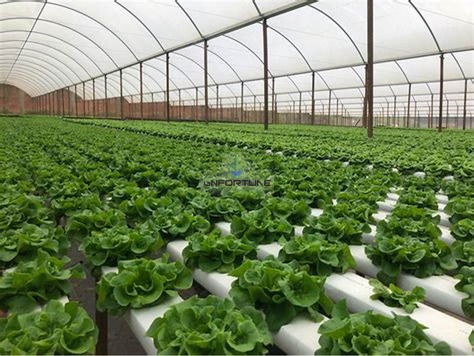
Specify the channel for the root mass the crop will build at harvest, not for the plug that goes in. Brassica roots are finer and denser than lettuce roots and fill a channel faster; a 100 mm trough that is comfortable for a five-week lettuce will be half full of root by the time a tatsoi crop finishes.
- Width. 100 to 150 mm for baby leaf, 150 mm and up where a full-size bok choy or kale crop runs past six weeks.
- Flow. 1 to 2 L/min per channel at the inlet, checked at the outlet, not at the pump.
- Slope. 1 to 2 percent, enough to move the film without starving the top of the run.
- Film depth. 5 to 10 mm under the plug base; deeper than that and the root zone loses oxygen.
- Run length. Under 12 to 15 m so the temperature and EC gradient along the channel stays manageable.
On site we often see the channel sized for lettuce and then blamed when brassicas pond at week five: the roots are doing what brassica roots do, and the trough was never wide enough for the mat they build. Once the mat bridges the channel, the top half of the run runs dry and the bottom half sits in stagnant solution, so the crop splits into two grades on one bench. Opening the spacing, widening the trough or shortening the run fixes it; raising the pump speed does not.
Spacing follows the harvest size, and getting it wrong costs either grade or yield per square metre.
| Crop and format | In-row spacing | Plants per m² | Target cycle |
|---|---|---|---|
| Baby leaf brassica mix | 5 to 8 cm | 150 to 300 | 18 to 28 days |
| Tatsoi, whole rosette | 12 to 18 cm | 30 to 55 | 30 to 45 days |
| Bok choy, baby | 10 to 15 cm | 45 to 80 | 28 to 40 days |
| Bok choy, full size | 18 to 25 cm | 18 to 30 | 40 to 60 days |
| Kale, baby leaf | 15 to 20 cm | 25 to 45 | 35 to 50 days |
Density interacts with airflow. A dense brassica canopy holds humidity at the leaf surface, which is the mechanism behind most downy mildew on a channel line.
Nutrient: EC, Nitrogen and Tipburn Risk
Feed brassicas slightly stronger than lettuce, and hold pH a little higher. A working band of EC 1.6 to 2.5 mS/cm suits most Asian greens, against roughly 1.2 to 1.8 mS/cm for head lettuce on the same water. Push the band to the top in cool, low-light months and pull it back in high-radiation summer; the crop salts up the channel faster than it uses the feed when transpiration drops.
Three nutrient points decide most of the problems seen on a brassica NFT line:
- Nitrogen form. Keep the ammonium fraction low, typically under 10 percent of total nitrogen. Brassicas take up nitrate fast and a high ammonium share drives soft, brittle leaf.
- pH. 6.0 to 6.5 works better than the 5.5 to 5.8 band lettuce prefers. Brassicas lose manganese and iron availability at the top of this range, so watch for interveinal chlorosis.
- Calcium and airflow. Tipburn on brassicas is a transport problem, not a deficiency problem. Fast growth with low transpiration leaves the leaf margin short of calcium; raising EC makes it worse.
The physiological disorders guide goes through the tipburn and bolting triggers in more detail, and the NFT system overview covers film depth and slope basics for a new line.
Cycle Length by Season
Cycle length follows temperature, and the same variety can differ by more than half between a summer and a winter turn. Plan 28 to 40 days for baby bok choy at 20 to 24 °C day temperature, and 45 to 60 days at 12 to 15 °C. Figures vary by region and season, so schedule propagation against the range.
Bolting is the seasonal risk that catches buyers out: a cold spell followed by long days sends a seed stem and the bunch is unmarketable. Use bolt-tolerant varieties for spring and autumn slots.
Pests: Flea Beetle and Downy Mildew
Two problems account for most crop losses on Asian greens in a protected house, and both are structure and climate problems before they are spray problems.
Flea beetle adults chew shot holes through the leaf and make a bunch unsaleable at low damage levels. Exclusion is the only reliable control: insect mesh on vents, door airlocks and a weed-free perimeter. Traps monitor pressure but do not protect a crop.
Downy mildew shows as yellow patches above with white sporulation beneath, and needs free water or very high humidity at the leaf surface. Keep the canopy dry overnight: heat and vent in the evening, run horizontal airflow fans, avoid late irrigation.
Harvest, Packing and Shelf Life
Asian greens are sold on appearance, and appearance is decided after the cut. Cut above the growing point for multi-cut crops or at the base for whole plants, then cool within 30 minutes; field heat left in a tote overnight is the difference between a ten-day shelf life and a four-day one.
- Cooling. Force-air or hydro-cool to 0 to 2 °C before packing.
- Bunching. Standard bunch weights by market, normally 200 to 500 g, banded or bagged.
- Storage. 0 to 2 °C at 95 percent relative humidity; brassicas wilt fast in dry cold rooms.
- Ethylene. Keep away from ripening fruit stores; brassicas yellow quickly in ethylene.
- Shelf life. Commonly 7 to 14 days cooled and packed, shorter for cut-and-come-again leaf.
Blending Asian greens into a salad line needs its own harvest planning, because bunch weights and cut heights differ from lettuce. The blended leafy greens guide covers that scheduling.
FAQ
Can Asian greens run on the same NFT channels as lettuce?
A: Yes, but specify 100 to 150 mm width and shorter runs, because brassicas build a denser root mat than lettuce and can bridge a narrow trough.
What EC suits bok choy in NFT?
A: EC 1.6 to 2.5 mS/cm for most brassicas, at pH 6.0 to 6.5. Pull back toward the lower end in hot, high-light months.
How long is a bok choy cycle from transplant to harvest?
A: Roughly 28 to 40 days in a warm house and 45 to 60 days in a cool one. Figures vary by region and season.
Why do leaves show shot holes shortly after transplant?
A: Flea beetle. Mesh the vents and add a door airlock; traps only measure pressure and will not protect the crop.
Can one crop be harvested more than once?
A: Mizuna, komatsuna and some mustard types regrow from the cut and give two or three cuts per transplant if the cut is made above the growing point.
Asian greens NFT production rewards the same discipline lettuce does, applied a little differently: wider troughs for the root mat, a stronger feed at higher pH, and a harvest and cooling step fast enough to protect the leaf. Growers who set those four things up front get a clean, uniform bunch off a channel line.
Request an NFT Layout Quoted for Asian Greens
Send your growing area, crop list and target bunch weight, and we will return a channel layout with width, spacing, flow rate and run length set for a brassica root load. Use the request an NFT layout quoted for Asian greens form, and see the commercial lettuce NFT guide for the baseline line design.


