
Hydroponic grow beds and tubs look like simple moulded items, and that is why they are so often bought on price per piece. Three specification lines decide what a bed actually costs over its service life: wall thickness, material and UV package, and drainage detail. A quotation missing any of the three cannot be compared with one that states them, whatever the unit price says. Buyers who specify those lines first tend to receive comparable bids on the first round, and to avoid the second-round surprise where a cheaper bed arrives with thinner walls and no UV stabiliser.
Bed vs Tub vs Trough: Which Shape for Which Crop
Shape follows root volume and harvest method. A shallow bed suits crops cut above the base and turned over quickly; a deep tub suits fruiting crops that stay in place for months; a trough suits continuous runs where the root mat is the crop support. Choosing on footprint alone is the most common specification error, because litres per plant is what the crop responds to.
| Format | Internal depth | Typical litres per plant | Crop fit |
|---|---|---|---|
| Shallow flood tray | 50 to 100 mm | Under 2 L | Propagation, microgreens, cut-and-come-again leaf |
| Standard grow bed | 150 to 200 mm | 2 to 6 L | Leafy greens, herbs, raft and media beds |
| Deep tub | 200 to 350 mm | 10 to 20 L or more | Fruiting crops in media, longer cycles |
| Trough or channel run | 40 to 100 mm, continuous | Set by run length and spacing | Continuous root mat, single-pass flow |
Dimensions and Litres per Plant
Litres per plant is the number to fix before quoting starts. Leafy crops in raft or media beds commonly sit at 2 to 6 L per plant; fruiting crops in media run materially higher, at 10 to 20 L per plant or more, because the root system has to support a canopy for months. Once litres per plant and plants per square metre are set, bed length and width are arithmetic, and module lengths can be chosen to suit the aisle layout and the rack span.
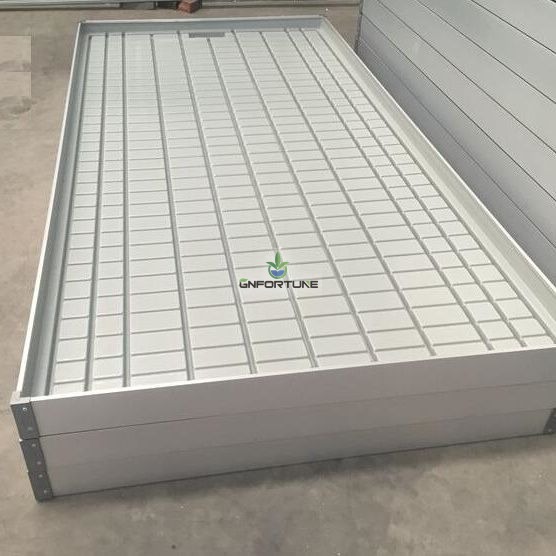
Two dimension details separate a workable bed from a returned one. Internal clearance at the drain end, which sets whether solution drains fully or leaves a stale sump, and rim geometry, which decides whether a bed can be lifted by two people when full. Both should appear on the drawing in the quotation, not in an email exchange afterwards.
Materials for Hydroponic Beds: PP, PE, Fibreglass, Steel
Material choice is a trade between stiffness at low wall thickness, impact behaviour at low temperature, and what the sanitising regime does to the surface over several seasons.
| Material | Forming | Behaviour in service | Cost position | What to confirm |
|---|---|---|---|---|
| Polypropylene (PP) | Injection or thermoformed | Stiff and light; can turn brittle at low temperature | Lowest unit cost at volume | UV stabiliser percentage, wall thickness in millimetres |
| Polyethylene (PE) | Rotational moulded or sheet | Better impact resistance, heavier, more creep under load | Moderate | Density grade, support spacing to limit sag |
| Fibreglass (GRP) | Hand lay-up or moulded | Very rigid, custom sizes, repairable | Higher, tooling light | Food-contact resin and gelcoat declaration |
| Steel-lined | Liner in galvanised or stainless frame | Long spans, high load, corrosion risk at cut edges | Highest, longest span | Liner weld detail, edge treatment, frame coating |
Material choice also interacts with cleaning. Oxidising sanitisers and hot washes age polyolefin surfaces, and the visible result is crazing around stress points near drains and corners. Where a farm runs an aggressive sanitation cycle, PE or GRP usually outlasts thin-wall PP despite the higher unit price; the equipment lifespan comparison sets out where that trade-off lands in practice. Certificates matter as much as the polymer itself, so ask for the material declaration referenced in the food-safe materials guide.
Drainage, Slope and Outlet Details
Drainage is where beds fail after installation, and the specification is short. Fix these four items in writing before the order is placed:
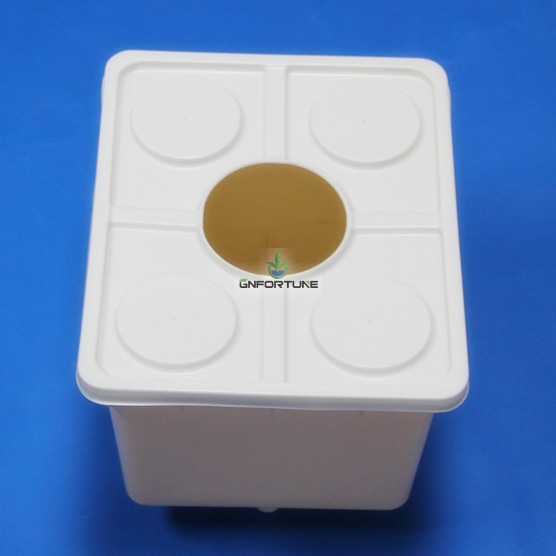
- Slope to the outlet, commonly 1 to 2 percent, formed into the floor of the bed rather than shimmed under it.
- Outlet size and thread type, matched to the return line, with a coarse screen that can be removed for cleaning.
- Overflow height, set above the working level so a blocked return floods the aisle instead of the crop support.
- Access for washing, including whether the outlet can be dismantled and whether corners are radiused rather than square.
On flood and drain systems the outlet also sets fill and drain timing, so bed volume, outlet bore, and pump capacity have to be quoted together. That interlock is covered in the flood tray and ebb-and-flow buying guide, and the raft format in the commercial raft bed design guide.
Support Structures and Load Ratings
Load rating is the line most buyers forget to ask for, and the one that decides whether a rack or bench quote can be trusted. Wet media weighs close to its water content, so a bed at 150 mm depth holds a substantial load per square metre before the crop is added. Confirm the distributed load the bed carries, the point load at the outlet, and the support spacing the manufacturer rates it for.
Racks and benches are quoted against those numbers rather than against bed length. Where beds sit on multi-tier structures, the structural and irrigation questions merge, and the multi-layer rack guide is the reference to send with the enquiry.
Ordering: Nesting, Stacking and Freight
Freight is a real share of landed cost on moulded goods, because volume rather than weight fills the container. Nesting ratio, stack height per pallet, and whether beds ship assembled or flat determine how many units fit per container, and that number belongs in the quotation. Sample policy matters too: a sample made on different tooling tells a buyer nothing about production wall thickness.
The quotation test we apply to bed and tub suppliers: if a bid states price per piece without wall thickness, material grade with UV package, and a load rating, it is not a quotation, it is an estimate. Three missing lines mean three places where the delivered goods can differ from the sample you approved.
Other red flags are consistent across suppliers. “Food grade” with no certificate reference. UV claimed but no stabiliser percentage. Drain fittings listed as standard rather than by thread and bore. Samples offered only in a different colour or from a different mould than production. A lead time quoted without a packing or pallet count. Each one is answerable in a single email, and a supplier who answers all five quickly is usually the one whose production matches the sample.
FAQ
How many litres should a bed hold per plant?
A: Commonly 2 to 6 L for leafy crops and 10 to 20 L or more for fruiting crops in media. Set that number first, then derive bed dimensions from plant spacing.
Is PP or PE better for grow beds?
A: PP gives stiffness and the lowest unit cost; PE gives better impact resistance and low-temperature behaviour. Where sanitising is aggressive or the site is cold, PE usually lasts longer.
What slope should a bed have to its outlet?
A: Around 1 to 2 percent, moulded into the bed floor. Shimmed slope moves under load and leaves low spots where solution stands.
Should beds be bought assembled or nested?
A: Nested where the design allows, because freight is charged on volume. Confirm nesting ratio and pallet count on the quotation rather than assuming a container quantity.
What load rating should be requested?
A: Distributed load per square metre with the bed full, plus point load at the outlet and the support spacing the rating assumes. Racks and benches are sized against those numbers.
Request a Grow Bed Specification Quote
A comparable bid needs five inputs from the buyer: crop, litres per plant, bed footprint, drainage and outlet arrangement, and support spacing. Send those with the target quantity and the material preference, and the quotation comes back with wall thickness, UV package, load rating, and packing count stated. Hydroponic grow beds and tubs are commodity-looking items that behave like engineered parts, so specify them accordingly and use the request a grow bed specification quote form to send the inputs.


