

The Gulf has become one of the most serious hydroponic markets in the world for a simple structural reason: salad crops that cost almost nothing to grow in temperate climates cost a great deal to import into a desert, and every kilogram of local leafy greens carries a food-security premium. Hydroponic farms in Saudi Arabia and the UAE now range from multi-hectare greenhouse operations serving supermarket programs to compact vertical farms inside cities and landscaped gardens on hospitality properties. For an operator or investor planning a facility in the region, the engineering decisions are dominated by three desert realities — extreme heat, scarce water, and dust — and this guide walks through each of them, plus the electrical, labeling, and compliance details that projects in Riyadh, Jeddah, Dubai, and Doha all have in common.
Why the Gulf Is a Billion-USD Hydroponics Pipeline
Government food-security programs across the Gulf states have set explicit targets for domestic fresh-produce supply, and protected agriculture is the only realistic way to meet them in this climate. The demand side reinforces it: a large expatriate population, a hospitality sector with year-round demand for premium greens and herbs, and retail chains that have learned that locally grown product arrives fresher and holds longer on the shelf than air-freighted imports. The result is a pipeline of projects spanning three formats — large pad-and-fan greenhouse farms on the urban fringe, high-specification indoor vertical farms close to distribution centers, and a steady stream of smaller custom installations for hotels, restaurants, and landscaped properties where the garden itself is the product.
For buyers of equipment, this means the Gulf is not one market but several, and the engineering envelope differs sharply between a 5-hectare farm outside Riyadh and a 300 m² rooftop installation in Dubai Marina. What they share is that the climate does the same thing to all of them, and underestimating it is the most common reason a first Gulf project misses its production plan. Before committing to any format, it is worth working through the economics in the commercial hydroponic system cost guide, because in this region the climate systems, not the growing systems, drive the capital budget.
Climate Baseline: 45°C Summers, Cool Nights, and Dust
The design baseline for a Gulf greenhouse is a summer in which outdoor temperatures exceed 45°C for weeks, combined with intense solar radiation and, inland, very low humidity. Winter is not free either: night temperatures can fall to 15°C or lower in the Saudi interior, which is cold enough to affect unheated crops and to make condensation — and therefore fungal pressure — a real management issue between seasons. The swing between the two is a year-round design constraint, not two separate seasons.
Dust and sand are treated as a first-class design input, not housekeeping. Dust storms reduce light transmission on greenhouse covers within days, clog evaporative cooling pads, and foul condensers and fans. Practical mitigation is standard on every serious project in the region: pad screens and pre-filters that can be cleaned daily, water treatment for recirculating pad systems, fans specified for operation in dusty air, and an access plan that lets maintenance staff clean covers and heat-exchange surfaces without production shutdowns. A farm that ignores dust schedules its cleaning regime by emergency rather than by calendar.
Cooling Load Math: Wet-Bulb vs Dry-Bulb Sizing
Cooling is the largest operating cost of a Gulf greenhouse, and the number that governs it is the wet-bulb temperature, not the dry-bulb temperature on the weather report. Evaporative pad-and-fan cooling — the default and most economical approach — can only approach the wet-bulb temperature of the incoming air, and its theoretical limit assumes perfect pads and unlimited airflow.
This creates a clear geographic split:
| Location type | Summer humidity | Cooling approach that works | Approximate pad-and-fan limit |
|---|---|---|---|
| Inland desert (Riyadh and the Saudi interior) | Low | Pad-and-fan performs close to theory; generous pad area matters more than backup | Achievable indoor temperatures within roughly 8–12°C above local wet-bulb |
| Coastal (Jeddah, Doha, Gulf coast cities) | Moderate to high | Pad-and-fan supplemented by shading, and hybrid or mechanical cooling for the worst weeks | Wet-bulb depression is small; pads alone may stall above crop targets in peak summer |
| Indoor / vertical (any city) | Controlled | Sealed envelope with mechanical cooling and dehumidification; heat recovery where possible | Not wet-bulb limited, but electricity cost becomes the yield-determining factor |
The commercial lesson is to size cooling for the worst two weeks of the year with aged, dusty pads, not for annual averages with new ones. Designing to the dry-bulb number produces a system that is oversized for ten months and still inadequate in August; designing to wet-bulb produces one that holds the crop through the peak. The engineering details of pad selection, fan staging, and water treatment for recirculating pad systems are covered in the greenhouse cooling fans and pads guide, which applies to the Gulf more directly than to almost any other region we serve.
Water Scarcity and the Desalination Nutrient Recipe
Most water available to Gulf farms is desalinated or reverse-osmosis treated, which is effectively blank water: near-zero EC, and stripped of the calcium, magnesium, and bicarbonate that well and surface waters elsewhere carry. That changes the nutrient program in both directions. On one hand, there is no sodium or chloride load to fight, so leafy quality is easy to achieve. On the other, every calcium and magnesium ion in the root zone is one your dosing system put there, and a recipe written for European or North American feed water will under-supply both elements when mixed with RO water.
The practical adjustments on regional projects: raise calcium and magnesium dosing targets relative to the base recipe, add bicarbonate buffering where the reservoir is small and swings fast, and treat water analysis as a standing input rather than a one-time commissioning document — a change in municipal supply or a new RO membrane shifts the recipe. The mixing and management side of this, including EC targets by crop and reservoir buffering behavior, is covered in the nutrient solution mixing guide. Any multi-site Gulf operator should also plan per-site reservoirs rather than one central blend, because two facilities 200 km apart can be working with genuinely different feed water.
Electrical Supply, Voltage, and Bilingual Labeling
Both Saudi Arabia and the UAE operate on 230 V, 50 Hz single-phase supply with UK-style three-pin (type G) plugs, and three-phase 400 V supply for larger equipment. Every pump, dosing unit, controller, and light fixture shipped into the region must match this — a motor wound for 60 Hz will run slower, hotter, and shorter-lived on 50 Hz, and plug patterns that look interchangeable in a catalogue are not interchangeable on a site. Equipment ordered from a manufacturer that routinely ships to the region arrives preconfigured for 230 V / 50 Hz with the correct plug standard, which is a detail worth confirming in writing rather than discovering at commissioning.
Labeling deserves the same attention, and it is an easy one to get right. A Gulf site typically runs a mixed workforce, and the working languages on the floor are English and Arabic. Safety signage, valve and manifold tags, control-panel legends, lockout points, and chemical and fertilizer drum labels should all be bilingual English-Arabic so that any member of the operations team can identify a valve, read a warning, or shut down a line correctly. This is not only a workforce matter — for consumer-facing installations, such as retail demonstration farms and hotel gardens, Arabic labeling on tanks and panels is also part of the visitor experience and of the professional impression the facility makes.
Local Compliance: SFDA, SASO, and Food Labeling
| Requirement | Applies to | What it covers for a hydroponic project |
|---|---|---|
| SFDA registration (Saudi Food and Drug Authority) | Produce sold in Saudi Arabia | Farm and product registration, residue and food-safety compliance for fresh produce entering the market |
| SASO conformity (Saudi Standards, Metrology and Quality Organization) | Imported equipment | Conformity assessment for electrical and material goods shipped into the Kingdom; certificates are checked at customs |
| UAE conformity scheme | Equipment imported into the UAE | Electrical safety and quality conformity for equipment; food-safety registration for produce sold domestically |
For the grower, the practical meaning is that the compliance chain runs in both directions: the equipment you import needs its conformity certificates in order at the border, and the produce you sell needs its food-safety registration in order at the shelf. Buyers should ask their equipment supplier for conformity documentation as part of the shipment package rather than as a post-clearance scramble. A supplier with regular Gulf shipments will have the certificate pack ready as a standard file.
The budget line most first Gulf projects miss: model the full-year electricity cost of cooling before anything else, because it dominates the operating margin — not the equipment price, and not the labor. Two facilities with identical growing systems can have different viability purely on their cooling strategy and their distance from the coast. Run the energy math before the crop plan, not after.
Project Snapshots: Riyadh, Jeddah, Dubai, Doha
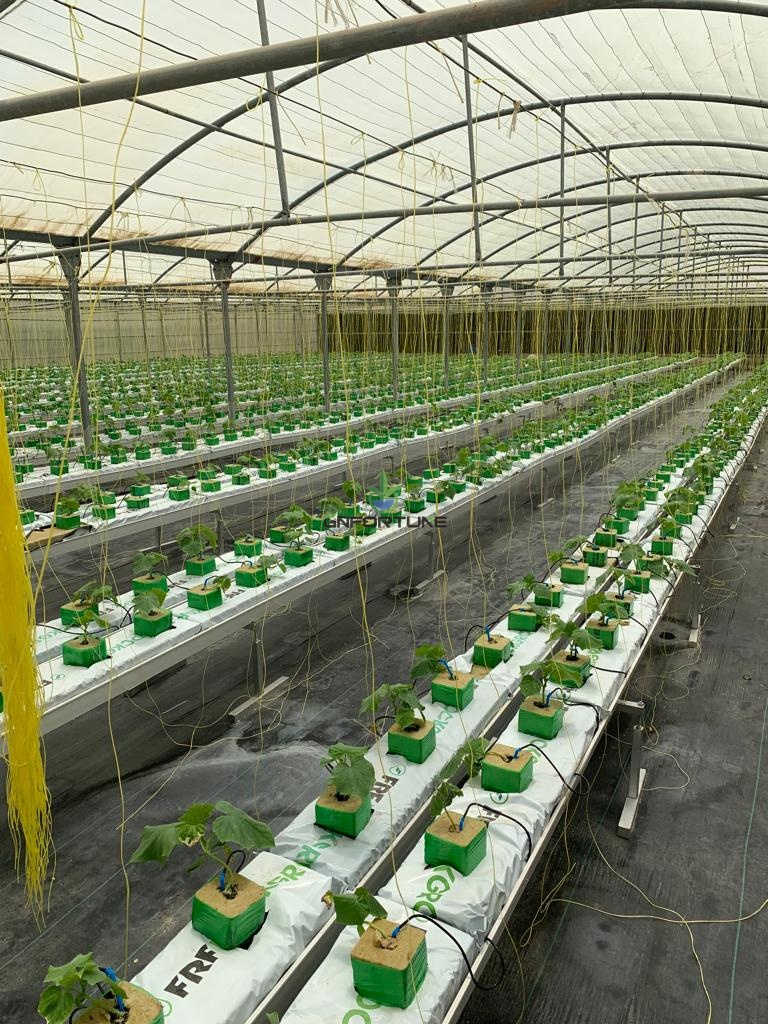
UAE hydroponic greenhouse interior with double rows of white grow channels and leafy crops under a bright roofIllustrative snapshots of the project types this region generates (figures generalized from mixed project experience; details vary by client and site):
- Riyadh — protected lettuce and herb line. A pad-and-fan greenhouse line for leafy greens in the dry interior climate, where low humidity lets evaporative cooling work close to its theoretical limit. The design margins went into pad area and dust pre-filtration rather than mechanical backup, with RO water corrected for calcium and magnesium.
- Jeddah — coastal herb production. Higher coastal humidity narrows the wet-bulb depression, so this project combined pads with shading and screen strategy for the peak weeks, accepting a slower summer growth curve rather than paying for mechanical cooling all year.
- Doha — mixed leafy greens for retail. A compact, high-turnover facility close to its retail customer, prioritizing post-harvest handling area and delivery speed over maximum growing area — the economics of the region reward freshness more than volume.
The Dubai case is a different category, and one that is growing fastest in the UAE: landscape and garden design projects for hospitality properties. A representative project supplied vertical hydroponic walls and strawberry gutter lines for a hotel’s landscaped terrace garden, where the system is visible to guests and must look like part of the garden rather than like farm equipment. The engineering requirements are a blend of everything above — 230 V pumps and dosing units running quietly on a timers-and-sensors regime, dust-managed irrigation because the installation sits in open air near the coast, and full bilingual English-Arabic labeling on panels and nutrient drums for the hotel’s mixed-language maintenance team. The horticultural design brief came from the landscape architect, and the equipment side was specified to disappear into it: concealed pipe runs, planting density tuned for visual effect rather than yield, and varieties chosen for foliage and fruit appearance across seasons. For growers and suppliers alike, these garden projects are the entry point into the UAE market that most competitors are not yet serving, and they draw directly on the vertical hydroponic system and strawberry gutter product lines. Full-farm projects, by contrast, follow the turnkey greenhouse delivery model used for our other regional references.
FAQ
Can hydroponics work in 45°C desert heat?
A: Yes, but only inside a properly cooled envelope. Inland, pad-and-fan cooling gets close to its wet-bulb limit and works well; on the humid coast and for indoor farms, hybrid or mechanical cooling carries the peak weeks. The cooling strategy — not the hydroponic system — decides the design.
Do I need to change the nutrient recipe for desalinated water?
A: Yes. RO water carries almost no calcium, magnesium, or bicarbonate, so recipes written for well water under-supply those elements. Dosing targets are raised on Gulf projects and water analysis is treated as a recurring input.
What voltage and frequency does the equipment need?
A: Saudi Arabia and the UAE both use 230 V, 50 Hz single-phase with type G plugs, and 400 V three-phase for larger equipment. Confirm at order time that motors, controllers, and pumps are wound and certified for 50 Hz service.
What certification does equipment need at Gulf customs?
A: SASO conformity documentation for goods entering Saudi Arabia and the equivalent UAE conformity scheme for the Emirates, plus food-safety registration for produce sold in either market. A supplier shipping regularly to the region provides the certificate pack with the shipment.
Which crops make sense for a first Gulf project?
A: Leafy greens and culinary herbs, where import substitution economics are strongest and cycles are short, with strawberries a proven second step for farms serving retail and hospitality. The regional constraint is cooling cost per kilogram, which favors fast, high-value crops.
Send Your Gulf Project Brief
Send your Gulf project brief — location, format, target crops, and the power and water situation on site — through the quote form, and the team will return a concept sized for desert conditions: cooling approach, water and nutrient strategy, electrical configuration for 230 V / 50 Hz supply, and the compliance documents to expect with the shipment. We design for desert conditions first and quote second, because in this region the order matters.